Oceanodroma leucorhoa
Leach's Storm-Petrel
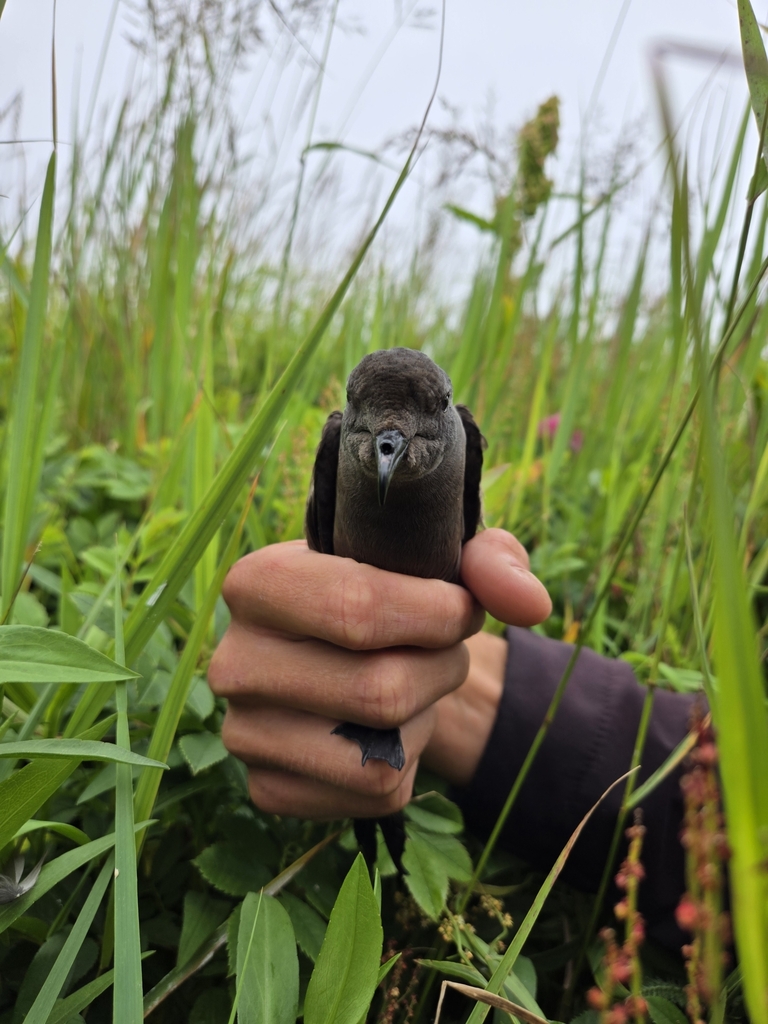
(c) Tomás Tamagno, some rights reserved (CC BY) · licence
Family: Hydrobatidae · Class: Aves · Order: Procellariiformes
Oceanodroma leucorhoa (Leach's Storm-Petrel) is a California animal in the Hydrobatidae family.
Leach's Storm-Petrel is a small seabird measuring 19-22 cm (7.5-8.7 inches) in length with a wingspan of 43-48 cm (17-19 inches). Adults weigh 40-50 grams (1.4-1.8 ounces). The species displays dark sooty-brown to blackish plumage overall, with a distinctive white rump patch that forms a U-shape extending onto the upper tail coverts. The tail is deeply forked, distinguishing it from other storm-petrels. Wings are long and narrow, adapted for dynamic soaring. The bill is black and hooked at the tip, typical of tube-nosed seabirds, with prominent tubular nostrils on the upper mandible. Leach's Storm-Petrel has a bipolar breeding distribution, nesting on islands in the North Pacific and North Atlantic. In California, the species breeds on offshore islands including the Farallon Islands, Channel Islands, and formerly on Alcatraz Island. The largest California breeding colony occurs on Southeast Farallon Island. During the non-breeding season, birds disperse widely across the Pacific Ocean, with some populations migrating to tropical and subtropical waters off Central and South America. Breeding habitat consists of offshore islands with suitable soil for burrow excavation, typically in areas with sparse vegetation or bare ground. Nests are constructed in burrows dug 0.5-3 meters deep in soft soil, often on grassy slopes or clifftops. Outside the breeding season, the species is strictly pelagic, inhabiting open ocean waters where it feeds on surface prey. Leach's Storm-Petrel feeds primarily on small fish, squid, crustaceans, and marine plankton obtained by surface-seizing and shallow plunge-diving. Birds often feed at night, taking advantage of vertically migrating prey that rises to the surface. The species exhibits strong site fidelity, with pairs returning to the same burrow annually. Breeding is highly synchronous within colonies. A single white egg is laid in late spring or early summer, with both parents sharing incubation duties for approximately 40-42 days. Chicks fledge after 63-70 days. Adults are nocturnal at breeding colonies, arriving and departing under cover of darkness to avoid predation by gulls and other diurnal predators. Leach's Storm-Petrel faces several conservation challenges despite not being federally listed. Climate change affects ocean productivity and prey distribution, potentially impacting foraging success. Introduced predators on breeding islands, including cats, rats, and non-native birds, pose significant threats to eggs, chicks, and adults. Light pollution from vessels and coastal development can disorient birds during night flights. Oil spills and marine pollution represent ongoing threats to this exclusively marine species. Population monitoring at California breeding colonies indicates relatively stable numbers, though some sites have experienced declines. Conservation efforts focus on predator control at breeding colonies and protection of critical marine habitats.
Classification
Class: Aves · Order: Procellariiformes · Family: Hydrobatidae
Frequently asked questions
How is Oceanodroma leucorhoa classified?
Oceanodroma leucorhoa belongs to class Aves, order Procellariiformes, family Hydrobatidae.
What family does Oceanodroma leucorhoa belong to?
Oceanodroma leucorhoa is in the Hydrobatidae family.
What is Oceanodroma leucorhoa?
Leach's Storm-Petrel is a small seabird measuring 19-22 cm (7.5-8.7 inches) in length with a wingspan of 43-48 cm (17-19 inches).
Is Oceanodroma leucorhoa found in California?
Yes. Oceanodroma leucorhoa is recorded in California in The California Species Project's catalogue.
Related species
Other California species in the same genus, family, or bioregion.
Data from The California Species Project — 14,000+ California species with verified data from CNPS, CDFW, USFWS, and more.