Ochotona princeps
American Pika
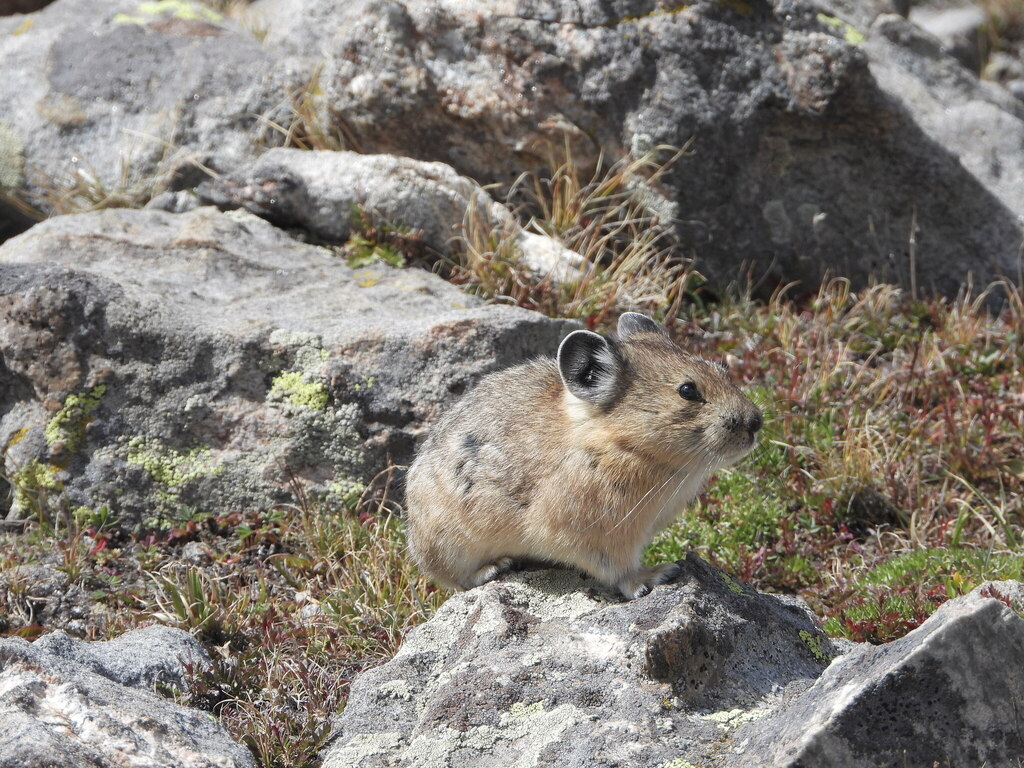
(c) Jared Shorma, some rights reserved (CC BY) · licence
Family: Ochotonidae · Class: Mammalia · Order: Lagomorpha
Ochotona princeps (American Pika) is a California animal in the Ochotonidae family.
The American pika is a small, compact mammal belonging to the rabbit and hare family (Lagomorpha). Adults measure 162 to 216 mm (6.4 to 8.5 inches) in body length and weigh 120 to 176 grams (4.2 to 6.2 ounces). The species lacks a visible tail and has short, rounded ears approximately 18 to 21 mm in length. Dense fur ranges from grayish-brown to cinnamon-brown dorsally, with lighter underparts. The soles of the feet are densely furred, providing traction on rocky surfaces. American pikas occur in mountainous regions of western North America, from central British Columbia south through the Sierra Nevada and Rocky Mountains to northern New Mexico. In California, populations are found primarily in the Sierra Nevada range, from Tulare County north to the Oregon border, and in scattered locations in the Cascade Range and Warner Mountains. The species also occurs in isolated populations in the White Mountains and Sweetwater Mountains of eastern California. Pikas inhabit talus slopes, rockslides, and boulder fields in alpine and subalpine zones, typically between 2,500 and 4,300 meters (8,200 to 14,100 feet) elevation. They require areas with suitable rock crevices for shelter and adjacent alpine meadows or other vegetation for foraging. Suitable habitat includes spaces between rocks that provide protection from predators and temperature extremes, while remaining accessible for movement and cache storage. American pikas are active during daylight hours and do not hibernate. Instead, they spend summer months gathering vegetation to create haypiles that sustain them through winter. Individual territories range from 400 to 700 square meters and are aggressively defended. Breeding occurs from April through September, with females producing one to two litters annually. Gestation lasts 30 days, and litters contain two to five young. Pikas communicate through a distinctive sharp alarm call and a longer song used in territorial displays. Their diet consists primarily of grasses, sedges, wildflowers, and other alpine vegetation. The American pika is not federally listed under the Endangered Species Act, though climate change poses significant long-term threats. The species has experienced local extinctions at lower elevations and southern range margins due to increasing temperatures. Pikas are physiologically adapted to cold conditions and can die from overheating when temperatures exceed 25.5°C (78°F) for extended periods. According to recent studies, populations have shifted to higher elevations and north-facing slopes as climate warming continues. The U.S. Fish and Wildlife Service determined in 2010 that listing was warranted but precluded by higher priority actions, and reaffirmed this decision in 2016. Current research focuses on identifying climate refugia and monitoring population trends across the species' range.
Classification
Class: Mammalia · Order: Lagomorpha · Family: Ochotonidae
Frequently asked questions
How is Ochotona princeps classified?
Ochotona princeps belongs to class Mammalia, order Lagomorpha, family Ochotonidae.
What family does Ochotona princeps belong to?
Ochotona princeps is in the Ochotonidae family.
What is Ochotona princeps?
The American pika is a small, compact mammal belonging to the rabbit and hare family (Lagomorpha).
Is Ochotona princeps found in California?
Yes. Ochotona princeps is recorded in California in The California Species Project's catalogue.
Related species
Other California species in the same genus, family, or bioregion.
Data from The California Species Project — 14,000+ California species with verified data from CNPS, CDFW, USFWS, and more.