Ochotona princeps schisticeps
Gray-headed Pika
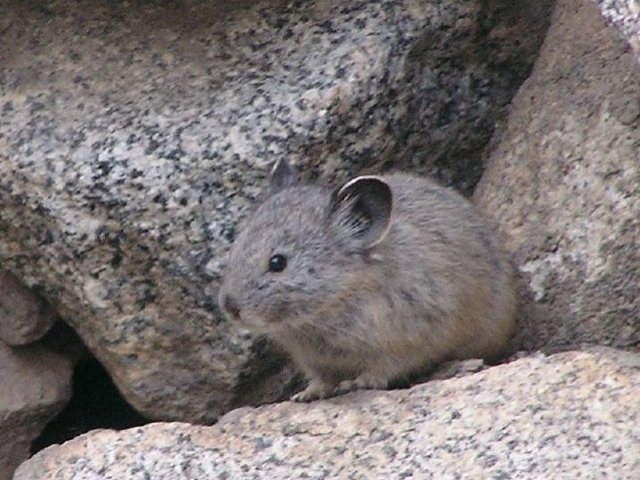
(c) Justin, some rights reserved (CC BY) · licence
Family: Ochotonidae · Class: Mammalia · Order: Lagomorpha
Conservation status: G5T4 S2S4
Ochotona princeps schisticeps (Gray-headed Pika) is a California animal in the Ochotonidae family.
The Gray-headed Pika (Ochotona princeps schisticeps) is a subspecies of American pika, a small lagomorph belonging to the family Ochotonidae. Adults typically measure 162 to 216 mm (6.4 to 8.5 inches) in total length and weigh 120 to 180 grams (4.2 to 6.3 ounces). The subspecies is distinguished by its grayish head coloration and relatively small body size compared to other American pika subspecies. The pelage is typically brownish-gray dorsally with a distinctly grayer head, while the ventral surface is lighter in coloration. The Gray-headed Pika occurs in high-elevation rocky habitats in the Sierra Nevada of California and Nevada. According to the U.S. Fish and Wildlife Service, this subspecies was among seven American pika subspecies petitioned for endangered species listing in 2007 due to concerns about climate change impacts (USFWS 2009). The subspecies' range is fragmented across alpine and subalpine zones, primarily above 2,400 meters (7,900 feet) elevation. This subspecies inhabits talus slopes, rocky outcrops, and boulder fields in alpine and subalpine environments. The rocky terrain provides essential thermal refugia and crevices for shelter and food storage. Gray-headed Pikas require areas with sufficient vegetation nearby for foraging, typically including alpine grasses, forbs, and shrubs. The species shows strong site fidelity to territories that provide both suitable microclimate conditions and adequate food resources. Like other American pika subspecies, Gray-headed Pikas are herbivorous, feeding on a variety of alpine plants including grasses, sedges, wildflowers, and shrubs. They exhibit characteristic hay-making behavior, collecting and curing vegetation in haypiles stored beneath rocks for winter consumption. Breeding occurs from late spring through summer, with females typically producing one to two litters per year containing two to five young. The species is known for its distinctive alarm calls and territorial vocalizations. The Gray-headed Pika has a Global/State rank of G5T4 S2S4, indicating the subspecies is apparently secure globally but imperiled to vulnerable in California. NatureServe reports that portions of this subspecies "may be at risk of extirpation due to potential impacts" from climate change (NatureServe 2025). The primary conservation concern is habitat loss and fragmentation due to warming temperatures, which forces populations to higher elevations with increasingly limited suitable habitat. As temperatures rise, the lower elevational limits of pika habitat are shifting upward, potentially isolating populations and reducing genetic connectivity. The U.S. Fish and Wildlife Service conducted a 12-month status review following the 2007 petition but ultimately determined that listing was not warranted for the American pika species complex as of 2010. However, ongoing climate monitoring and population studies continue to assess the vulnerability of high-elevation subspecies like schisticeps to environmental changes.
Classification
Class: Mammalia · Order: Lagomorpha · Family: Ochotonidae
Conservation status
G5T4 S2S4
Frequently asked questions
How is Ochotona princeps schisticeps classified?
Ochotona princeps schisticeps belongs to class Mammalia, order Lagomorpha, family Ochotonidae.
What family does Ochotona princeps schisticeps belong to?
Ochotona princeps schisticeps is in the Ochotonidae family.
Is Ochotona princeps schisticeps protected or of conservation concern?
Ochotona princeps schisticeps carries the following status: G5T4 S2S4.
What is Ochotona princeps schisticeps?
The Gray-headed Pika (Ochotona princeps schisticeps) is a subspecies of American pika, a small lagomorph belonging to the family Ochotonidae.
Is Ochotona princeps schisticeps found in California?
Yes. Ochotona princeps schisticeps is recorded in California in The California Species Project's catalogue.
Related species
Other California species in the same genus, family, or bioregion.
Data from The California Species Project — 14,000+ California species with verified data from CNPS, CDFW, USFWS, and more.