Odocoileus hemionus
Mule Deer
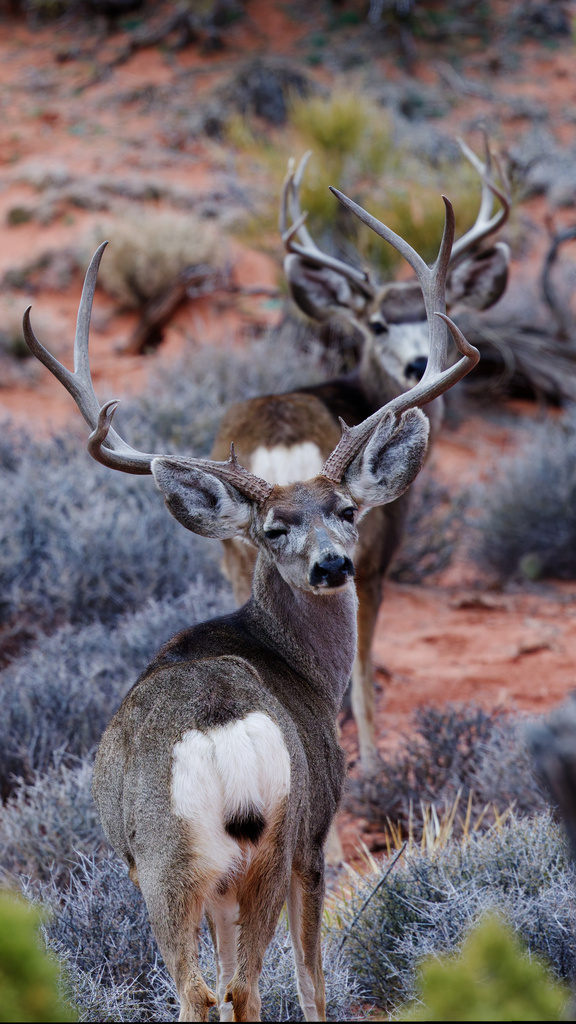
(c) Daughter Dad, some rights reserved (CC BY) · licence
Family: Cervidae · Class: Mammalia · Order: Artiodactyla
Odocoileus hemionus (Mule Deer) is a California animal in the Cervidae family.
The mule deer is a medium to large cervid characterized by its distinctive large ears, which can measure up to 25 cm (10 inches) in length and give the species its common name. Adults typically measure 1.2 to 2.1 meters (4 to 7 feet) in total length, with males (bucks) weighing 68 to 136 kg (150 to 300 pounds) and females (does) weighing 43 to 90 kg (95 to 200 pounds). The species exhibits sexual dimorphism, with males bearing branched antlers that are shed and regrown annually. Summer pelage is reddish-brown to tan, while winter coats are gray-brown. The tail is distinctive: white with a black tip, contrasting with the white-tailed deer's brown tail with white underside. Mule deer range across western North America from southeastern Alaska to northern Mexico. In California, the species occurs throughout the state except for the Central Valley floor and Colorado Desert regions. Populations inhabit diverse elevations from sea level to over 3,000 meters (10,000 feet), with many herds exhibiting seasonal migrations between summer and winter ranges. California supports multiple subspecies, including the California mule deer (O. h. californicus) and the desert mule deer (O. h. eremicus). Habitat requirements vary considerably across the species' range. Mule deer occupy chaparral, oak woodlands, coniferous forests, riparian zones, grasslands, and desert shrublands. Key habitat components include diverse plant communities for forage, escape cover, and water sources. The species demonstrates adaptability to elevation gradients, with many populations migrating seasonally from high-elevation summer ranges to lower-elevation winter areas to avoid deep snow. Mule deer are primarily browsers, consuming a varied diet of shrubs, forbs, and tree foliage. Preferred plant families include Rosaceae, Ericaceae, and various composite species. Dietary composition shifts seasonally based on plant phenology and availability. Breeding occurs from October through December, with peak activity in November. Gestation lasts approximately 200 days, with does typically producing one to three fawns in late May or June. Females reach sexual maturity at 1.5 years, while males typically breed at 2.5 years. Lifespan in the wild averages 10 to 12 years. Mule deer are not federally or state listed in California, maintaining stable populations across most of their range as of December 2025. However, populations face various management challenges including habitat fragmentation, vehicle collisions, and disease transmission. Urban expansion and infrastructure development have created barriers to traditional migration corridors. The California Department of Fish and Wildlife manages the species through regulated hunting seasons and habitat conservation programs. Climate change poses emerging threats through altered precipitation patterns and vegetation community shifts, potentially affecting forage availability and migration timing.
Classification
Class: Mammalia · Order: Artiodactyla · Family: Cervidae
Frequently asked questions
How is Odocoileus hemionus classified?
Odocoileus hemionus belongs to class Mammalia, order Artiodactyla, family Cervidae.
What family does Odocoileus hemionus belong to?
Odocoileus hemionus is in the Cervidae family.
What is Odocoileus hemionus?
The mule deer is a medium to large cervid characterized by its distinctive large ears, which can measure up to 25 cm (10 inches) in length and give the species its common name.
Is Odocoileus hemionus found in California?
Yes. Odocoileus hemionus is recorded in California in The California Species Project's catalogue.
Related species
Other California species in the same genus, family, or bioregion.
Data from The California Species Project — 14,000+ California species with verified data from CNPS, CDFW, USFWS, and more.