Odocoileus virginianus leucurus
Columbian white-tailed deer
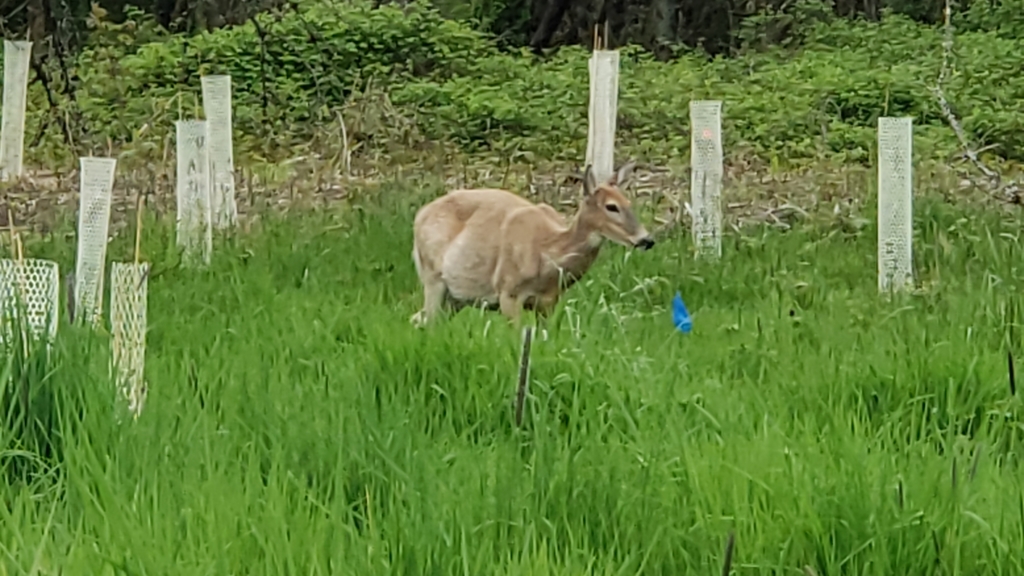
(c) Gavin Slater, some rights reserved (CC BY) · licence
Family: Cervidae · Class: Mammalia · Order: Artiodactyla
Conservation status: Threatened
Odocoileus virginianus leucurus (Columbian white-tailed deer) is a California animal in the Cervidae family.
The Columbian white-tailed deer is a subspecies of white-tailed deer endemic to the Pacific Northwest. Adults typically measure 60-75 cm (24-30 inches) at the shoulder and weigh 40-90 kg (88-200 pounds), with males (bucks) being larger than females (does). The species is distinguished from mule deer by its longer tail that is brown rather than black on the dorsal surface, a smaller metatarsal gland, and in adult males, antlers with prongs arising from a single main beam rather than the bifurcated pattern of mule deer. The tail varies from cinnamon buff to tawny dorsally with a small, partially concealed subterminal patch, and is broadly fringed with white above and pure white below. The coat is mars brown with buffy tips, and the outer surfaces of legs extend to the base of hoofs in near sayal brown coloration. Historically, Columbian white-tailed deer ranged throughout the Columbia River floodplains from Puget Sound south to the Umpqua River in Oregon. Currently, the species occurs in two distinct population segments. The Columbia River population inhabits Clark, Cowlitz, Pacific, Skamania, and Wahkiakum Counties in Washington, and Clatsop, Columbia, and Multnomah Counties in Oregon. A second population exists in Douglas County, Oregon, which was delisted from federal protection. The Columbian white-tailed deer is the only subspecies of white-tailed deer found west of the Cascade mountain range and represents one of 38 recognized subspecies of Odocoileus virginianus. The species inhabits riparian woodlands, grasslands, and agricultural areas adjacent to the Columbia River and its tributaries. They prefer areas with a mosaic of forest cover for security and open areas for foraging. Critical habitat components include dense shrub cover for bedding and escape, edge habitats between forest and grassland, and access to water sources. The deer utilize both bottomland hardwood forests and upland prairies, moving between these habitats seasonally. Columbian white-tailed deer are primarily crepuscular, being most active during dawn and dusk hours. They are herbivorous, feeding on grasses, forbs, shrubs, and tree leaves. Breeding occurs from October through December, with does typically giving birth to 1-2 fawns after a gestation period of approximately 200 days. Fawns are born spotted and remain hidden in dense vegetation for their first few weeks. The species exhibits limited migration patterns compared to other deer subspecies, with most movement related to seasonal habitat use and food availability. The Columbia River population segment is federally listed as threatened as of December 2025, having been downlisted from endangered status. The Douglas County, Oregon population has been delisted entirely. Primary threats include habitat loss from agricultural conversion and development, vehicle strikes, predation, and competition with introduced species. According to the U.S. Fish and Wildlife Service's 2025 Species Status Assessment, population recovery efforts have included habitat restoration, land acquisition, and partnerships with private landowners. The species' recovery represents a conservation success story, though continued monitoring and habitat protection remain essential for long-term viability.
Classification
Class: Mammalia · Order: Artiodactyla · Family: Cervidae
Conservation status
Threatened
Frequently asked questions
How is Odocoileus virginianus leucurus classified?
Odocoileus virginianus leucurus belongs to class Mammalia, order Artiodactyla, family Cervidae.
What family does Odocoileus virginianus leucurus belong to?
Odocoileus virginianus leucurus is in the Cervidae family.
Is Odocoileus virginianus leucurus protected or of conservation concern?
Odocoileus virginianus leucurus carries the following status: Threatened.
What is Odocoileus virginianus leucurus?
The Columbian white-tailed deer is a subspecies of white-tailed deer endemic to the Pacific Northwest.
Is Odocoileus virginianus leucurus found in California?
Yes. Odocoileus virginianus leucurus is recorded in California in The California Species Project's catalogue.
Related species
Other California species in the same genus, family, or bioregion.
Data from The California Species Project — 14,000+ California species with verified data from CNPS, CDFW, USFWS, and more.