Oecanthus californicus
Western Tree Cricket
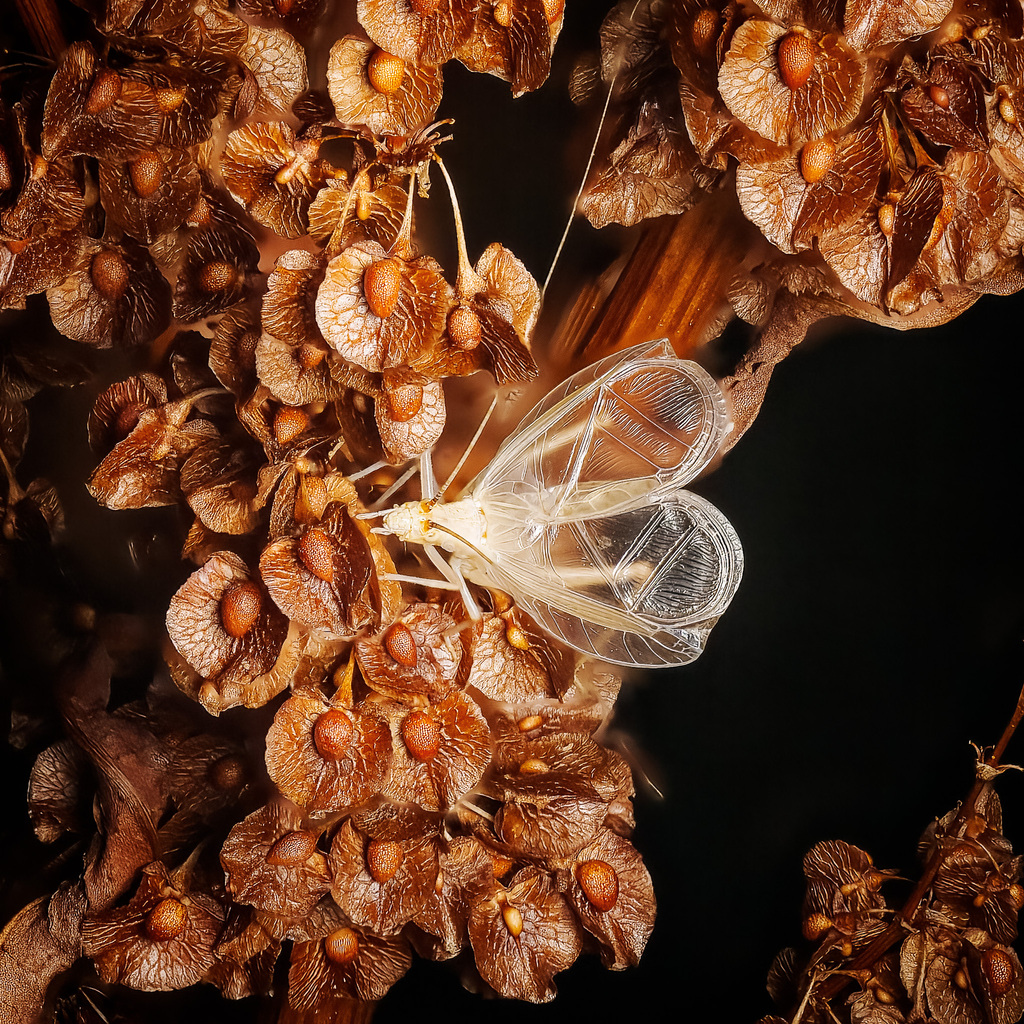
(c) Claus Giloi, some rights reserved (CC BY) · licence
Family: Gryllidae · Class: Insecta · Order: Orthoptera
Oecanthus californicus (Western Tree Cricket) is a California animal in the Gryllidae family.
The western tree cricket is a small orthopteran insect belonging to the family Gryllidae. Males typically measure 10-15 mm in body length, while females are slightly larger at 12-17 mm. The species exhibits sexual dimorphism in coloration: males are pale green to yellowish-green with translucent wing covers (tegmina) that bear conspicuous dark veins, while females are generally paler with a more yellowish coloration. Both sexes possess long, thread-like antennae that can exceed body length and slender legs adapted for climbing on vegetation. Males can be distinguished by their broad, flattened tegmina used for sound production, while females display a prominent, sword-like ovipositor extending from the abdomen. Oecanthus californicus occurs throughout much of western North America, with its primary range extending from British Columbia south through California, Nevada, Arizona, and into northwestern Mexico (BugGuide). In California, the species is widely distributed across suitable habitats from the coast to interior valleys and foothills. The species shows considerable elevational tolerance, occurring from near sea level to approximately 2,500 meters elevation in montane areas. The western tree cricket inhabits a diverse array of plant communities, showing particular affinity for riparian areas, oak woodlands, chaparral, and mixed coniferous forests. Adults and nymphs are commonly found on shrubs and trees, including oak species (Quercus spp.), willow (Salix spp.), elderberry (Sambucus spp.), and various other broadleaf vegetation. The species also occurs in urban and suburban environments where suitable host plants are present, making it one of the more adaptable tree cricket species in its range. Adults are primarily nocturnal and arboreal, spending daylight hours concealed among foliage. Males produce distinctive calling songs during evening and nighttime hours from late spring through early fall, with peak activity occurring during summer months. The species is omnivorous, feeding on aphids, small soft-bodied insects, plant material, and occasionally nectar. Females use their ovipositors to insert eggs into plant stems and bark crevices during late summer and fall. Eggs overwinter and hatch the following spring, with nymphs undergoing five to six molts before reaching adulthood. The species is univoltine in most areas, completing one generation per year. The western tree cricket is not federally or state-listed and appears to maintain stable populations throughout its range as of December 2025. The species' adaptability to various habitat types, including disturbed and urban environments, has likely contributed to its continued success. Unlike many specialized invertebrates, Oecanthus californicus benefits from its broad host plant associations and tolerance of habitat modification. Climate change may affect the species' distribution and phenology, but current evidence suggests populations remain robust across most of the species' range.
Classification
Class: Insecta · Order: Orthoptera · Family: Gryllidae
Frequently asked questions
How is Oecanthus californicus classified?
Oecanthus californicus belongs to class Insecta, order Orthoptera, family Gryllidae.
What family does Oecanthus californicus belong to?
Oecanthus californicus is in the Gryllidae family.
What is Oecanthus californicus?
The western tree cricket is a small orthopteran insect belonging to the family Gryllidae.
Is Oecanthus californicus found in California?
Yes. Oecanthus californicus is recorded in California in The California Species Project's catalogue.
Related species
Other California species in the same genus, family, or bioregion.
Data from The California Species Project — 14,000+ California species with verified data from CNPS, CDFW, USFWS, and more.