Oecobius navus
Wall Spider
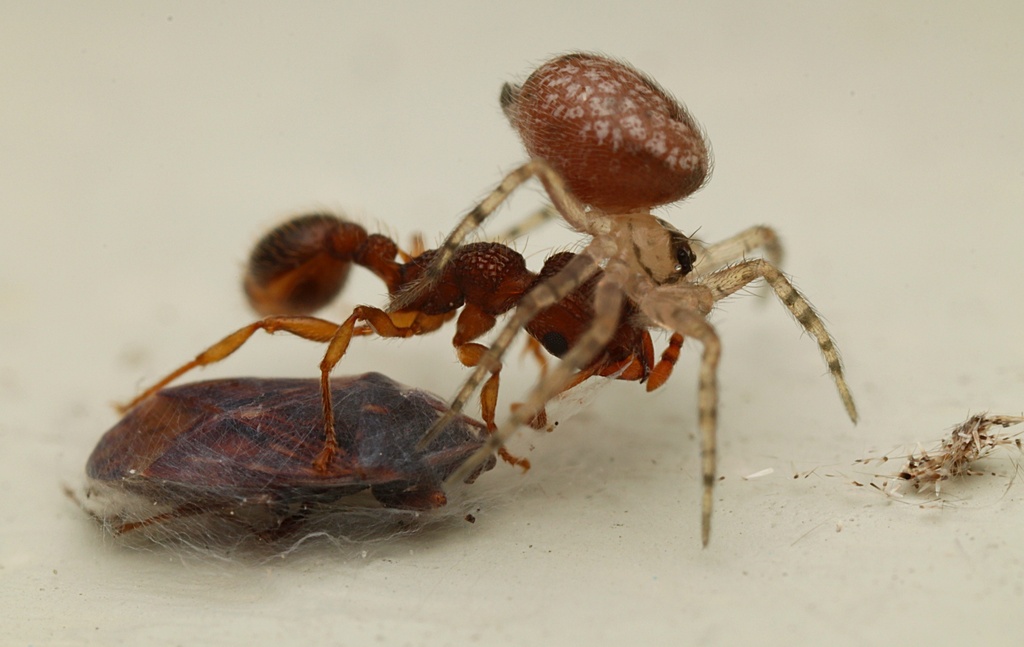
(c) Tom, some rights reserved (CC BY) · licence
Family: Oecobiidae · Class: Arachnida · Order: Araneae
Oecobius navus (Wall Spider) is a California animal in the Oecobiidae family.
Oecobius navus, commonly known as the wall spider, is a small member of the family Oecobiidae found across much of North America. Adults are tiny spiders, typically measuring 2-3 mm in body length, with a compact, rounded abdomen and relatively short legs. The body coloration ranges from pale yellow to light brown, often with subtle darker markings on the abdomen. Like other members of the genus Oecobius, this species has a distinctively flattened appearance that allows it to fit into narrow crevices. The species has a broad distribution across North America, ranging from Oregon and California in the west to Massachusetts and New York in the northeast, and south through Texas, Louisiana, Mississippi, Alabama, and Florida (BugGuide). In California, the species occurs throughout much of the state, with documented observations from coastal to inland regions. The range extends into Mexico and likely includes much of the southwestern United States. Wall spiders are highly synanthropic, showing a strong preference for human-modified environments. They are commonly found on the exterior walls of buildings, particularly stucco surfaces, under bark on trees and grape vines, and among rocks (BugGuide). The species frequently inhabits houses and other structures, where it can be found in cracks and crevices in walls, around window frames, and under eaves. This adaptability to urban and suburban environments has likely contributed to the species' widespread distribution. Oecobius navus constructs distinctive flat, sheet-like webs that are characteristic of the family Oecobiidae. These webs are typically built against surfaces such as walls, bark, or rocks, and serve as both shelter and hunting platform. The spiders are active predators that feed primarily on ants and other small insects (BugGuide). Based on BugGuide occurrence data, the species appears to be active throughout much of the year in warmer regions, with observations recorded from February through December in California and other southern states. Peak activity periods vary by region but generally coincide with warmer months when prey insects are most abundant. Due to their synanthropic nature and apparent adaptability, populations of O. navus may have expanded in recent decades as human development has increased. The species does not appear on federal or state conservation lists and is considered to have a secure conservation status. NatureServe lists the species as G4 (apparently secure globally), indicating stable populations across its range. The species' ability to thrive in human-modified environments and its broad distribution suggest it faces no immediate conservation concerns. However, like many small arthropods, detailed population studies are lacking, and the species may face localized impacts from habitat modification or pesticide use in some areas. The species' small size and cryptic behavior make it easily overlooked, and it likely occurs in many areas where it has not yet been formally documented.
Classification
Class: Arachnida · Order: Araneae · Family: Oecobiidae
Frequently asked questions
How is Oecobius navus classified?
Oecobius navus belongs to class Arachnida, order Araneae, family Oecobiidae.
What family does Oecobius navus belong to?
Oecobius navus is in the Oecobiidae family.
What is Oecobius navus?
Oecobius navus, commonly known as the wall spider, is a small member of the family Oecobiidae found across much of North America.
Is Oecobius navus found in California?
Yes. Oecobius navus is recorded in California in The California Species Project's catalogue.
More California species
This species has no close relatives in our California data — here are other species to explore.
Data from The California Species Project — 14,000+ California species with verified data from CNPS, CDFW, USFWS, and more.