Oenanthe oenanthe
Northern Wheatear
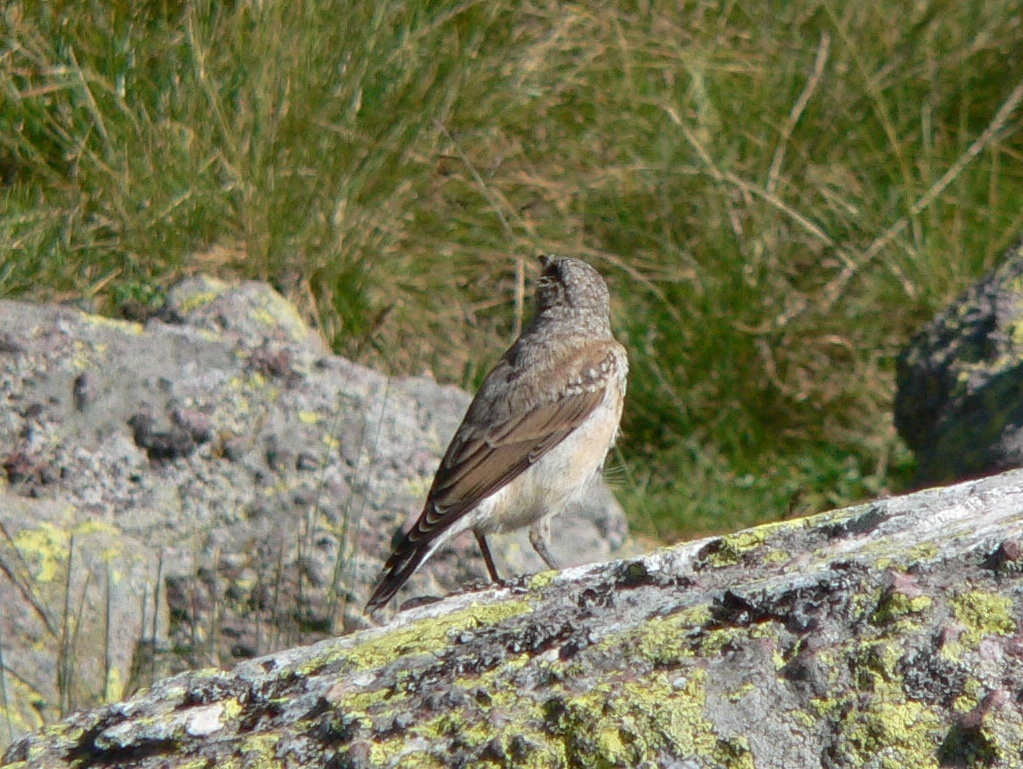
(c) Mario Bassini, some rights reserved (CC BY) · licence
Family: Muscicapidae · Class: Aves · Order: Passeriformes
Oenanthe oenanthe (Northern Wheatear) is a California animal in the Muscicapidae family.
The Northern Wheatear is a small, ground-dwelling songbird measuring 14 to 16 centimeters (5.5 to 6.3 inches) in length with a wingspan of 26 to 32 centimeters (10.2 to 12.6 inches). Adults weigh between 17 to 30 grams (0.6 to 1.1 ounces). Breeding males display blue-gray upperparts, a black mask through the eye, and peachy-buff underparts. Females are more subdued with brownish-gray upperparts and pale buff underparts. Both sexes show the species' diagnostic white rump patch and distinctive inverted black 'T' pattern on the white tail, most visible in flight. Non-breeding adults appear more uniform brown-gray above with pale underparts. The Northern Wheatear has one of the most extensive breeding ranges of any passerine, spanning northern Europe, Asia, Greenland, and eastern Canada, with small populations in Alaska. The species undertakes extensive long-distance migrations of over 15,000 kilometers (9,300 miles) between breeding and wintering grounds. In North America, breeding occurs primarily in Alaska's arctic and subarctic regions, with occasional records in northwestern Canada. The species winters primarily in sub-Saharan Africa. California records are extremely rare, consisting of vagrant individuals that have strayed far from normal migration routes, typically occurring during fall migration from September to November. Northern Wheatears inhabit open, sparsely vegetated landscapes including tundra, alpine meadows, grasslands, moorlands, and rocky terrain. They prefer areas with scattered rocks, stone walls, or other elevated perches for hunting and singing. In Alaska, they occupy tundra habitats from sea level to elevations of 1,200 meters (3,900 feet). The species requires short vegetation for foraging and suitable cavities or crevices for nesting. These birds are primarily insectivorous, feeding on beetles, flies, moths, caterpillars, spiders, and other arthropods captured through ground foraging and aerial hawking. They hunt from elevated perches, dropping to the ground to capture prey or making short flights to snatch insects from the air. Northern Wheatears nest in cavities including rock crevices, stone walls, abandoned burrows, and artificial structures. Females construct cup-shaped nests of grass, moss, and other plant materials lined with feathers and hair. Breeding occurs from May to July, with females laying 4 to 7 pale blue eggs spotted with reddish-brown. Incubation lasts 13 to 14 days, and nestlings fledge after 15 to 16 days. Pairs typically raise one brood per season, occasionally two in favorable conditions. The Northern Wheatear is not federally listed and is considered secure globally by BirdLife International, classified as Least Concern by the IUCN as of December 2025. However, some regional populations have experienced declines due to habitat loss, agricultural intensification, and climate change affecting arctic breeding grounds. In California, the species remains an extremely rare vagrant with fewer than a dozen documented records. The species faces ongoing threats from habitat modification in breeding areas and potential impacts of climate change on migration patterns and timing.
Classification
Class: Aves · Order: Passeriformes · Family: Muscicapidae
Frequently asked questions
How is Oenanthe oenanthe classified?
Oenanthe oenanthe belongs to class Aves, order Passeriformes, family Muscicapidae.
What family does Oenanthe oenanthe belong to?
Oenanthe oenanthe is in the Muscicapidae family.
What is Oenanthe oenanthe?
The Northern Wheatear is a small, ground-dwelling songbird measuring 14 to 16 centimeters (5.5 to 6.3 inches) in length with a wingspan of 26 to 32 centimeters (10.2 to 12.6 inches).
Is Oenanthe oenanthe found in California?
Yes. Oenanthe oenanthe is recorded in California in The California Species Project's catalogue.
Related species
Other California species in the same genus, family, or bioregion.
Data from The California Species Project — 14,000+ California species with verified data from CNPS, CDFW, USFWS, and more.