Oeneis chryxus
Chryxus Arctic
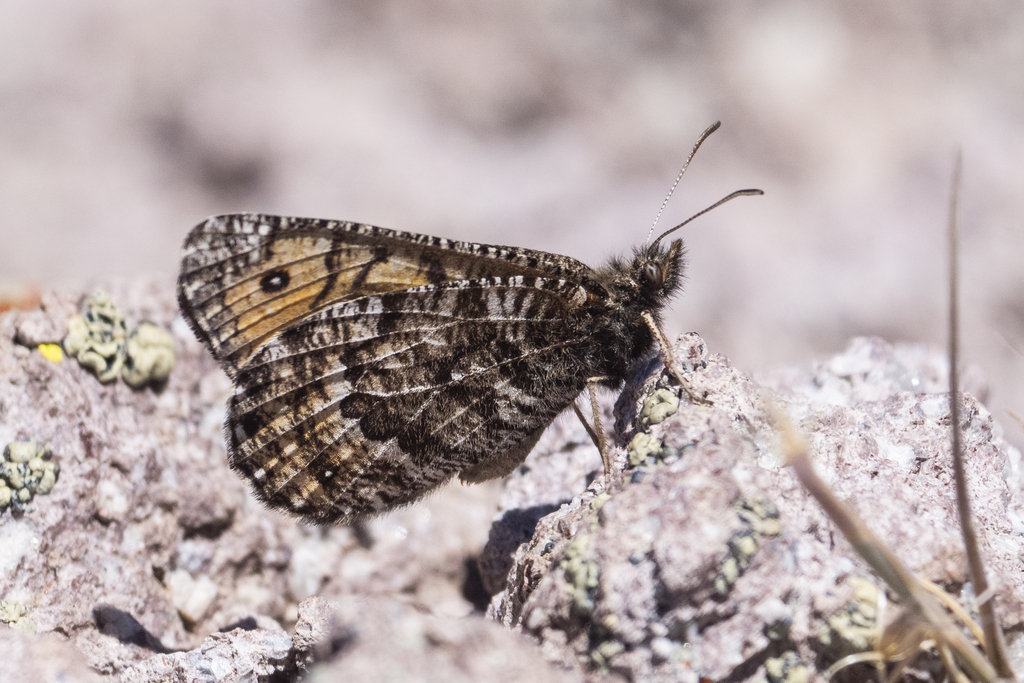
(c) Sam Eberhard, some rights reserved (CC BY) · licence
Family: Nymphalidae · Class: Insecta · Order: Lepidoptera
Oeneis chryxus (Chryxus Arctic) is a California animal in the Nymphalidae family.
The Chryxus Arctic (Oeneis chryxus) is a medium-sized butterfly in the family Nymphalidae, subfamily Satyrinae. Adults have a wingspan of 38 to 51 mm (1.5 to 2.0 inches), with forewings displaying a mottled brown and orange pattern. The dorsal surfaces are typically tawny-brown with darker brown markings and small eyespots, while the ventral hindwings show cryptic gray-brown mottling that provides effective camouflage against bark and rock surfaces. Males and females are similar in appearance, though females tend to be slightly larger with more subdued coloration. The Chryxus Arctic has an extensive North American distribution, ranging from southern Alaska and Yukon Territory south through the western mountains to New Mexico, and extending east across Canada to Manitoba. Isolated populations occur in eastern Canada, Wisconsin, and Michigan. In California, this species is found primarily in montane regions of the Sierra Nevada and Cascade Range, typically at elevations between 1,500 and 3,350 meters (4,900 to 11,000 feet). This species inhabits open coniferous forests, subalpine meadows, and montane grasslands. Adults are commonly found in areas with scattered trees, forest clearings, and rocky outcrops where the host plant grows. The habitat typically features well-drained soils and exposure to direct sunlight for portions of the day. In the Sierra Nevada, populations occur in lodgepole pine, red fir, and whitebark pine forest zones. Chryxus Arctic larvae feed exclusively on poverty oat-grass (Danthonia spicata), a perennial bunchgrass native to western North America. This species exhibits a biennial life cycle in most locations, with eggs overwintering and larvae requiring two years to complete development. First-instar larvae feed briefly before entering winter diapause, resuming feeding the following spring. After a second overwintering period as partially grown larvae, development continues through spring and early summer of the second year. Adults typically emerge from mid-June through August, with peak flight occurring in July. Males establish territories and engage in patrolling behavior to locate females. Females lay eggs singly on or near the host plant. The Chryxus Arctic is not federally listed and appears to maintain stable populations across much of its range. However, climate change poses potential long-term threats to montane populations through upward shifts in suitable habitat zones and altered precipitation patterns affecting host plant distribution. In some regions, forest management practices and recreational activities may impact local populations through habitat modification. The species' dependence on a single host plant species makes it vulnerable to changes in grassland composition and structure. Population monitoring has been limited across the range, making trend assessment difficult for many locations.
Classification
Class: Insecta · Order: Lepidoptera · Family: Nymphalidae
Frequently asked questions
How is Oeneis chryxus classified?
Oeneis chryxus belongs to class Insecta, order Lepidoptera, family Nymphalidae.
What family does Oeneis chryxus belong to?
Oeneis chryxus is in the Nymphalidae family.
What is Oeneis chryxus?
The Chryxus Arctic (Oeneis chryxus) is a medium-sized butterfly in the family Nymphalidae, subfamily Satyrinae.
Is Oeneis chryxus found in California?
Yes. Oeneis chryxus is recorded in California in The California Species Project's catalogue.
Related species
Other California species in the same genus, family, or bioregion.
Data from The California Species Project — 14,000+ California species with verified data from CNPS, CDFW, USFWS, and more.