Oeneis nevadensis
Great Arctic
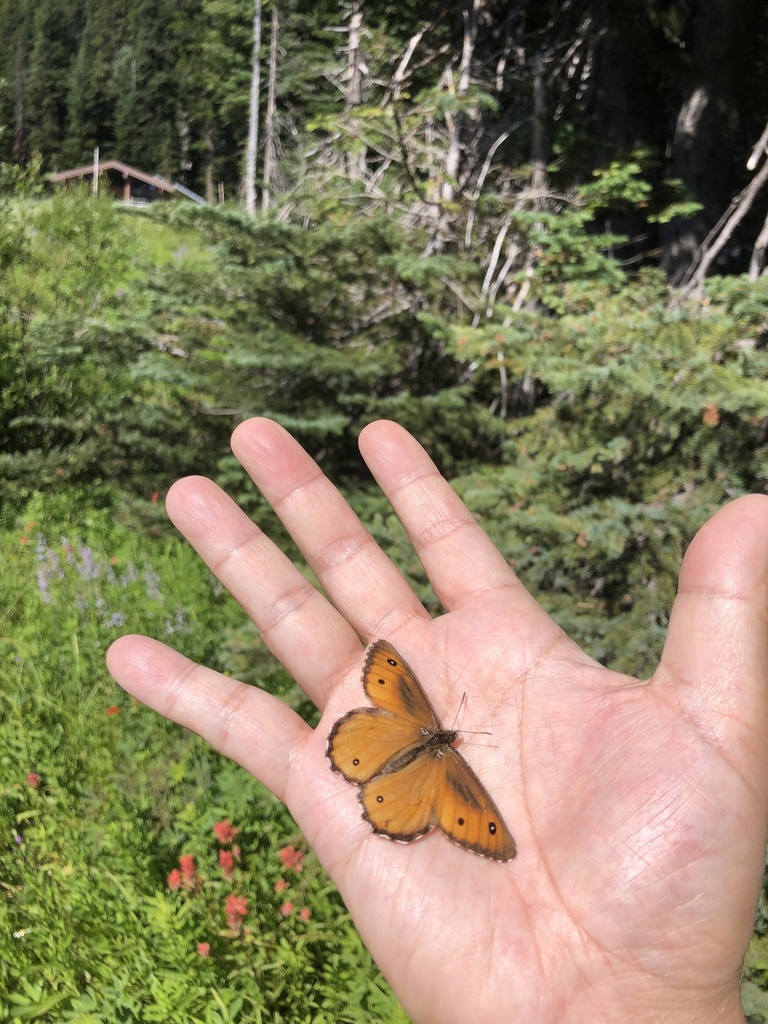
(c) Koji Shiraiwa, some rights reserved (CC BY) · licence
Family: Nymphalidae · Class: Insecta · Order: Lepidoptera
Oeneis nevadensis (Great Arctic) is a California animal in the Nymphalidae family.
The Great Arctic (Oeneis nevadensis) is a medium-sized satyrine butterfly in the family Nymphalidae. Adults have a wingspan of 44 to 60 mm (1.7 to 2.4 inches). The dorsal wing surfaces are tawny orange-brown with darker brown borders and variable dark markings. Males typically display more subdued coloration than females. The ventral hindwings are mottled gray-brown with irregular light and dark patterns that provide effective camouflage against tree bark and rock surfaces. A distinctive eyespot near the forewing apex is present in some individuals, though this feature can be variable or absent. The Great Arctic ranges from Vancouver Island, British Columbia south through the Cascade Mountains and Sierra Nevada to Tulare County, California. Coastal populations extend south to Sonoma County, California. This distribution represents a disjunct pattern typical of montane and boreal species that became isolated during post-glacial warming. California populations occur primarily in the Sierra Nevada and northern Coast Ranges, with elevation ranges typically between 1,200 and 3,000 meters (4,000 to 10,000 feet). This species inhabits coniferous forest openings, meadow edges, and areas with mixed forest and grassland. Great Arctic butterflies are associated with Douglas fir, ponderosa pine, and mixed conifer communities. Adults are often found in forest clearings, along logging roads, and in natural openings where their host plants grow. The species shows a preference for areas with moderate moisture and partial shade rather than fully exposed sites. Great Arctic butterflies are univoltine, producing one generation per year. Adults emerge in late June through August, with peak flight activity typically occurring in July. Males establish territories in suitable habitat and engage in patrolling behavior to locate females. Mating occurs during afternoon hours when temperatures are optimal. Females deposit eggs singly on or near grasses, which serve as the larval host plants. Larvae overwinter and likely require two years to complete development, feeding on various grass species during their extended development period. Larvae are cryptically colored green or brown caterpillars that feed primarily on grasses, though specific host plant relationships in California populations require further study. Adult butterflies nectar on various wildflowers including asters, goldenrod, and other late-summer blooming species. The extended larval development period and specific habitat requirements make this species particularly sensitive to environmental changes. The Great Arctic has no federal or state conservation listing status, but populations may face pressure from habitat modification, forestry practices, and climate change. Forest management activities that alter the balance between forest cover and open areas could impact local populations. The species' montane distribution makes it potentially vulnerable to warming temperatures that could force populations to higher elevations. Monitoring of California populations would provide valuable information about population trends and habitat requirements for this northern species at the southern edge of its range.
Classification
Class: Insecta · Order: Lepidoptera · Family: Nymphalidae
Frequently asked questions
How is Oeneis nevadensis classified?
Oeneis nevadensis belongs to class Insecta, order Lepidoptera, family Nymphalidae.
What family does Oeneis nevadensis belong to?
Oeneis nevadensis is in the Nymphalidae family.
What is Oeneis nevadensis?
The Great Arctic (Oeneis nevadensis) is a medium-sized satyrine butterfly in the family Nymphalidae.
Is Oeneis nevadensis found in California?
Yes. Oeneis nevadensis is recorded in California in The California Species Project's catalogue.
Related species
Other California species in the same genus, family, or bioregion.
Data from The California Species Project — 14,000+ California species with verified data from CNPS, CDFW, USFWS, and more.