Okanagana arboraria
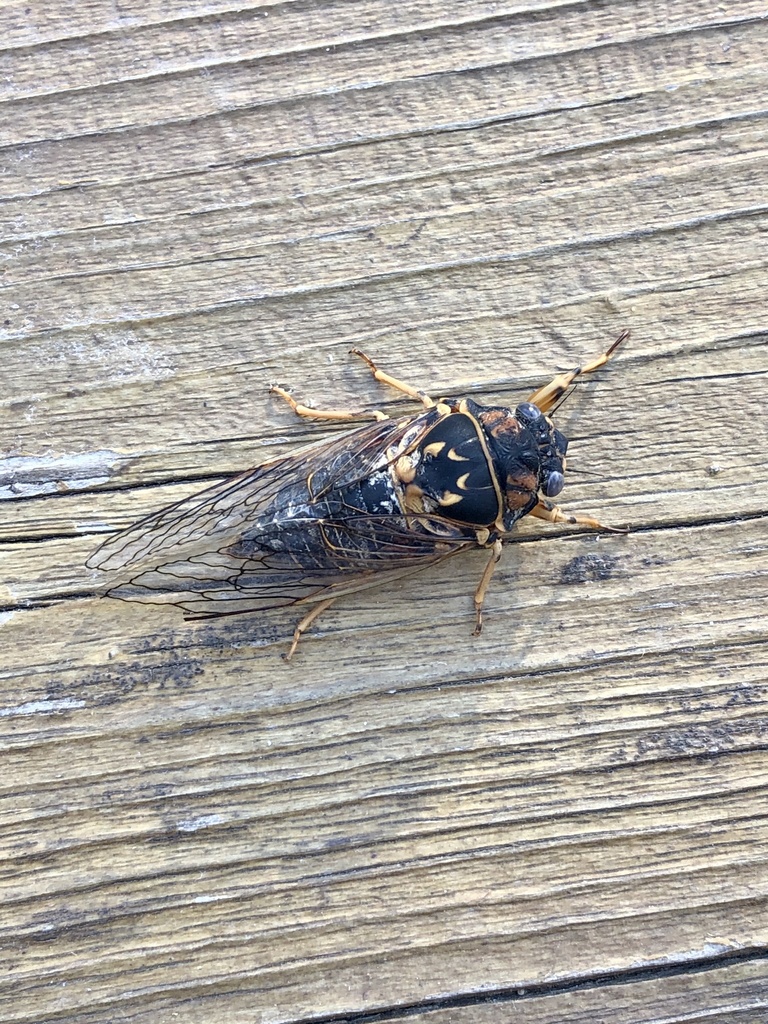
(c) Jamie Hunter, some rights reserved (CC BY) · licence
Family: Cicadidae · Class: Insecta · Order: Hemiptera
Okanagana arboraria is a California animal in the Cicadidae family.
Okanagana arboraria is a cicada species originally described by Wymore in 1934. This species belongs to the genus Okanagana, which comprises 46 species in North America, named after the Okanagan region of British Columbia (BugGuide 2025). As indicated by its specific epithet "arboraria," this species exhibits arboreal habits, distinguishing it from many ground-dwelling cicada species. Physical characteristics of O. arboraria follow the typical cicada body plan, with adults measuring approximately 30 millimeters in length based on field observations. Like other Okanagana species, adults possess prominent compound eyes, short antennae, and membranous wings with distinct venation patterns. The species displays variable coloration patterns that can include reddish markings on the pronotum, though detailed morphological descriptions remain limited in the scientific literature. The geographic range of O. arboraria includes western North America, with documented occurrences in California. Specific records include observations from Santa Clara County, California, where specimens have been collected in the Sierra Azul area (BugGuide 2025). The full extent of the species' distribution requires further documentation, as many Okanagana species have restricted or poorly known ranges. Habitat preferences reflect the species' arboreal nature, as suggested by its scientific name. Unlike ground-dwelling cicada species that utilize soil for nymphal development, O. arboraria appears adapted to tree-associated environments. The species has been observed in forested and wooded habitats, though specific elevation ranges and vegetation associations have not been thoroughly documented. California populations occur in areas with mixed forest and woodland vegetation types. The life cycle of O. arboraria likely follows the typical hemimetabolous development pattern of cicadas, with eggs deposited in woody plant tissues, followed by multiple nymphal instars that develop in soil or potentially in association with tree roots. Adult emergence timing and seasonal activity patterns have not been well documented for this species. Like other cicadas, males presumably produce species-specific acoustic signals for mate attraction, though the call characteristics of O. arboraria have not been described in available literature. Conservation status information for O. arboraria is not available through standard databases, and the species does not appear on federal or state endangered species lists as of December 2025. The apparent rarity of field observations suggests limited population sizes or highly restricted habitat requirements. Climate change and habitat modification may pose threats to specialized cicada species with narrow ecological niches, though specific conservation concerns for O. arboraria have not been assessed. Detailed ecological studies of this species are lacking. The above information synthesizes available observations from BugGuide and taxonomic literature. Additional research is needed to document habitat requirements, distribution patterns, life history characteristics, and conservation needs. Field surveys targeting arboreal cicada species could provide valuable data for understanding this poorly known species.
Classification
Class: Insecta · Order: Hemiptera · Family: Cicadidae
Frequently asked questions
How is Okanagana arboraria classified?
Okanagana arboraria belongs to class Insecta, order Hemiptera, family Cicadidae.
What family does Okanagana arboraria belong to?
Okanagana arboraria is in the Cicadidae family.
What is Okanagana arboraria?
Okanagana arboraria is a cicada species originally described by Wymore in 1934.
Is Okanagana arboraria found in California?
Yes. Okanagana arboraria is recorded in California in The California Species Project's catalogue.
Related species
Other California species in the same genus, family, or bioregion.
Data from The California Species Project — 14,000+ California species with verified data from CNPS, CDFW, USFWS, and more.