Olios giganteus
Giant Crab Spider
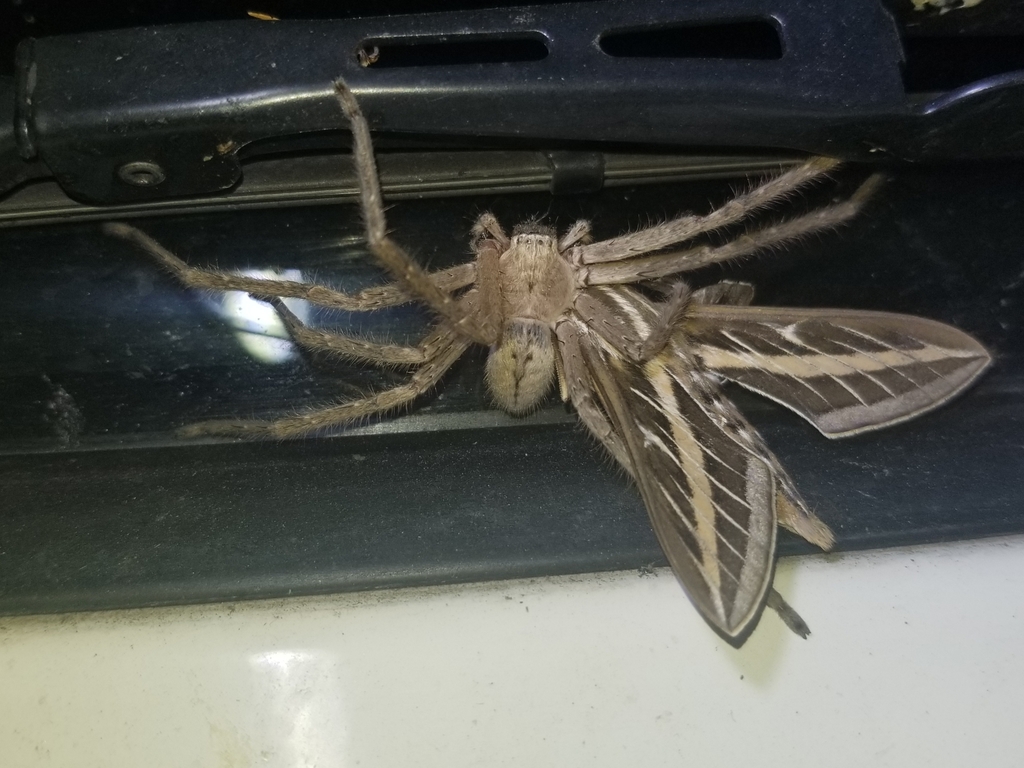
(c) Bob Miller, some rights reserved (CC BY) · licence
Family: Sparassidae · Class: Arachnida · Order: Araneae
Olios giganteus (Giant Crab Spider) is a California animal in the Sparassidae family.
Olios giganteus is a large huntsman spider in the family Sparassidae, distinguished by its substantial size and characteristic features. The species exhibits dark chelicerae and a prominent cardiac mark pattern on the cephalothorax. Like other huntsman spiders, O. giganteus has a flattened body profile and relatively long legs that extend laterally, giving it a crab-like appearance and enabling rapid sideways movement. The giant crab spider ranges across the southwestern United States, occurring from California to Texas, with additional populations documented in Utah and Nevada (BugGuide 2025). In California, the species has been recorded from various locations, with observations concentrated in the southern and desert regions of the state. The distribution extends into adjacent states including Arizona, New Mexico, Colorado, and Oregon, with occasional records from Washington and Wyoming. This species inhabits arid and semi-arid environments typical of the southwestern United States. Olios giganteus is commonly found in desert scrub, chaparral, and oak woodland habitats, where it utilizes rock crevices, tree bark, and human structures for shelter. The species demonstrates considerable adaptability to various microhabitats, from natural rock formations to buildings and other artificial structures in developed areas. As an active hunter, O. giganteus does not construct webs to capture prey but instead relies on speed and ambush tactics. The species is primarily nocturnal, emerging at night to hunt for insects and other small arthropods. During daylight hours, individuals typically remain hidden under bark, rocks, or within crevices. Like other huntsman spiders, females are responsible for egg care, carrying their egg sacs and guarding newly hatched spiderlings. Seasonal activity data from BugGuide indicates year-round activity in warmer regions like Arizona, with peak observations during spring and summer months (BugGuide 2025). Based on available occurrence data, O. giganteus appears to maintain stable populations across its range, with no current conservation concerns identified. The species benefits from its broad distribution across multiple states and its adaptability to various habitat types, including disturbed and developed areas. Arizona shows the highest concentration of documented observations, suggesting robust populations in that state's desert ecosystems. The spider's ability to utilize human-modified environments likely contributes to its persistence in regions experiencing urban development. No federal or state listing status has been designated for this species, and it does not appear on any conservation priority lists as of December 2025. The species' wide distribution and habitat flexibility suggest it faces fewer conservation pressures compared to more specialized arachnid species in the region.
Classification
Class: Arachnida · Order: Araneae · Family: Sparassidae
Frequently asked questions
How is Olios giganteus classified?
Olios giganteus belongs to class Arachnida, order Araneae, family Sparassidae.
What family does Olios giganteus belong to?
Olios giganteus is in the Sparassidae family.
What is Olios giganteus?
Olios giganteus is a large huntsman spider in the family Sparassidae, distinguished by its substantial size and characteristic features.
Is Olios giganteus found in California?
Yes. Olios giganteus is recorded in California in The California Species Project's catalogue.
More California species
This species has no close relatives in our California data — here are other species to explore.
Data from The California Species Project — 14,000+ California species with verified data from CNPS, CDFW, USFWS, and more.