Olla v-nigrum
Ashy Gray Lady Beetle
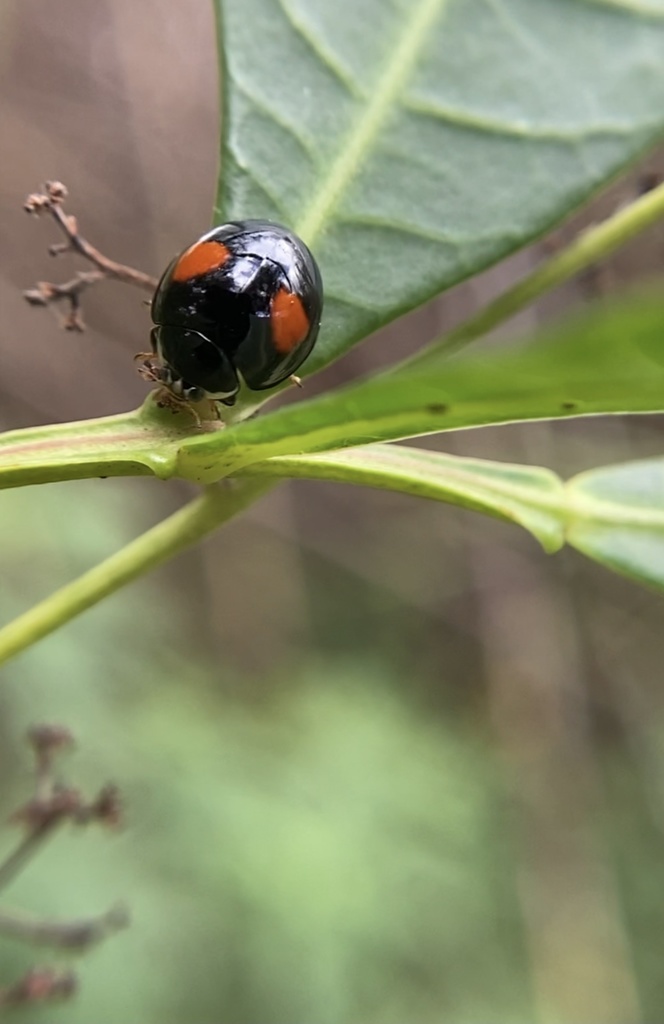
(c) Sandra H Statner, some rights reserved (CC BY) · licence
Family: Coccinellidae · Class: Insecta · Order: Coleoptera
Olla v-nigrum (Ashy Gray Lady Beetle) is a California animal in the Coccinellidae family.
The Ashy Gray Lady Beetle is a medium-sized coccinellid beetle measuring 4-6 mm in length. This species exhibits notable color polymorphism, with two primary forms: a pale gray to cream-colored form with black spots, and a dark form that is predominantly black with red or orange markings. The pale form typically displays 6-15 black spots on the elytra, while maintaining the characteristic white crown marking on the head that distinguishes it from similar species like the Asian Lady Beetle (Harmonia axyridis). The dark form features distinctive triangular or wedge-shaped red markings rather than circular spots, and prominent white markings on the pronotum that slope toward the rear. The pronotum markings are typically narrow and may form a white front margin (BugGuide). Olla v-nigrum occurs throughout much of North America, with populations documented from southern Canada through Mexico. In California, the species is found in diverse habitats across multiple elevation zones, from coastal areas to mountainous regions. The beetle has adapted to both natural and agricultural landscapes throughout the state. This species inhabits a wide range of environments including agricultural fields, gardens, grasslands, and woodland edges. Adults and larvae are commonly found on various plants where aphid colonies are present, as these serve as their primary food source. The species shows particular association with agricultural crops and ornamental plants where aphid populations are abundant. During winter months, adults seek shelter in protected locations including native bunch grass clumps, under tree bark, and in leaf litter (Xerces Society). Ashy Gray Lady Beetles are voracious predators, with both adults and larvae feeding primarily on aphids, though they also consume other soft-bodied insects including scale insects, thrips, and mites. Adults are capable of consuming substantial numbers of aphids per day, making them valuable biological control agents in agricultural systems. The species overwinters as adults in aggregations, often clustering together in protected microhabitats. Reproduction occurs in spring and early summer, with females laying yellow, oval eggs in clusters near aphid colonies. Development from egg to adult occurs over several weeks under favorable conditions, and multiple generations per year are typical in warmer climates. Currently, Olla v-nigrum holds no special conservation status at federal or state levels. The species appears to maintain stable populations across its range and may actually benefit from certain agricultural practices that support diverse prey populations. As a native beneficial insect, it plays a significant role in natural pest control and ecosystem balance. The species faces typical challenges associated with habitat modification and pesticide use in agricultural areas, but its adaptability to various habitats and association with human-modified landscapes has likely contributed to its continued widespread distribution. Conservation efforts for beneficial insects like lady beetles focus on maintaining diverse agricultural landscapes and reducing pesticide impacts through integrated pest management practices.
Classification
Class: Insecta · Order: Coleoptera · Family: Coccinellidae
Frequently asked questions
How is Olla v-nigrum classified?
Olla v-nigrum belongs to class Insecta, order Coleoptera, family Coccinellidae.
What family does Olla v-nigrum belong to?
Olla v-nigrum is in the Coccinellidae family.
What is Olla v-nigrum?
The Ashy Gray Lady Beetle is a medium-sized coccinellid beetle measuring 4-6 mm in length.
Is Olla v-nigrum found in California?
Yes. Olla v-nigrum is recorded in California in The California Species Project's catalogue.
Related species
Other California species in the same genus, family, or bioregion.
Data from The California Species Project — 14,000+ California species with verified data from CNPS, CDFW, USFWS, and more.