Oncopeltus fasciatus
Large Milkweed Bug
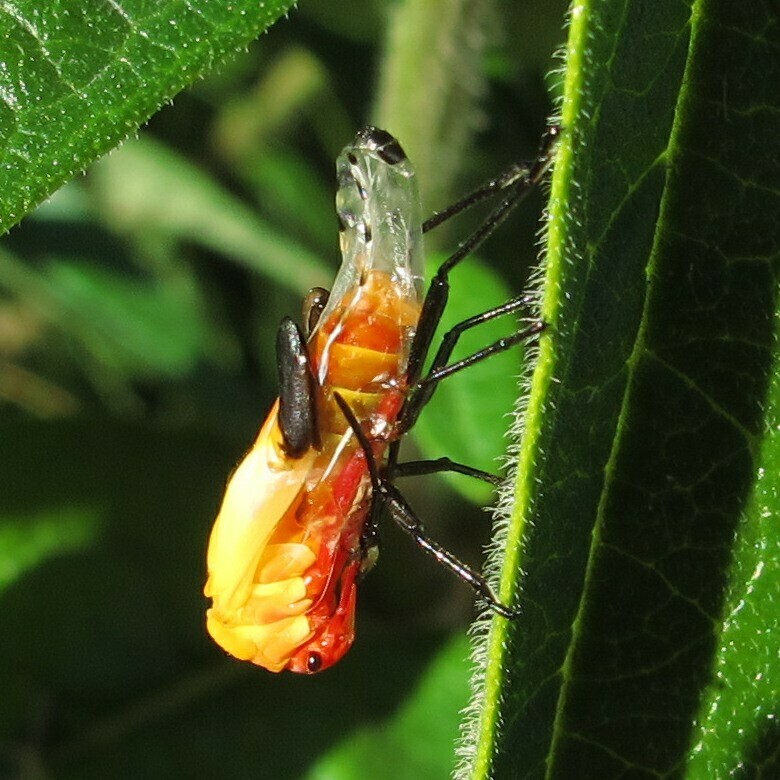
(c) Ilona, some rights reserved (CC BY-SA) · licence
Family: Lygaeidae · Class: Insecta · Order: Hemiptera
Oncopeltus fasciatus (Large Milkweed Bug) is a California animal in the Lygaeidae family.
The large milkweed bug is a distinctive hemipteran insect measuring 10 to 18 millimeters (0.4 to 0.7 inches) in length. Adults display bright orange-red coloration with contrasting black markings, including a prominent black band across the forewings and black head, antennae, and legs. The robust body shape and bold warning coloration serve as aposematic signals to potential predators, advertising the insect's toxicity acquired from its milkweed diet. Oncopeltus fasciatus occurs throughout much of North America, with its range extending from southern Canada through the United States and into northern Mexico. The species is widely distributed across the eastern United States from North Dakota to Texas and eastward, with populations also documented in California and other western states. In California, the species has been recorded in association with native milkweed populations throughout the state's diverse ecological regions. Large milkweed bugs inhabit areas where milkweed species (Asclepias spp.) are present, including grasslands, fields, roadsides, disturbed areas, and riparian zones. The species demonstrates a strong fidelity to milkweed habitats, occurring from sea level to elevations exceeding 7,500 feet in mountainous regions. Adults are commonly found on milkweed plants during the growing season, particularly in areas with robust milkweed populations that support both feeding and reproduction. This species exhibits obligate dependence on milkweeds and closely related plants in the family Apocynaceae. While large milkweed bugs will feed on young leaves, flowers, and developing seed pods, seeds provide optimal nutrition for growth and reproduction (Xerces Society 2017). Adults typically lay their eggs in clusters near developing milkweed pods, ensuring immediate food availability for emerging nymphs (Yonke & Medler 1969). The species undergoes incomplete metamorphosis, with five nymphal instars before reaching adulthood. Both adults and nymphs pierce plant tissues with their needle-like mouthparts to extract fluids, concentrating cardiac glycosides from their host plants that render them unpalatable to predators. Large milkweed bugs are active from spring through fall, with peak abundance coinciding with milkweed flowering and seed production periods. The species overwinters as adults in protected locations such as leaf litter, tree bark crevices, or human-made structures (Chaplin & Chaplin 1981). Multiple generations may occur annually in warmer regions, with up to three generations documented in southern areas (Slater & Baranowski 1978). Oncopeltus fasciatus is not federally or state listed and appears to maintain stable populations throughout most of its range. However, the species' dependence on milkweed plants makes it vulnerable to habitat loss and degradation that affects milkweed populations. Agricultural intensification, herbicide use, and urban development have reduced milkweed abundance in some areas. Conservation efforts focused on monarch butterfly habitat restoration, which emphasize milkweed conservation and establishment, also benefit large milkweed bug populations. The species serves as an important component of milkweed-associated insect communities and contributes to the ecological complexity of these plant-insect interactions.
Classification
Class: Insecta · Order: Hemiptera · Family: Lygaeidae
Frequently asked questions
How is Oncopeltus fasciatus classified?
Oncopeltus fasciatus belongs to class Insecta, order Hemiptera, family Lygaeidae.
What family does Oncopeltus fasciatus belong to?
Oncopeltus fasciatus is in the Lygaeidae family.
What is Oncopeltus fasciatus?
The large milkweed bug is a distinctive hemipteran insect measuring 10 to 18 millimeters (0.4 to 0.7 inches) in length.
Is Oncopeltus fasciatus found in California?
Yes. Oncopeltus fasciatus is recorded in California in The California Species Project's catalogue.
Related species
Other California species in the same genus, family, or bioregion.
Data from The California Species Project — 14,000+ California species with verified data from CNPS, CDFW, USFWS, and more.