Oncorhynchus gilae
Gila trout
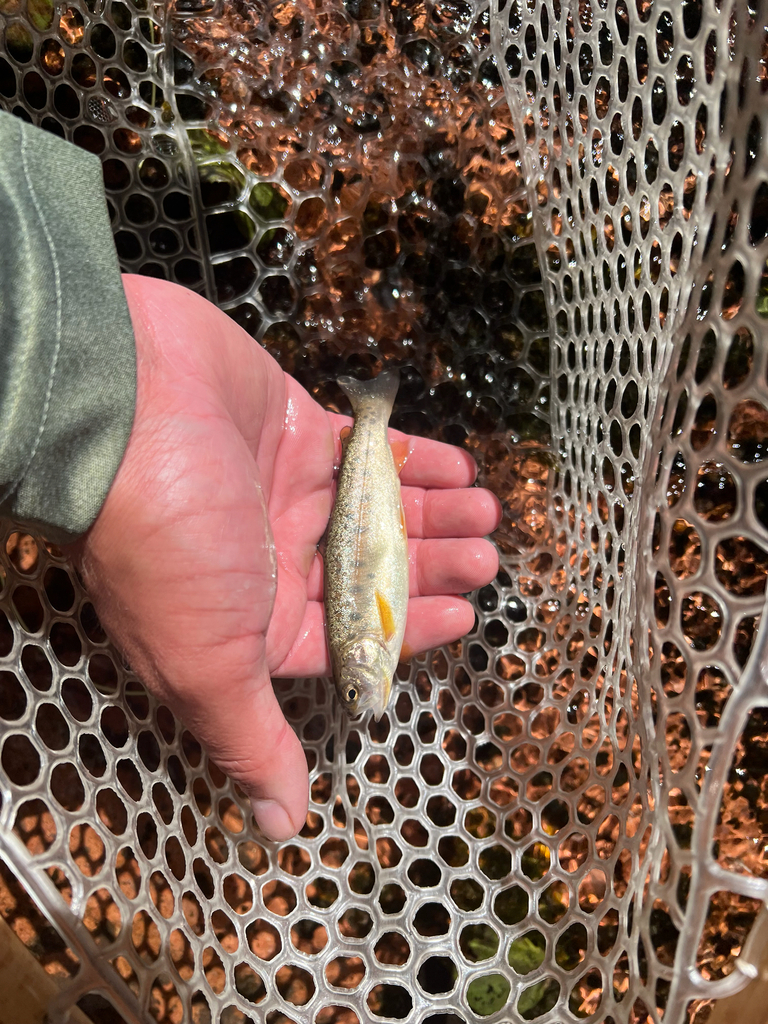
(c) Reizo Knapp, some rights reserved (CC BY) · licence
Family: Salmonidae · Class: Actinopterygii · Order: Salmoniformes
Conservation status: Threatened
Oncorhynchus gilae (Gila trout) is a California animal in the Salmonidae family.
The Gila trout is a medium-sized salmonid endemic to mountain streams in the southwestern United States. Adults typically measure 100 to 400 mm (4 to 16 inches) in total length, with mature fish generally exceeding 150 mm (6 inches). The species is readily identified by its distinctive iridescent gold sides that blend to a darker copper shade on the opercles (gill covers). The body displays scattered dark spots, and the overall coloration provides camouflage in the clear mountain waters it inhabits. Historically, Gila trout occurred throughout the Gila, San Francisco, Agua Fria, and Verde River drainages in New Mexico and Arizona (USFWS 2022). The species was known in the upper Gila River basin since at least 1885 but was not scientifically described until 1950, by which time its distribution had been dramatically reduced (Miller 1950). Currently, the species is restricted to headwater streams in the upper Gila River drainage in New Mexico, with populations in Main Diamond Creek, South Diamond Creek, McKenna Creek, Spruce Creek, and Iron Creek representing the core of its remaining range. Gila trout inhabit perennial montane streams at elevations ranging from 1,660 to over 2,800 meters (5,400 to 9,200 feet). These cold-water environments are characterized by clear, well-oxygenated streams with rocky substrates and abundant cover. Riparian habitats are typically situated within ponderosa pine and mixed conifer forests, with streamside vegetation including willows, red-osier dogwood, and thinleaf alder. Suitable habitat occurs between approximately 33° to 35° north latitude and 107° 45' to 112° 15' west longitude. Gila trout are primarily insectivorous, feeding on aquatic and terrestrial insects, though there is evidence of occasional piscivory in larger individuals (Regan 1964). The species exhibits typical salmonid life history characteristics, with spawning occurring in spring when water temperatures and flows are appropriate. Juvenile fish under 100 mm show different habitat preferences than adults, utilizing shallow, protected areas with lower water velocities. Growth rates vary with environmental conditions, with fish reaching sexual maturity at approximately 150 mm total length. The Gila trout was listed as endangered under the Endangered Species Act in 1967 and reclassified as threatened in 2006. As of December 2025, the species maintains its threatened status throughout its range. Primary threats include habitat loss and fragmentation, competition and hybridization with non-native trout species, wildfire effects, and climate change impacts on stream flow and temperature. The species has a recovery priority number of 8, indicating moderate threat with high recovery potential (USFWS 2020). Multiple recovery plans have been developed since 1979, with the most recent revision approved in 2022. Conservation efforts focus on habitat restoration, removal of non-native species, and establishment of additional populations within the historical range to ensure long-term persistence.
Classification
Class: Actinopterygii · Order: Salmoniformes · Family: Salmonidae
Conservation status
Threatened
Frequently asked questions
How is Oncorhynchus gilae classified?
Oncorhynchus gilae belongs to class Actinopterygii, order Salmoniformes, family Salmonidae.
What family does Oncorhynchus gilae belong to?
Oncorhynchus gilae is in the Salmonidae family.
Is Oncorhynchus gilae protected or of conservation concern?
Oncorhynchus gilae carries the following status: Threatened.
What is Oncorhynchus gilae?
The Gila trout is a medium-sized salmonid endemic to mountain streams in the southwestern United States.
Is Oncorhynchus gilae found in California?
Yes. Oncorhynchus gilae is recorded in California in The California Species Project's catalogue.
Related species
Other California species in the same genus, family, or bioregion.
Data from The California Species Project — 14,000+ California species with verified data from CNPS, CDFW, USFWS, and more.