Oncorhynchus kisutch
Coho salmon - Southern Oregon - Northern California Coast ESU
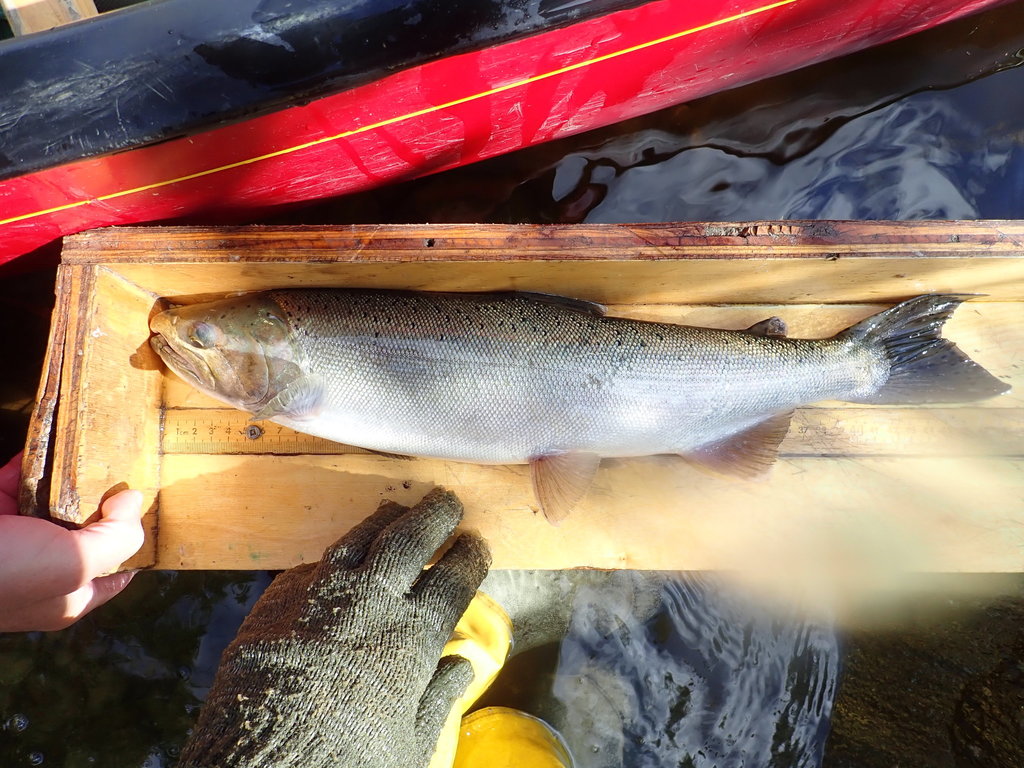
(c) Rob Foster, some rights reserved (CC BY) · licence
Family: Salmonidae · Class: Actinopterygii · Order: Salmoniformes
Conservation status: ST · Threatened · G5T2Q S2
Oncorhynchus kisutch (Coho salmon - Southern Oregon - Northern California Coast ESU) is a California animal in the Salmonidae family.
The Southern Oregon - Northern California Coast Evolutionarily Significant Unit (SONCC ESU) of coho salmon is an anadromous Pacific salmon that displays the characteristic life history of spawning in freshwater and maturing in marine environments. Adults typically measure 24 to 30 inches (61 to 76 cm) in length and weigh 8 to 12 pounds (3.6 to 5.4 kg), though individuals can reach up to 6 kg (13.2 pounds). During their freshwater spawning phase, coho salmon develop hooked jaws and take on darker coloration with reddish hues, while ocean-phase fish display bright silver sides with dark backs and small black spots on the back and upper lobe of the tail fin. The SONCC ESU includes all coho salmon populations from Cape Blanco, Oregon to Punta Gorda, California. According to the California Department of Fish and Wildlife, this ESU historically occurred in 582 California streams but had been lost from approximately half of these streams by 1991. In California, spawning populations currently occur from the Smith River in Del Norte County near the Oregon border south to Aptos Creek in Santa Cruz County. From Humboldt County north to the Oregon border, coho salmon are now found in approximately two-thirds of streams identified as historical habitat, while in the southern portion of their range, they are absent from all tributaries of San Francisco Bay and many streams south of the Bay. Coho salmon require cool, clean, connected rivers and healthy ocean conditions throughout their life cycle. Adults spawn in freshwater streams, typically in areas with gravel substrates suitable for redd construction. Juveniles require diverse freshwater habitats including pools, riffles, and side channels with adequate cover from woody debris and undercut banks. The species depends on unobstructed migration corridors between freshwater spawning areas and marine feeding grounds. Coho salmon exhibit a complex anadromous life history, spending their first 1-2 years in freshwater before migrating to the ocean where they mature for 1-2 additional years. Adults return to natal streams to spawn, typically dying after reproduction. During their marine phase, they feed on small fish, squid, and crustaceans, while juveniles in freshwater consume aquatic insects, terrestrial insects, and small fish. The SONCC ESU was listed as threatened under the Federal Endangered Species Act on May 6, 1997. Major threats contributing to population declines include habitat loss and degradation from dams, water diversions, poor logging practices, agricultural development, marijuana cultivation, and overfishing. Climate change exacerbates these threats through altered precipitation patterns and increased water temperatures. The National Marine Fisheries Service included ESA protections for hatchery-raised coho salmon from Iron Gate Hatchery, Trinity River Hatchery, and Cole M. Rivers Hatchery in 2005. Recovery efforts focus on habitat restoration, flow management, and removal of migration barriers to support wild population recovery.
Classification
Class: Actinopterygii · Order: Salmoniformes · Family: Salmonidae
Conservation status
ST · Threatened · G5T2Q S2
Frequently asked questions
How is Oncorhynchus kisutch classified?
Oncorhynchus kisutch belongs to class Actinopterygii, order Salmoniformes, family Salmonidae.
What family does Oncorhynchus kisutch belong to?
Oncorhynchus kisutch is in the Salmonidae family.
Is Oncorhynchus kisutch protected or of conservation concern?
Oncorhynchus kisutch carries the following status: ST · Threatened · G5T2Q S2.
What is Oncorhynchus kisutch?
The Southern Oregon - Northern California Coast Evolutionarily Significant Unit (SONCC ESU) of coho salmon is an anadromous Pacific salmon that displays the characteristic life history of spawning in freshwater and maturing in marine environments.
Is Oncorhynchus kisutch found in California?
Yes. Oncorhynchus kisutch is recorded in California in The California Species Project's catalogue.
Related species
Other California species in the same genus, family, or bioregion.
Data from The California Species Project — 14,000+ California species with verified data from CNPS, CDFW, USFWS, and more.