Oncorhynchus mykiss aguabonita
California golden trout
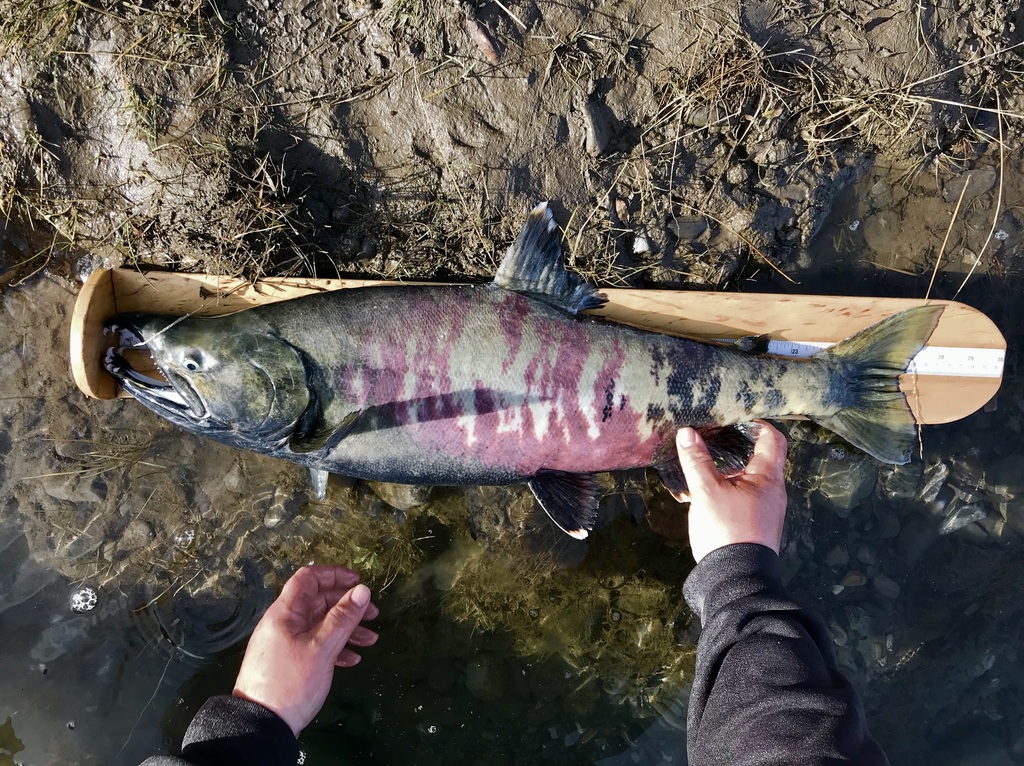
(c) Kevin Brix, some rights reserved (CC BY-SA) · licence
Family: Salmonidae · Class: Actinopterygii · Order: Salmoniformes
Conservation status: G5T1 S1
Oncorhynchus mykiss aguabonita (California golden trout) is a California animal in the Salmonidae family.
The California golden trout is a distinctive subspecies of rainbow trout endemic to high-elevation waters of the southern Sierra Nevada. Adults typically measure 150 to 280 mm (5.9 to 11.0 inches) in total length, though individuals in optimal habitat may reach 350 mm (13.8 inches). The species displays brilliant golden-yellow coloration on the sides and belly, with a deep red band along the lateral line extending from the gill cover to the tail. The back is olive-green to dark green, and the lower fins are orange to red-tipped. Small black spots are scattered along the back and upper sides, with fewer spots below the lateral line compared to other rainbow trout subspecies. Historically, California golden trout were restricted to the Kern River drainage above Kern Falls in Tulare County, specifically in Golden Trout Creek, Volcano Creek, and the South Fork Kern River. The native range encompassed approximately 50 stream miles in high-elevation watersheds between 2,100 and 3,400 meters (6,900 to 11,200 feet) elevation. Through transplantation efforts beginning in the early 1900s, populations now exist in numerous high-elevation lakes and streams throughout the Sierra Nevada, though genetic purity varies among these introduced populations. The subspecies inhabits cold, clear mountain streams and alpine lakes characterized by granite substrates, sparse riparian vegetation, and water temperatures typically below 20°C (68°F). Native habitat consists of small streams with pool-riffle sequences, undercut banks, and boulder cover. Spawning occurs in shallow gravel areas with moderate current flow. The species demonstrates tolerance for the extreme temperature fluctuations and low productivity typical of high-elevation aquatic systems. California golden trout are opportunistic feeders, consuming terrestrial insects, aquatic invertebrates including chironomid larvae and mayfly nymphs, and occasionally small crustaceans. Spawning occurs from late May through August, depending on elevation and snowmelt timing. Females construct redds in gravel substrates where they deposit 300 to 2,100 eggs. Sexual maturity is reached at age 2 to 3 years. The species exhibits slower growth rates compared to lower-elevation trout due to shortened growing seasons and limited food availability. The Global/State Rank of G5T1 S1 indicates the subspecies is critically imperiled in California. Pure native populations remain only in the headwater streams of Golden Trout Creek and Volcano Creek, with hybridization and genetic introgression from introduced rainbow trout representing the primary threat. According to the California Department of Fish and Wildlife, habitat degradation from historical grazing, water diversions, and introduced species has eliminated pure populations from much of the historical range. Climate change poses an emerging threat through rising temperatures and altered precipitation patterns that may reduce suitable cold-water habitat. Conservation efforts focus on maintaining genetic integrity of remaining pure populations and removing non-native trout from critical watersheds.
Classification
Class: Actinopterygii · Order: Salmoniformes · Family: Salmonidae
Conservation status
G5T1 S1
Frequently asked questions
How is Oncorhynchus mykiss aguabonita classified?
Oncorhynchus mykiss aguabonita belongs to class Actinopterygii, order Salmoniformes, family Salmonidae.
What family does Oncorhynchus mykiss aguabonita belong to?
Oncorhynchus mykiss aguabonita is in the Salmonidae family.
Is Oncorhynchus mykiss aguabonita protected or of conservation concern?
Oncorhynchus mykiss aguabonita carries the following status: G5T1 S1.
What is Oncorhynchus mykiss aguabonita?
The California golden trout is a distinctive subspecies of rainbow trout endemic to high-elevation waters of the southern Sierra Nevada.
Is Oncorhynchus mykiss aguabonita found in California?
Yes. Oncorhynchus mykiss aguabonita is recorded in California in The California Species Project's catalogue.
Related species
Other California species in the same genus, family, or bioregion.
Data from The California Species Project — 14,000+ California species with verified data from CNPS, CDFW, USFWS, and more.