Oncorhynchus mykiss aquilarum
Eagle Lake rainbow trout
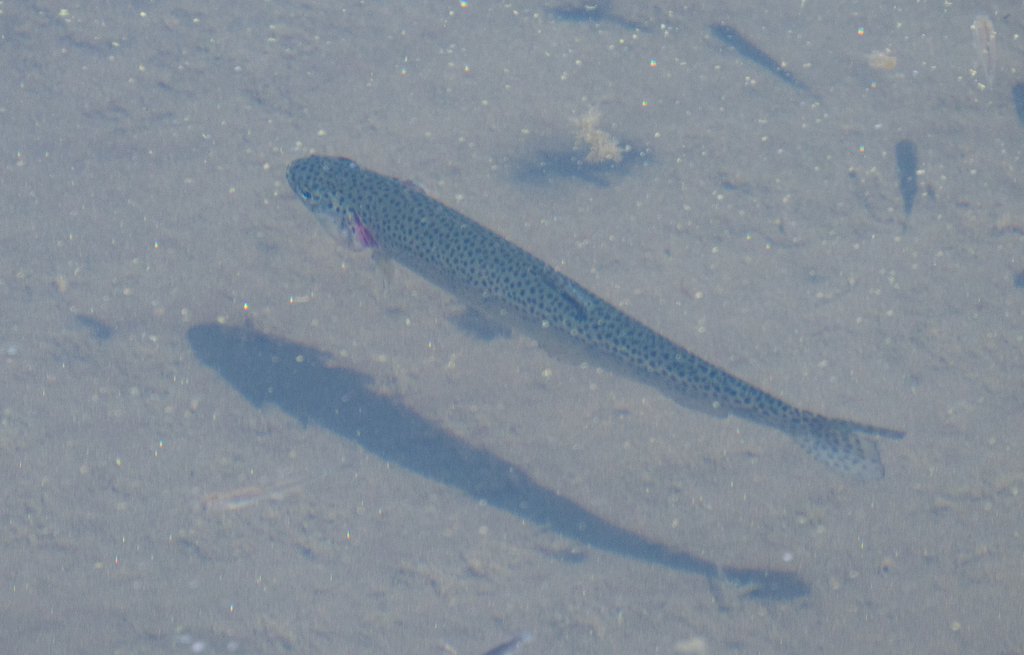
(c) avocat, some rights reserved (CC BY) · licence
Family: Salmonidae · Class: Actinopterygii · Order: Salmoniformes
Conservation status: G5T1Q S1
Oncorhynchus mykiss aquilarum (Eagle Lake rainbow trout) is a California animal in the Salmonidae family.
The Eagle Lake rainbow trout is a distinct subspecies of rainbow trout endemic to Eagle Lake in Lassen County, California. Adults typically measure 300 to 600 mm (12 to 24 inches) in total length, with some individuals reaching up to 760 mm (30 inches). The body is streamlined and laterally compressed, with a broad head and relatively large mouth. Coloration varies seasonally and with maturity, displaying a silver base with pink to reddish lateral stripes. Spawning individuals develop more pronounced coloration, with males showing deeper reds and pronounced kype development. Historically, Eagle Lake rainbow trout were found only in Eagle Lake, a large alkaline lake covering approximately 100 square kilometers in the high desert of northeastern California. The subspecies evolved in isolation within this closed-basin lake system at an elevation of 1,545 meters (5,069 feet). The original population was extirpated from Eagle Lake by the 1950s due to habitat degradation and water diversions that eliminated suitable spawning tributaries. The subspecies adapted to Eagle Lake's unique alkaline environment, with pH levels ranging from 8.8 to 9.6 and total dissolved solids exceeding 2,500 parts per million. These conditions would be lethal to most other salmonid populations. Eagle Lake rainbow trout evolved specialized physiological adaptations including enhanced osmoregulatory capabilities and modified gill morphology to process the highly mineralized water. Natural spawning historically occurred in Pine Creek, the lake's primary tributary, typically from April through June when water temperatures reached optimal ranges. Eagle Lake rainbow trout are opportunistic feeders, consuming zooplankton, aquatic insects, and small fish. Their diet in Eagle Lake includes Tui chub, which comprise a significant portion of larger individuals' intake. The subspecies exhibits anadromous-like behavior, migrating from the alkaline lake environment to freshwater tributaries for spawning. Adults can live up to seven years and reach sexual maturity between ages three and four. The subspecies faces critical conservation challenges with a Global/State Rank of G5T1Q S1, indicating extreme rarity and questionable taxonomic status. The California Department of Fish and Wildlife maintains the subspecies through an artificial propagation program using broodstock collected from Eagle Lake before the original population's extirpation. Since 1959, hatchery-produced fish have been stocked annually to maintain a fishable population in Eagle Lake. However, without natural reproduction, the long-term genetic integrity and evolutionary trajectory of the subspecies remain uncertain. Current research focuses on habitat restoration in Pine Creek and other tributaries to potentially restore natural spawning runs. Water management practices, including maintaining adequate flows in spawning tributaries and controlling water diversions, are essential for any recovery efforts. The subspecies' extreme specialization to Eagle Lake's alkaline environment makes it particularly vulnerable to environmental changes and limits translocation options for conservation.
Classification
Class: Actinopterygii · Order: Salmoniformes · Family: Salmonidae
Conservation status
G5T1Q S1
Frequently asked questions
How is Oncorhynchus mykiss aquilarum classified?
Oncorhynchus mykiss aquilarum belongs to class Actinopterygii, order Salmoniformes, family Salmonidae.
What family does Oncorhynchus mykiss aquilarum belong to?
Oncorhynchus mykiss aquilarum is in the Salmonidae family.
Is Oncorhynchus mykiss aquilarum protected or of conservation concern?
Oncorhynchus mykiss aquilarum carries the following status: G5T1Q S1.
What is Oncorhynchus mykiss aquilarum?
The Eagle Lake rainbow trout is a distinct subspecies of rainbow trout endemic to Eagle Lake in Lassen County, California.
Is Oncorhynchus mykiss aquilarum found in California?
Yes. Oncorhynchus mykiss aquilarum is recorded in California in The California Species Project's catalogue.
Related species
Other California species in the same genus, family, or bioregion.
Data from The California Species Project — 14,000+ California species with verified data from CNPS, CDFW, USFWS, and more.