Oncorhynchus mykiss ssp. 1
Goose Lake redband trout
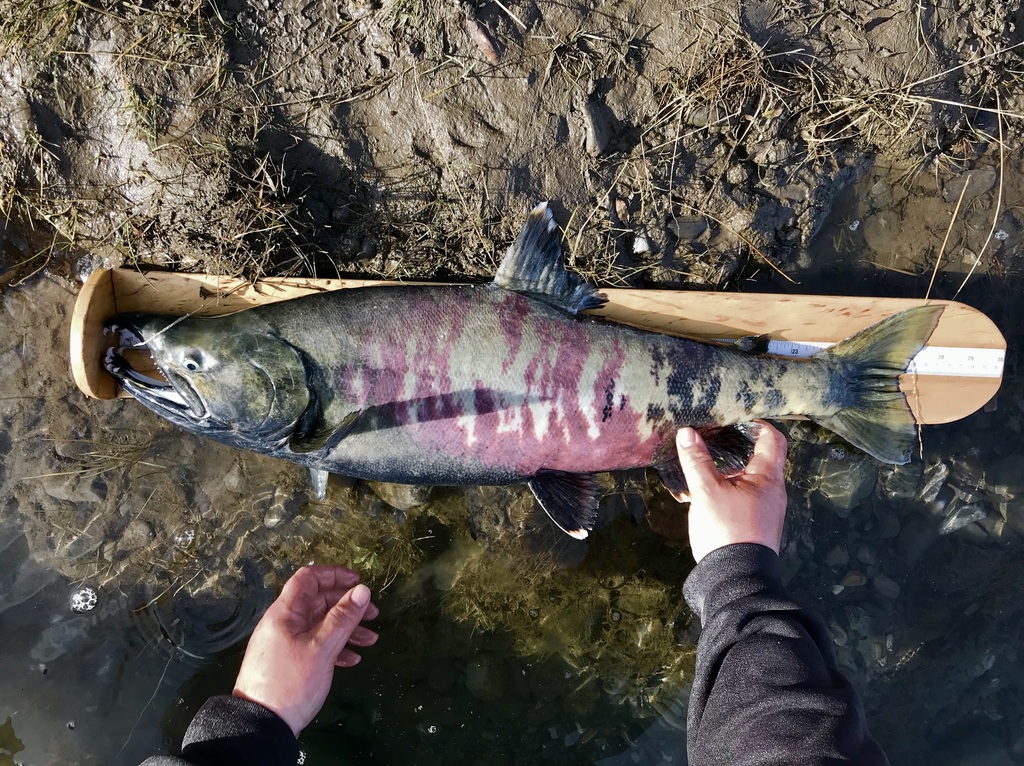
(c) Kevin Brix, some rights reserved (CC BY-SA) · licence
Family: Salmonidae · Class: Actinopterygii · Order: Salmoniformes
Conservation status: G5T2Q S2
Oncorhynchus mykiss ssp. 1 (Goose Lake redband trout) is a California animal in the Salmonidae family.
The Goose Lake redband trout (Oncorhynchus mykiss ssp. 1) is a genetically distinct subspecies of rainbow trout endemic to the closed-basin Goose Lake system of northeastern California and south-central Oregon. Adults typically measure 150 to 300 mm (6 to 12 inches) in total length, though some individuals may reach 400 mm (16 inches). The species exhibits the characteristic rainbow trout body plan with an elongated, laterally compressed form. Coloration varies with habitat and life stage, featuring olive-green to blue-green dorsal surfaces, silvery sides, and pale yellow to white ventral areas. A distinctive pinkish-red band extends along the lateral line, most prominent in spawning adults. Small black spots are scattered across the back, dorsal fin, and upper sides, with spotting typically extending below the lateral line. Historically, Goose Lake redband trout occupied Goose Lake and its tributary streams in Modoc County, California, and Lake County, Oregon. The subspecies is endemic to this approximately 1,000 square kilometer closed basin system. Current distribution is significantly reduced from historical range, with populations now restricted to several tributary streams including Cottonwood Creek, Thomas Creek, and Willow Creek on the California side, and additional streams in Oregon. The species has been extirpated from Goose Lake proper due to periodic desiccation events and habitat degradation. Goose Lake redband trout inhabit montane streams at elevations ranging from 1,372 to 2,134 meters (4,500 to 7,000 feet). Preferred habitat includes cool, clear streams with rocky or gravelly substrates, adequate riparian cover, and stable flow regimes. Stream temperatures rarely exceed 20°C (68°F) in occupied areas. The species requires clean gravel beds for spawning and deep pools for overwinter survival. Riparian vegetation provides essential shade and terrestrial insect inputs. Spawning occurs from March through June, depending on water temperature and flow conditions. Adults migrate upstream to spawn in tributary headwaters, constructing redds in gravel substrates. Females deposit 800 to 3,000 eggs depending on body size. Fry emerge after 4 to 7 weeks and remain in natal areas for one to two years before moving to larger stream reaches. The species exhibits opportunistic feeding behavior, consuming aquatic and terrestrial insects, crustaceans, and small fish when available. Mayflies, caddisflies, and chironomid midges constitute primary prey items. The subspecies carries a Global/State Rank of G5T2Q S2, indicating it is imperiled in California with 6 to 20 occurrences. Primary threats include habitat fragmentation, water diversions, livestock grazing impacts, introduced species competition, and climate change effects on stream flow and temperature. The California Department of Fish and Wildlife considers this subspecies a Species of Special Concern. Recent genetic studies confirm the distinctiveness of Goose Lake populations, supporting subspecies designation. Conservation efforts focus on habitat restoration, water rights protection, and livestock management in critical watersheds.
Classification
Class: Actinopterygii · Order: Salmoniformes · Family: Salmonidae
Conservation status
G5T2Q S2
Frequently asked questions
How is Oncorhynchus mykiss ssp. 1 classified?
Oncorhynchus mykiss ssp. 1 belongs to class Actinopterygii, order Salmoniformes, family Salmonidae.
What family does Oncorhynchus mykiss ssp. 1 belong to?
Oncorhynchus mykiss ssp. 1 is in the Salmonidae family.
Is Oncorhynchus mykiss ssp. 1 protected or of conservation concern?
Oncorhynchus mykiss ssp. 1 carries the following status: G5T2Q S2.
What is Oncorhynchus mykiss ssp. 1?
The Goose Lake redband trout (Oncorhynchus mykiss ssp.
Is Oncorhynchus mykiss ssp. 1 found in California?
Yes. Oncorhynchus mykiss ssp. 1 is recorded in California in The California Species Project's catalogue.
Related species
Other California species in the same genus, family, or bioregion.
Data from The California Species Project — 14,000+ California species with verified data from CNPS, CDFW, USFWS, and more.