Oncorhynchus mykiss whitei
Little Kern golden trout
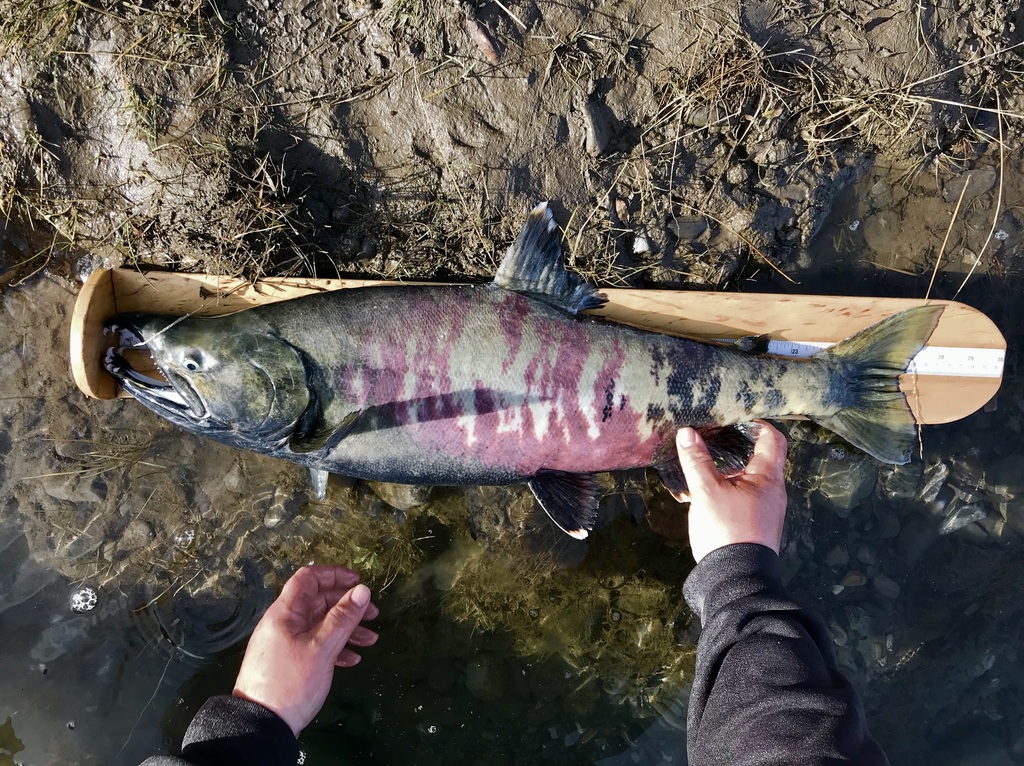
(c) Kevin Brix, some rights reserved (CC BY-SA) · licence
Family: Salmonidae · Class: Actinopterygii · Order: Salmoniformes
Conservation status: Threatened · G5T2 S2
Oncorhynchus mykiss whitei (Little Kern golden trout) is a California animal in the Salmonidae family.
The Little Kern golden trout is a subspecies of rainbow trout endemic to the Little Kern River drainage in California's southern Sierra Nevada. Adults typically measure 150 to 250 mm (6 to 10 inches) in total length, though individuals can reach up to 300 mm (12 inches). The species displays the characteristic golden coloration of California's golden trout subspecies, with olive-green backs transitioning to bright golden-yellow sides and white bellies. A distinctive pink to red lateral stripe extends along the body, and the fins often exhibit orange to red coloration. Parr marks may persist in adults as vertical dark bars along the sides. Historically, Little Kern golden trout occupied approximately 50 kilometers of the Little Kern River system in Tulare County, including the mainstem and tributaries such as Peppermint Creek, Clicks Creek, and Wet Meadows Creek. The current range has been significantly reduced due to habitat degradation and hybridization with introduced rainbow trout. Pure populations are now restricted to the uppermost headwater reaches of the Little Kern River system, primarily above natural and artificial barriers at elevations between 2,100 and 3,050 meters (6,900 to 10,000 feet). The subspecies inhabits high-elevation montane streams characterized by cold, well-oxygenated water with temperatures typically below 20°C (68°F). Preferred habitat includes pools and runs with rocky or gravel substrates, often associated with granite bedrock typical of the Sierra Nevada. Stream flows are generally low, ranging from 0.1 to 2.0 cubic meters per second during summer months. Riparian vegetation consists primarily of mountain meadow grasses, willows, and scattered conifers including lodgepole pine and red fir. Little Kern golden trout are opportunistic feeders, consuming aquatic and terrestrial insects, small crustaceans, and algae. Primary prey items include mayfly and caddisfly larvae, midges, and terrestrial ants and beetles that fall into the water. Spawning occurs from May through July, depending on snowmelt timing and water temperature. Females construct redds in gravel substrates of tributary streams, depositing 300 to 800 eggs per female. Sexual maturity is typically reached at 2 to 3 years of age. The U.S. Fish and Wildlife Service listed the Little Kern golden trout as threatened under the Endangered Species Act in 1978. According to the California Department of Fish and Wildlife, the species was originally described as Salmo aguabonita whitei but has undergone taxonomic revision, with recent studies indicating it is a subspecies of rainbow trout, hence the current designation as Oncorhynchus mykiss whitei. Primary threats include hybridization and genetic introgression from introduced rainbow trout, habitat degradation from grazing and recreational activities, and climate change effects on stream temperature and flow regimes. Recovery efforts focus on maintaining genetic integrity through barrier construction and non-native trout removal, along with habitat restoration and monitoring programs.
Classification
Class: Actinopterygii · Order: Salmoniformes · Family: Salmonidae
Conservation status
Threatened · G5T2 S2
Frequently asked questions
How is Oncorhynchus mykiss whitei classified?
Oncorhynchus mykiss whitei belongs to class Actinopterygii, order Salmoniformes, family Salmonidae.
What family does Oncorhynchus mykiss whitei belong to?
Oncorhynchus mykiss whitei is in the Salmonidae family.
Is Oncorhynchus mykiss whitei protected or of conservation concern?
Oncorhynchus mykiss whitei carries the following status: Threatened · G5T2 S2.
What is Oncorhynchus mykiss whitei?
The Little Kern golden trout is a subspecies of rainbow trout endemic to the Little Kern River drainage in California's southern Sierra Nevada.
Is Oncorhynchus mykiss whitei found in California?
Yes. Oncorhynchus mykiss whitei is recorded in California in The California Species Project's catalogue.
Related species
Other California species in the same genus, family, or bioregion.
Data from The California Species Project — 14,000+ California species with verified data from CNPS, CDFW, USFWS, and more.