Oncorhynchus tshawytscha pop. 3
Chinook salmon - Klamath-Trinity spring run
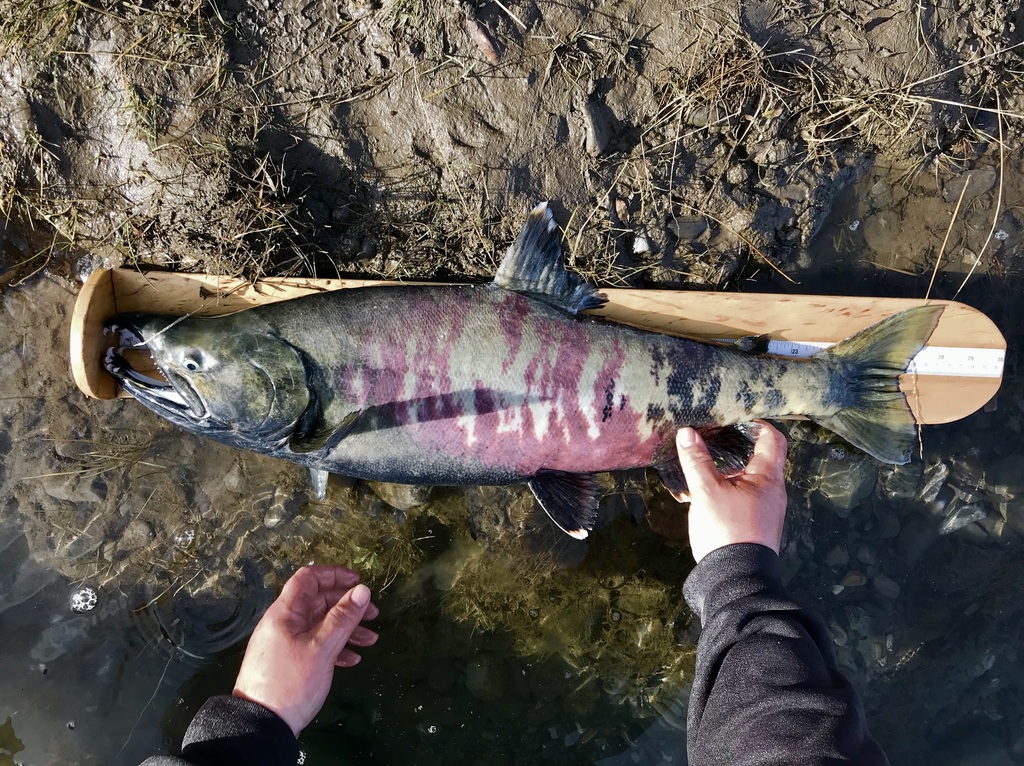
(c) Kevin Brix, some rights reserved (CC BY-SA) · licence
Family: Salmonidae · Class: Actinopterygii · Order: Salmoniformes
Conservation status: G5 S1S2
Oncorhynchus tshawytscha pop. 3 (Chinook salmon - Klamath-Trinity spring run) is a California animal in the Salmonidae family.
The Klamath-Trinity spring run Chinook salmon is an evolutionarily significant unit (ESU) of Oncorhynchus tshawytscha endemic to the upper Klamath and Trinity river systems in northern California and southern Oregon. Adult spring run Chinook salmon typically measure 60 to 91 centimeters (24 to 36 inches) in length and weigh 4.5 to 14 kilograms (10 to 30 pounds), though individuals can reach larger sizes. During spawning, males develop pronounced hooked jaws (kypes) and females become darker with reddish coloration. Ocean-phase adults display silvery sides with dark backs and small black spots on the back, dorsal fin, and upper lobe of the caudal fin. Historically, this ESU occupied the upper Klamath River basin above Klamath Falls and the Trinity River system above the North Fork Trinity River confluence. The population spawned in tributary streams throughout the upper Klamath basin including the Williamson, Sprague, and Wood rivers, and in Trinity River tributaries such as the South Fork Trinity River. Current distribution is severely restricted compared to historical range, with access to much of the upper Klamath basin blocked by dams. Spring run Chinook salmon require cold, well-oxygenated water for spawning and juvenile rearing. Adults prefer deep pools and cover during their extended freshwater residence, while juveniles utilize riffle-pool complexes with gravel substrates and overhead cover. Spawning occurs in areas with clean gravel beds, typically 1.3 to 10 centimeters in diameter, with adequate water flow for egg incubation. Stream temperatures must remain below 13°C (55°F) during critical life stages. This life history variant is distinguished by its spring entry into freshwater, typically from March through July, followed by several months of holding in deep pools before spawning in late summer or fall. Adults cease feeding upon freshwater entry and rely on stored energy reserves. Females construct redds in gravel beds where they deposit 3,000 to 5,000 eggs. Juveniles emerge in spring and may rear in freshwater for one to two years before migrating to the ocean. The species is anadromous, spending most of its adult life in the Pacific Ocean before returning to natal streams to spawn. The upper Klamath and Trinity Rivers ESU faces severe conservation challenges. According to NOAA Fisheries, the population has experienced dramatic declines since the early 1900s due to dam construction, habitat degradation, water diversions, and disease outbreaks. The Klamath River dam removal project, completed in 2024, represents the largest dam removal project in U.S. history and aims to restore access to historical spawning habitat. However, the Trinity River population remains isolated by Trinity Dam. Current population estimates suggest extremely low abundance, with the global rank of G5 S1S2 indicating the subspecies is critically imperiled in California despite the overall species being secure globally.
Classification
Class: Actinopterygii · Order: Salmoniformes · Family: Salmonidae
Conservation status
G5 S1S2
Frequently asked questions
How is Oncorhynchus tshawytscha pop. 3 classified?
Oncorhynchus tshawytscha pop. 3 belongs to class Actinopterygii, order Salmoniformes, family Salmonidae.
What family does Oncorhynchus tshawytscha pop. 3 belong to?
Oncorhynchus tshawytscha pop. 3 is in the Salmonidae family.
Is Oncorhynchus tshawytscha pop. 3 protected or of conservation concern?
Oncorhynchus tshawytscha pop. 3 carries the following status: G5 S1S2.
What is Oncorhynchus tshawytscha pop. 3?
The Klamath-Trinity spring run Chinook salmon is an evolutionarily significant unit (ESU) of Oncorhynchus tshawytscha endemic to the upper Klamath and Trinity river systems in northern California and southern Oregon.
Is Oncorhynchus tshawytscha pop. 3 found in California?
Yes. Oncorhynchus tshawytscha pop. 3 is recorded in California in The California Species Project's catalogue.
Related species
Other California species in the same genus, family, or bioregion.
Data from The California Species Project — 14,000+ California species with verified data from CNPS, CDFW, USFWS, and more.