Oncorhynchus tshawytscha pop. 30
Chinook salmon - upper Klamath and Trinity Rivers ESU
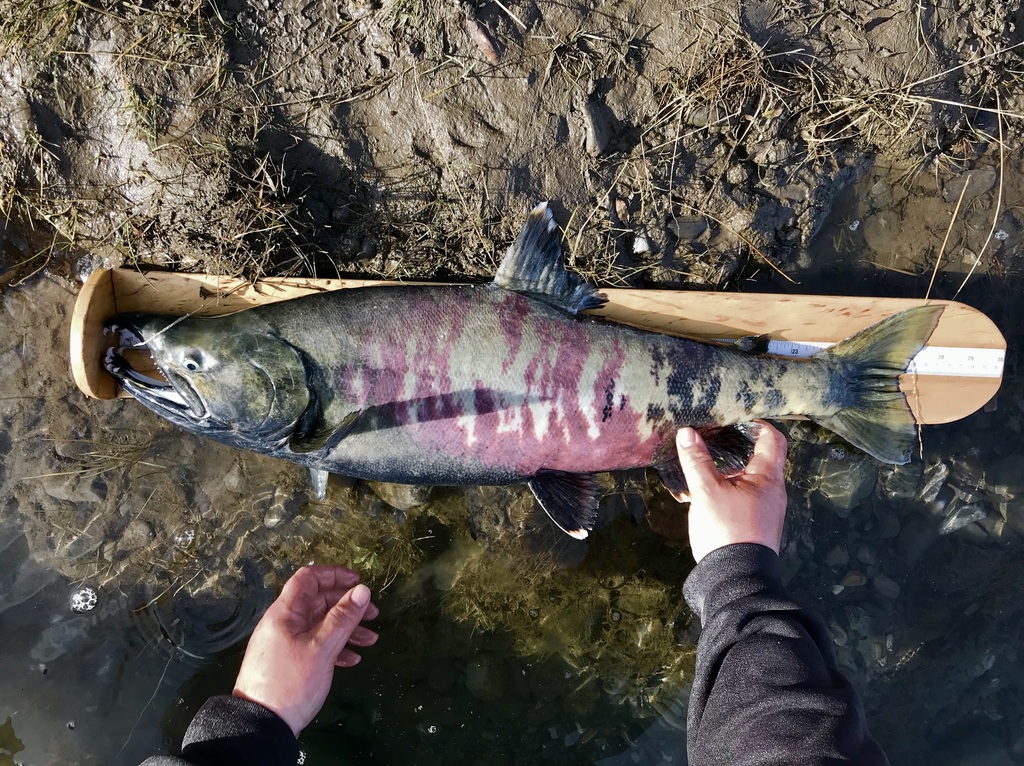
(c) Kevin Brix, some rights reserved (CC BY-SA) · licence
Family: Salmonidae · Class: Actinopterygii · Order: Salmoniformes
Conservation status: ST · Candidate · G5T2Q S2
Oncorhynchus tshawytscha pop. 30 (Chinook salmon - upper Klamath and Trinity Rivers ESU) is a California animal in the Salmonidae family.
The Chinook salmon of the upper Klamath and Trinity Rivers ESU (Oncorhynchus tshawytscha pop. 30) represents spring-run populations of North America's largest Pacific salmon species. Adults typically average 27 inches in length and 40 pounds in weight, though individuals have been recorded exceeding 100 pounds and 50 inches in length. During spawning, both sexes develop hooked jaws (kypes), with males displaying more pronounced secondary sexual characteristics including darker coloration and enlarged teeth. The maximum reported age for Chinook salmon is 9 years, with these fish spending the longest time at sea among Pacific salmon species. This ESU encompasses spring-run Chinook salmon populations in the Trinity River and the Klamath River upstream of the mouth of the Trinity River, according to the California Department of Fish and Wildlife. Within the Trinity River system, spawning occurs in the mainstem (with upstream distribution limited by Lewiston Dam), the north and south forks, Hayfork Creek, New River, and Canyon Creek. In the Klamath River portion of their range, these salmon historically ascended into Upper Klamath Lake, Oregon, to spawn in major tributaries including the Williamson, Sprague, and Wood Rivers. Current distribution has been significantly reduced from historical levels due to habitat modifications and dam construction. Chinook salmon inhabit both freshwater and marine environments during their anadromous life cycle. Spawning adults prefer gravel substrates in areas with adequate water flow and dissolved oxygen levels. The extended time these salmon spend at sea enables them to reach sizes capable of migrating upstream long distances and excavating deep redds in powerful river systems. Juvenile rearing habitat includes pools, side channels, and areas with overhead cover and suitable water temperatures. Spring-run Chinook salmon exhibit a distinctive life history pattern, entering freshwater during spring and early summer months but delaying spawning until fall. Adults hold in deep pools throughout the summer, utilizing their stored energy reserves. Spawning typically occurs from September through November, with females constructing redds in gravel substrates where they deposit 2,000 to 17,000 eggs depending on body size. Juveniles may rear in freshwater for several months to over a year before migrating to the ocean. At sea, they feed on a variety of prey including anchovies, sardines, squid, and crustaceans. The upper Klamath and Trinity Rivers ESU currently holds federal candidate status, indicating that listing under the Endangered Species Act may be warranted but is precluded by higher priority actions. California has listed these populations as threatened under state law. The ESU was proposed for federal listing in 1998, but listing was determined to be "not warranted" at that time. Primary threats include habitat loss from dam construction, water diversions, logging, mining, and climate change impacts on stream temperatures and flow patterns. Disease outbreaks, particularly from Ceratomyxa shasta and Parvicapsula minibicornis parasites, have significantly impacted juvenile survival in the Klamath River system. Population abundances have declined dramatically from historical levels, contributing to the current conservation concern for this evolutionarily significant unit.
Classification
Class: Actinopterygii · Order: Salmoniformes · Family: Salmonidae
Conservation status
ST · Candidate · G5T2Q S2
Frequently asked questions
How is Oncorhynchus tshawytscha pop. 30 classified?
Oncorhynchus tshawytscha pop. 30 belongs to class Actinopterygii, order Salmoniformes, family Salmonidae.
What family does Oncorhynchus tshawytscha pop. 30 belong to?
Oncorhynchus tshawytscha pop. 30 is in the Salmonidae family.
Is Oncorhynchus tshawytscha pop. 30 protected or of conservation concern?
Oncorhynchus tshawytscha pop. 30 carries the following status: ST · Candidate · G5T2Q S2.
What is Oncorhynchus tshawytscha pop. 30?
The Chinook salmon of the upper Klamath and Trinity Rivers ESU (Oncorhynchus tshawytscha pop.
Is Oncorhynchus tshawytscha pop. 30 found in California?
Yes. Oncorhynchus tshawytscha pop. 30 is recorded in California in The California Species Project's catalogue.
Related species
Other California species in the same genus, family, or bioregion.
Data from The California Species Project — 14,000+ California species with verified data from CNPS, CDFW, USFWS, and more.