Onychomys torridus tularensis
Tulare Grasshopper Mouse
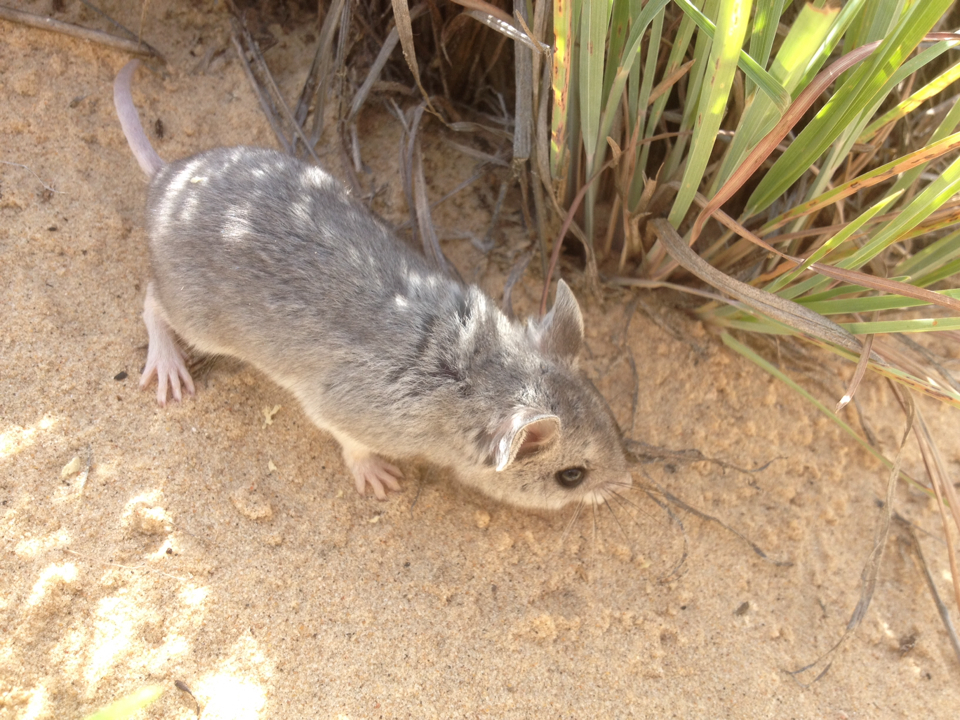
(c) Logan Ediger, some rights reserved (CC BY) · licence
Family: Cricetidae · Class: Mammalia · Order: Rodentia
Conservation status: G5T1T2 S1S2
Onychomys torridus tularensis (Tulare Grasshopper Mouse) is a California animal in the Cricetidae family.
The Tulare grasshopper mouse is a small rodent subspecies endemic to California's San Joaquin Valley. Adults typically measure 110 to 120 mm (4.3 to 4.7 inches) in total length, with the tail comprising approximately 40% of total body length. The species displays the characteristic stocky build of grasshopper mice, with short ears, small eyes, and powerful hindlimbs adapted for terrestrial locomotion. The dorsal pelage ranges from grayish-brown to cinnamon-brown, while the ventral surface is white to pale gray. The tail is distinctly bicolored, dark above and white below, with a white tip. Historically, the Tulare grasshopper mouse was distributed throughout the San Joaquin Valley floor and adjacent foothills. According to NatureServe, the subspecies remains restricted to the San Joaquin Valley but is widespread yet nowhere locally abundant. Current populations persist primarily in Fresno, Kern, Kings, and Tulare counties, with scattered records extending north to Merced and Stanislaus counties. The species has likely experienced range contraction from historical levels due to extensive agricultural conversion of native habitats. The subspecies occupies alkali desert scrub and desert scrub habitats, as documented by the California Department of Fish and Wildlife. These communities typically occur on valley floors and lower slopes, characterized by sparse shrub cover dominated by saltbush (Atriplex spp.), iodine bush (Allenrolfea occidentalis), and greasewood (Sarcobatus vermiculatus). The species shows preference for areas with well-drained soils and scattered shrub cover providing both foraging opportunities and escape cover. Elevation ranges from near sea level to approximately 500 meters (1,640 feet). Grasshopper mice are primarily insectivorous and carnivorous, distinguishing them from most other cricetid rodents. The diet consists primarily of arthropods including grasshoppers, beetles, moths, and scorpions, supplemented occasionally with seeds and green vegetation. The species exhibits nocturnal activity patterns and is known for its distinctive territorial howling behavior. Breeding occurs from spring through early fall, with females producing 2 to 6 young per litter. The gestation period is approximately 32 days, and females may produce multiple litters annually under favorable conditions. The Tulare grasshopper mouse is classified with a global rank of G5T1T2 and state rank of S1S2, indicating the subspecies is critically imperiled to imperiled in California. While the species is not federally listed, it is designated as a California Species of Special Concern, reflecting ongoing conservation concerns. Primary threats include habitat loss and fragmentation from agricultural conversion, urban development, and industrial activities. Approximately 95% of the San Joaquin Valley's native habitats have been converted to agriculture or urban uses, severely reducing available habitat. Additional threats include pesticide use in agricultural areas, which may reduce prey availability, and altered hydrology affecting soil chemistry in remaining alkali habitats. Climate change may exacerbate these pressures through increased temperatures and altered precipitation patterns affecting both habitat quality and prey abundance.
Classification
Class: Mammalia · Order: Rodentia · Family: Cricetidae
Conservation status
G5T1T2 S1S2
Frequently asked questions
How is Onychomys torridus tularensis classified?
Onychomys torridus tularensis belongs to class Mammalia, order Rodentia, family Cricetidae.
What family does Onychomys torridus tularensis belong to?
Onychomys torridus tularensis is in the Cricetidae family.
Is Onychomys torridus tularensis protected or of conservation concern?
Onychomys torridus tularensis carries the following status: G5T1T2 S1S2.
What is Onychomys torridus tularensis?
The Tulare grasshopper mouse is a small rodent subspecies endemic to California's San Joaquin Valley.
Is Onychomys torridus tularensis found in California?
Yes. Onychomys torridus tularensis is recorded in California in The California Species Project's catalogue.
Related species
Other California species in the same genus, family, or bioregion.
Data from The California Species Project — 14,000+ California species with verified data from CNPS, CDFW, USFWS, and more.