Onychoprion fuscatus
Sooty Tern
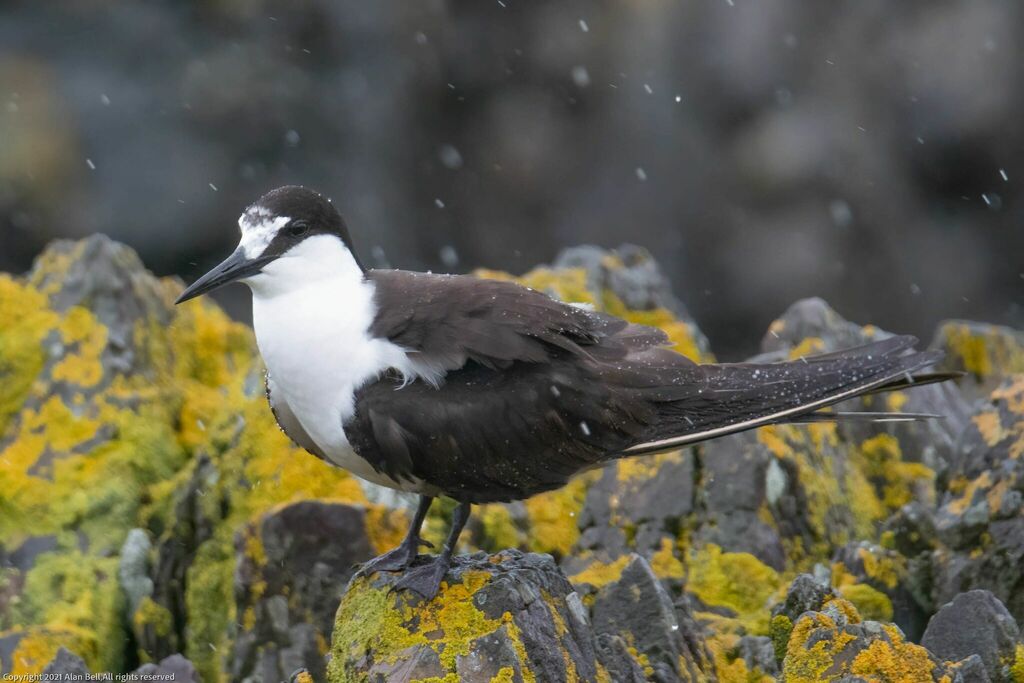
(c) Alan Bell, some rights reserved (CC BY) · licence
Family: Laridae · Class: Aves · Order: Charadriiformes
Onychoprion fuscatus (Sooty Tern) is a California animal in the Laridae family.
The Sooty Tern is a medium-sized seabird measuring 36 to 45 cm (14 to 18 inches) in length with a wingspan of 82 to 94 cm (32 to 37 inches). Adults weigh between 150 and 240 grams. The species exhibits distinct sexual dimorphism in size, with females typically larger than males. Adult breeding plumage features a black cap extending from the forehead to the nape, contrasting sharply with white underparts and forehead. The upperparts are dark sooty brown to black, giving the species its common name. The bill is black with a slight downward curve, and the legs are black. Juvenile birds display mottled brown and white plumage with pale scaling on the back and wings. The tail is deeply forked, and the wings are long and narrow, adapted for sustained flight over oceanic waters. Sooty Terns have a pantropical distribution, breeding on islands throughout the tropical and subtropical Atlantic, Pacific, and Indian Oceans. In California waters, the species occurs as a rare vagrant, typically observed during late summer and fall months when individuals may be displaced northward by tropical storms or follow warm water masses. Most California records come from offshore waters, particularly around the Channel Islands and along the continental shelf edge. The species has been documented from San Diego County north to Monterey County, with sightings concentrated between July and October. This species inhabits tropical and subtropical oceanic environments, rarely approaching continental shores except during breeding or when displaced by weather events. Sooty Terns are highly pelagic, spending most of their lives over deep oceanic waters where surface temperatures exceed 25°C (77°F). They prefer areas with active upwelling or convergence zones where prey concentrations are highest. Unlike many seabirds, Sooty Terns cannot dive underwater due to their light bone structure and minimal waterproofing, restricting them to surface feeding in areas where prey is accessible near the water's surface. Sooty Terns are highly gregarious, forming large feeding flocks that may number in the thousands. They feed primarily by surface dipping and contact dipping, capturing small fish, squid, and crustaceans from the upper water column. Primary prey species include flying fish, anchovies, sardines, and juvenile tuna. The species often associates with cetaceans, other seabirds, and feeding tuna schools that drive prey to the surface. Breeding occurs in dense colonies on tropical islands, with pairs producing a single spotted egg laid directly on sand or coral rubble. The breeding cycle extends over 8 to 12 months, and adults may remain at sea continuously for 3 to 10 years between breeding attempts. Sooty Terns are not federally listed under the Endangered Species Act, and their global population is considered stable with an estimated 21 to 25 million individuals worldwide. However, breeding colonies face threats from habitat loss, introduced predators, and climate change effects on prey availability. In California, the species remains a rare visitor with no established breeding populations, making conservation efforts focused primarily on protecting marine habitat quality and monitoring population trends in established breeding areas throughout their tropical range.
Classification
Class: Aves · Order: Charadriiformes · Family: Laridae
Frequently asked questions
How is Onychoprion fuscatus classified?
Onychoprion fuscatus belongs to class Aves, order Charadriiformes, family Laridae.
What family does Onychoprion fuscatus belong to?
Onychoprion fuscatus is in the Laridae family.
What is Onychoprion fuscatus?
The Sooty Tern is a medium-sized seabird measuring 36 to 45 cm (14 to 18 inches) in length with a wingspan of 82 to 94 cm (32 to 37 inches).
Is Onychoprion fuscatus found in California?
Yes. Onychoprion fuscatus is recorded in California in The California Species Project's catalogue.
Related species
Other California species in the same genus, family, or bioregion.
Data from The California Species Project — 14,000+ California species with verified data from CNPS, CDFW, USFWS, and more.