Ophionereis annulata
Banded Brittle Star
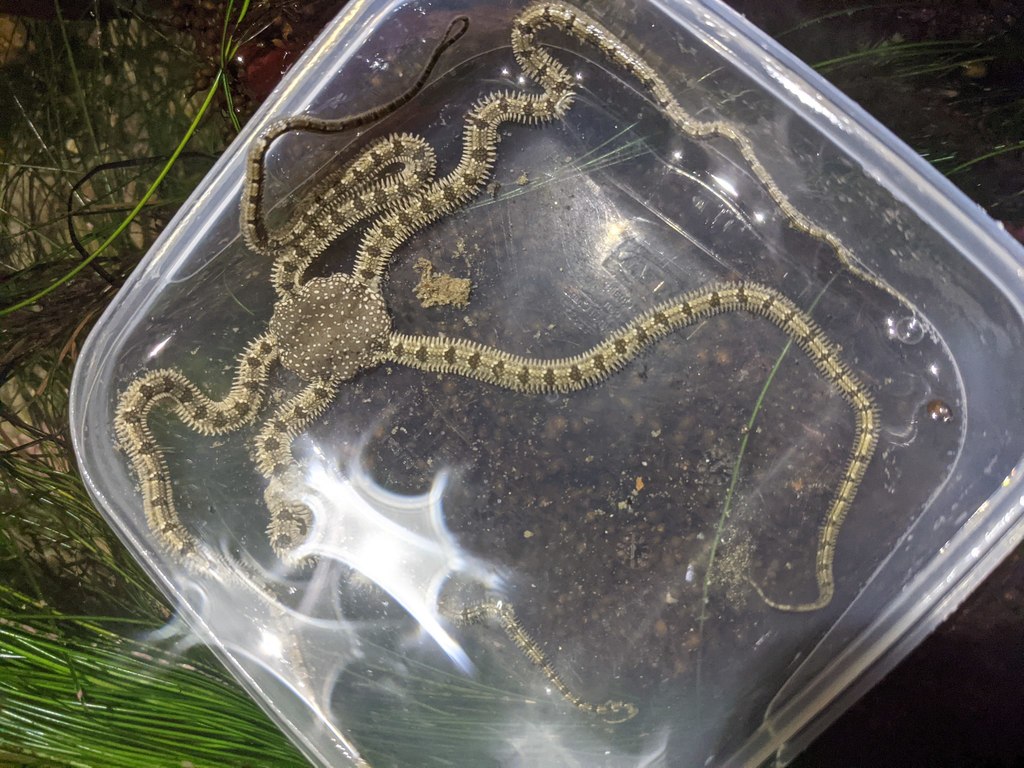
(c) Trevor Van Loon, some rights reserved (CC BY) · licence
Family: Ophionereididae · Class: Ophiuroidea · Order: Ophiurida
Ophionereis annulata (Banded Brittle Star) is a California animal in the Ophionereididae family.
The banded brittle star (Ophionereis annulata) is a marine echinoderm in the family Ophionereididae, characterized by its distinctive banded coloration pattern that gives the species its common name. This brittle star displays alternating light and dark bands across its five slender, flexible arms, which radiate from a central disc. The arms are capable of rapid, snake-like movements that distinguish brittle stars from their relatives, the sea stars. The central disc is typically small relative to arm length, and the entire animal exhibits the characteristic brittle star morphology with clearly demarcated arms and disc. Ophionereis annulata occurs along the Pacific coast, with documented populations in California waters. The species has been observed in Southern California locations including Point Vicente and La Jolla, based on recent iNaturalist observations and California Department of Fish and Wildlife marine protected area documentation. The species' range extends along the eastern Pacific, though specific distributional limits require further documentation. This brittle star inhabits rocky intertidal and subtidal environments, typically found among kelp forests, rocky reefs, and hard substrate habitats. According to California Department of Fish and Wildlife, the species occurs in areas with complex seafloor topography that provides shelter and foraging opportunities. The species is associated with tidepools and nearshore rocky environments where it can find refuge among coralline algae mats, seaweed, and rocky crevices. These habitats experience daily tidal fluctuations, requiring adaptations to varying water levels and wave action. Like other brittle stars, O. annulata is likely a deposit feeder and scavenger, using its flexible arms to capture organic particles and small prey items from the substrate and water column. The species exhibits typical ophiuroid feeding behavior, extending arms to collect food particles and transferring them to the central mouth. Reproduction follows the general brittle star pattern of broadcast spawning, with separate sexes releasing gametes into the water column for external fertilization. Development proceeds through a planktonic larval stage before settlement and metamorphosis to the adult form. The banded brittle star currently lacks formal conservation status designations at federal or state levels. Population trends and specific threats to the species have not been well documented in the scientific literature. As a component of rocky intertidal and kelp forest ecosystems, the species may be subject to threats affecting these habitats, including coastal development, water quality degradation, and climate change impacts on marine ecosystems. The presence of O. annulata in California's marine protected areas, including Point Vicente State Marine Conservation Area, provides some habitat protection. However, comprehensive population assessments and threat evaluations are needed to determine conservation needs for this species.
Classification
Class: Ophiuroidea · Order: Ophiurida · Family: Ophionereididae
Frequently asked questions
How is Ophionereis annulata classified?
Ophionereis annulata belongs to class Ophiuroidea, order Ophiurida, family Ophionereididae.
What family does Ophionereis annulata belong to?
Ophionereis annulata is in the Ophionereididae family.
What is Ophionereis annulata?
The banded brittle star (Ophionereis annulata) is a marine echinoderm in the family Ophionereididae, characterized by its distinctive banded coloration pattern that gives the species its common name.
Is Ophionereis annulata found in California?
Yes. Ophionereis annulata is recorded in California in The California Species Project's catalogue.
More California species
This species has no close relatives in our California data — here are other species to explore.
Data from The California Species Project — 14,000+ California species with verified data from CNPS, CDFW, USFWS, and more.