Oreoscoptes montanus
Sage Thrasher
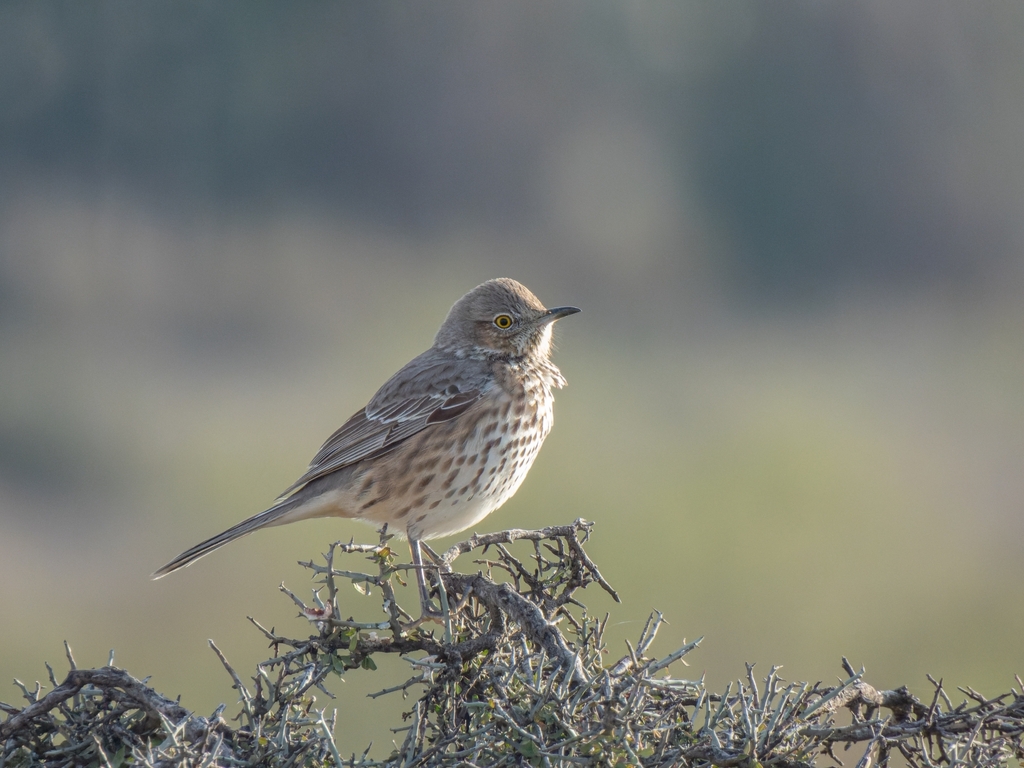
(c) Pedro Guevara, some rights reserved (CC BY) · licence
Family: Mimidae · Class: Aves · Order: Passeriformes
Oreoscoptes montanus (Sage Thrasher) is a California animal in the Mimidae family.
The Sage Thrasher is a medium-sized songbird measuring 20 to 23 centimeters (8 to 9 inches) in length with a wingspan of 28 to 32 centimeters (11 to 12.5 inches). Adults weigh approximately 40 to 50 grams (1.4 to 1.8 ounces). The upperparts are grayish-brown with subtle streaking, while the underparts are pale with distinct dark streaking across the breast and flanks. The species displays a relatively short, straight bill compared to other thrashers, and yellow eyes in adults. The tail is shorter and less graduated than in related thrasher species, with white corners visible in flight. Juveniles show similar plumage patterns but with less distinct streaking and darker eyes. The Sage Thrasher breeds across the western United States and southwestern Canada, with California populations concentrated in the northeastern counties including Modoc, Lassen, and Mono counties. The species extends into portions of Inyo and eastern Siskiyou counties. During winter, populations migrate south to desert regions of the southwestern United States and northwestern Mexico. California supports breeding populations at elevations ranging from 1,200 to 2,400 meters (4,000 to 8,000 feet), with some records extending to 3,000 meters (10,000 feet) in montane areas. The species inhabits sagebrush steppe ecosystems, showing strong association with big sagebrush (Artemisia tridentata) communities. Preferred breeding habitat includes areas with 20 to 50 percent shrub cover, particularly where sagebrush reaches 0.5 to 2 meters (1.6 to 6.5 feet) in height. The species also utilizes mixed shrublands containing bitterbrush, rabbitbrush, and juniper. During migration and winter, Sage Thrashers occupy desert scrub habitats including creosote bush and saltbush communities. Sage Thrashers are primarily insectivorous during the breeding season, consuming beetles, grasshoppers, caterpillars, and ants. Diet shifts to include berries and small fruits during fall and winter months. Males establish territories of 2 to 8 hectares (5 to 20 acres) and perform elaborate song flights from prominent perches. The breeding season extends from April through July, with peak nesting occurring in May and June. Females construct cup-shaped nests in dense shrub cover, typically 0.3 to 2 meters (1 to 6.5 feet) above ground. Clutches contain 3 to 5 pale blue eggs with brown spotting. Incubation lasts 13 to 17 days, and fledglings leave the nest after 11 to 14 days. Pairs may produce two broods per season under favorable conditions. The Sage Thrasher is not federally or state listed but faces significant conservation challenges. According to the North American Breeding Bird Survey, populations declined by approximately 2.1 percent annually between 1966 and 2019. Primary threats include sagebrush habitat conversion for agriculture, energy development, and urban expansion. Invasive annual grasses alter fire regimes, leading to increased wildfire frequency that eliminates mature sagebrush communities. Climate change threatens to shift suitable habitat ranges northward and to higher elevations. Conservation efforts focus on sagebrush ecosystem restoration and protection of large, intact habitat blocks essential for maintaining viable breeding populations.
Classification
Class: Aves · Order: Passeriformes · Family: Mimidae
Frequently asked questions
How is Oreoscoptes montanus classified?
Oreoscoptes montanus belongs to class Aves, order Passeriformes, family Mimidae.
What family does Oreoscoptes montanus belong to?
Oreoscoptes montanus is in the Mimidae family.
What is Oreoscoptes montanus?
The Sage Thrasher is a medium-sized songbird measuring 20 to 23 centimeters (8 to 9 inches) in length with a wingspan of 28 to 32 centimeters (11 to 12.5 inches).
Is Oreoscoptes montanus found in California?
Yes. Oreoscoptes montanus is recorded in California in The California Species Project's catalogue.
Related species
Other California species in the same genus, family, or bioregion.
Data from The California Species Project — 14,000+ California species with verified data from CNPS, CDFW, USFWS, and more.