Orgyia antiqua
Rusty Tussock Moth
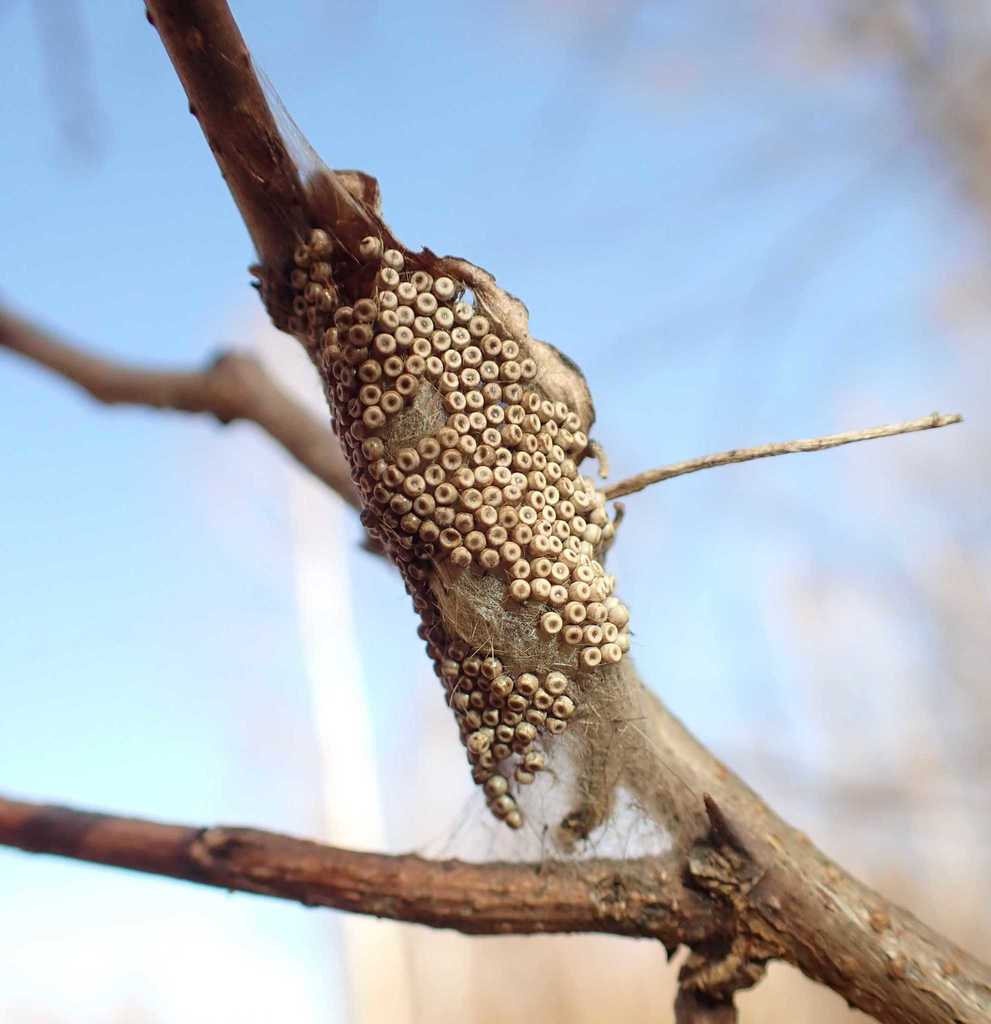
(c) Sascha Nunheim, some rights reserved (CC BY) · licence
Family: Erebidae · Class: Insecta · Order: Lepidoptera
Orgyia antiqua (Rusty Tussock Moth) is a California animal in the Erebidae family.
The rusty tussock moth (Orgyia antiqua) is a small to medium-sized moth in the family Erebidae, subfamily Lymantriinae. Adult males display distinctive feathery antennae and brownish forewings with darker markings, while females are wingless and pale yellow to gray in coloration (BugGuide 2025). Males typically measure 25-35 mm in wingspan, whereas flightless females are smaller and remain near their emergence sites. The species exhibits pronounced sexual dimorphism, with males capable of flight and females adapted for sedentary reproduction. Native to Europe, Orgyia antiqua has established populations throughout North America, Europe, and parts of Africa and Asia. In North America, the species was introduced from Europe and has become widely distributed across Canada and the United States, including California. The moth has been documented from Alaska, where it shows abundant populations in interior regions around Fairbanks (Lepidopterists' Society 2013), to various western states. Its broad distribution reflects the species' adaptability to diverse climatic conditions across multiple continents. Rusty tussock moths inhabit a wide range of environments, from urban areas to natural forests. The species thrives in deciduous and mixed woodlands, parks, gardens, and suburban landscapes where host plants are abundant. Adults are active primarily during late summer and fall months, with peak flight periods typically occurring from July through September. The species demonstrates significant habitat flexibility, successfully colonizing both disturbed and undisturbed environments. Larvae feed on numerous deciduous trees and shrubs, including willows (Salix species), poplars (Populus species), oaks (Quercus species), birches (Betula species), and various fruit trees (BugGuide 2025). Caterpillars are notable for their dense covering of tufted hairs, which serve as defense mechanisms against predators. The species typically produces one generation per year in northern regions, though warmer climates may support additional broods (Lepidopterists' Society 2012). Females deposit egg masses on bark or other surfaces near host plants, where eggs overwinter before hatching the following spring. Mating occurs through pheromone communication, with wingless females releasing chemical signals to attract flying males (BugGuide 2025). After mating, females remain stationary and lay clusters of eggs covered with protective foam and body hairs. Caterpillars undergo five to six instars before pupating in cocoons constructed from silk and larval hairs, typically attached to tree bark or hidden in leaf litter. As an introduced species, Orgyia antiqua is not afforded conservation protection and is considered naturalized across its North American range. The species occasionally reaches outbreak densities that can cause defoliation of host trees, though populations typically remain at manageable levels due to natural predators, parasites, and diseases (BugGuide 2025). Climate change may influence the species' distribution and voltinism patterns, potentially expanding its range further north as temperatures increase. The rusty tussock moth serves as an example of successful biological invasion, demonstrating how European lepidopteran species have established self-sustaining populations across North America through human-mediated dispersal.
Classification
Class: Insecta · Order: Lepidoptera · Family: Erebidae
Frequently asked questions
How is Orgyia antiqua classified?
Orgyia antiqua belongs to class Insecta, order Lepidoptera, family Erebidae.
What family does Orgyia antiqua belong to?
Orgyia antiqua is in the Erebidae family.
What is Orgyia antiqua?
The rusty tussock moth (Orgyia antiqua) is a small to medium-sized moth in the family Erebidae, subfamily Lymantriinae.
Is Orgyia antiqua found in California?
Yes. Orgyia antiqua is recorded in California in The California Species Project's catalogue.
Related species
Other California species in the same genus, family, or bioregion.
Data from The California Species Project — 14,000+ California species with verified data from CNPS, CDFW, USFWS, and more.