Orgyia pseudotsugata
Douglas-fir tussock moth
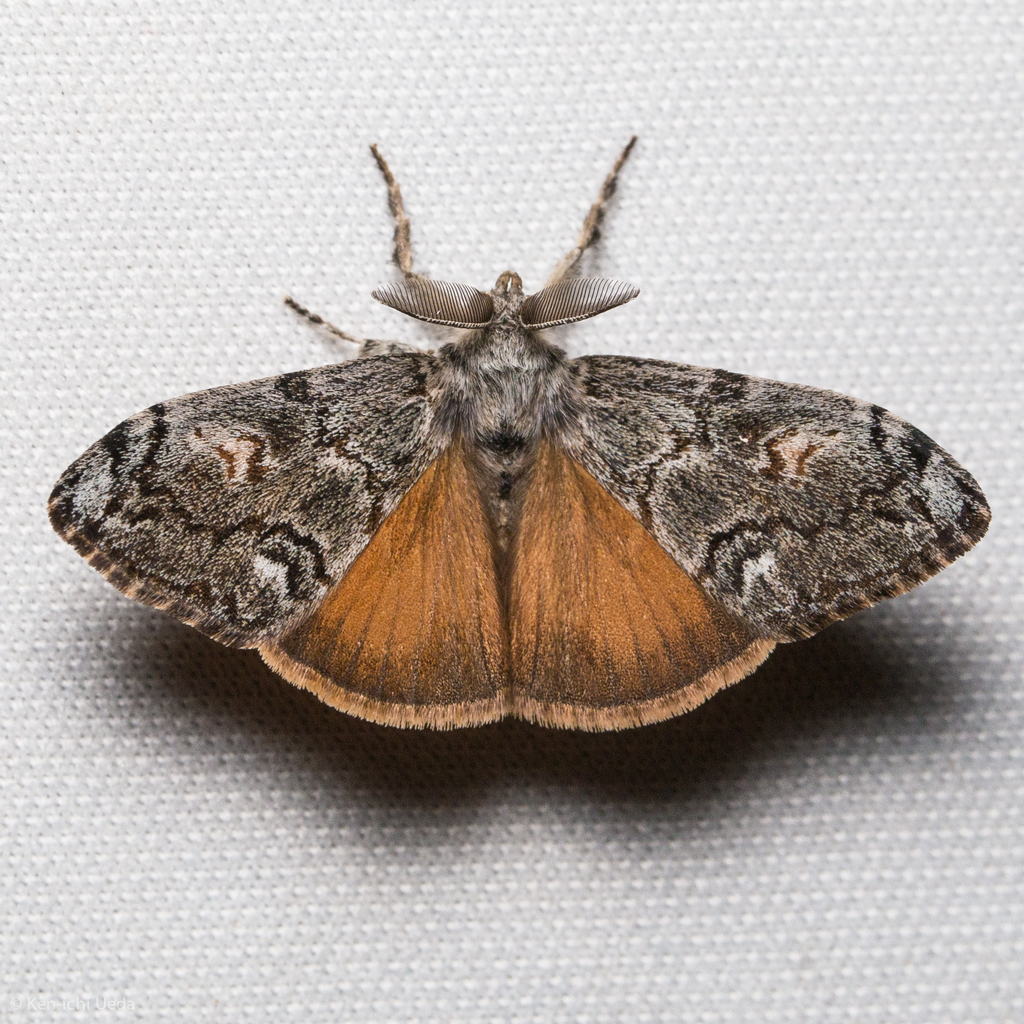
(c) Ken-ichi Ueda, some rights reserved (CC BY) · licence
Family: Erebidae · Class: Insecta · Order: Lepidoptera
Orgyia pseudotsugata (Douglas-fir tussock moth) is a California animal in the Erebidae family.
The Douglas-fir tussock moth is a medium-sized defoliating moth belonging to the family Erebidae. Adult males are brownish-gray with feathery antennae and a wingspan of approximately 25-35 mm. Females are larger but flightless, with vestigial wings and a robust, woolly body reaching 12-20 mm in length. The species is named for the distinctive tufted larvae, which display dense clusters of hairs (setae) including characteristic white and black tufts along the dorsal surface and longer pencil-like projections at the head and rear. The Douglas-fir tussock moth ranges from British Columbia south through the western United States to Colorado, Arizona, and southern California. In California, populations occur primarily in montane coniferous forests of the Sierra Nevada, Cascade Range, and scattered locations in southern California mountains. The species inhabits areas where suitable host trees are present, typically at elevations between 1,000 and 3,000 meters. This moth inhabits coniferous forests dominated by Douglas-fir (Pseudotsuga menziesii), white fir (Abies concolor), and grand fir (Abies grandis). Host trees also include other conifers such as western hemlock, western larch, and occasionally pine species. The species prefers mature forest stands but can establish populations in younger plantations and mixed-age forests. Larvae develop on needle foliage of host trees, with population densities varying dramatically based on environmental conditions. The Douglas-fir tussock moth exhibits cyclical population dynamics, with outbreak periods occurring approximately every 7-10 years. During non-outbreak years, populations remain at low, endemic levels. Females are flightless and mate near their emergence sites, laying egg masses on tree bark covered with protective scales and hairs from the female's abdomen. Eggs overwinter and hatch in spring when new foliage emerges. Larvae feed gregariously on needles, progressing through six instars over 6-8 weeks. Pupation occurs in cocoons attached to bark or other surfaces. Adults emerge in late summer, typically August through September. Larval feeding can cause significant defoliation during outbreak periods. Severe infestations may result in tree mortality, particularly when combined with other stressors such as drought or disease. The species serves as an important food source for various predators and parasitoids, including birds, spiders, and parasitic wasps that help regulate population levels. The Douglas-fir tussock moth is not federally or state listed as threatened or endangered. However, the species is considered a significant forest pest during outbreak years (NatureServe 2025). Climate change may affect outbreak patterns and geographic distribution, potentially altering host tree distribution and forest composition. Forest management practices, including timber harvesting and fire suppression, can influence habitat suitability and population dynamics. Monitoring programs track population levels to predict potential outbreaks and guide forest management decisions.
Classification
Class: Insecta · Order: Lepidoptera · Family: Erebidae
Frequently asked questions
How is Orgyia pseudotsugata classified?
Orgyia pseudotsugata belongs to class Insecta, order Lepidoptera, family Erebidae.
What family does Orgyia pseudotsugata belong to?
Orgyia pseudotsugata is in the Erebidae family.
What is Orgyia pseudotsugata?
The Douglas-fir tussock moth is a medium-sized defoliating moth belonging to the family Erebidae.
Is Orgyia pseudotsugata found in California?
Yes. Orgyia pseudotsugata is recorded in California in The California Species Project's catalogue.
Related species
Other California species in the same genus, family, or bioregion.
Data from The California Species Project — 14,000+ California species with verified data from CNPS, CDFW, USFWS, and more.