Orgyia vetusta
Western Tussock Moth
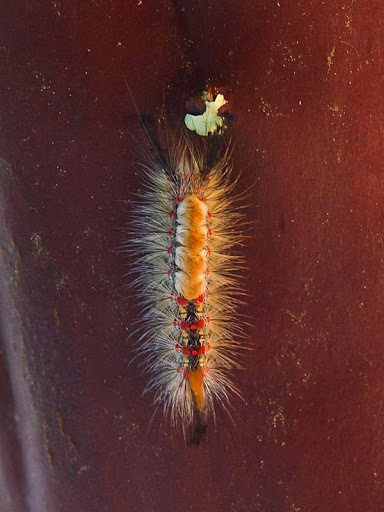
(c) folini, some rights reserved (CC BY) · licence
Family: Erebidae · Class: Insecta · Order: Lepidoptera
Orgyia vetusta (Western Tussock Moth) is a California animal in the Erebidae family.
The Western Tussock Moth is a medium-sized moth in the family Erebidae, with adults displaying distinct sexual dimorphism. Males have feathery antennae and fully developed wings with a wingspan of approximately 25-35 mm (1.0-1.4 inches). Their forewings are typically gray-brown with darker crossbands and white markings. Females are flightless with vestigial wings and a robust, woolly body covered in dense scales, measuring 15-20 mm (0.6-0.8 inches) in length. The species is most easily recognized in its larval stage, when caterpillars display characteristic tufts of hair (tussocks) along their dorsal surface, including distinctive black, white, and orange hair pencils. Orgyia vetusta is native to western North America, with populations distributed along the Pacific Coast from British Columbia south to Baja California. In California, the species occurs primarily in coastal and near-coastal regions, extending inland through the Central Valley and into foothill areas of the Sierra Nevada and Coast Ranges. The distribution encompasses elevations from sea level to approximately 1,500 meters (4,900 feet). The Western Tussock Moth inhabits a variety of habitats including coastal scrub, oak woodlands, riparian areas, and urban environments. Larvae feed on a wide range of deciduous trees and shrubs, with documented host plants including various species of oak (Quercus), willow (Salix), alder (Alnus), cherry (Prunus), and rose family plants (Rosaceae). The species also utilizes ornamental plants in landscaped areas, making it common in suburban settings. Adults emerge primarily in late summer and early fall, typically from August through October. Males are strong fliers and locate females through pheromone detection, while flightless females remain near their pupal sites to mate and lay eggs. After mating, females deposit 100-300 eggs in foam-like masses, often covering them with scales from their own bodies for protection. Eggs overwinter and hatch the following spring. Larvae undergo five to six instars over 6-8 weeks, pupating in cocoons constructed among host plant foliage or bark crevices. The species typically completes one generation per year in most locations. The Western Tussock Moth has no formal conservation listing and is considered secure throughout its range as of December 2025. Populations appear stable and the species demonstrates adaptability to human-modified environments. In some areas, particularly in urban settings with abundant ornamental plantings, the species can reach high densities. While occasionally considered a minor pest on ornamental trees and shrubs, significant defoliation events are rare. The species' broad host plant range and tolerance of various habitat types contribute to its population stability. Climate change may potentially affect distribution patterns, particularly at the southern extent of the range, but current populations show no signs of decline. The moth serves as a food source for various bird species, spiders, and other predators, contributing to local ecosystem food webs.
Classification
Class: Insecta · Order: Lepidoptera · Family: Erebidae
Frequently asked questions
How is Orgyia vetusta classified?
Orgyia vetusta belongs to class Insecta, order Lepidoptera, family Erebidae.
What family does Orgyia vetusta belong to?
Orgyia vetusta is in the Erebidae family.
What is Orgyia vetusta?
The Western Tussock Moth is a medium-sized moth in the family Erebidae, with adults displaying distinct sexual dimorphism.
Is Orgyia vetusta found in California?
Yes. Orgyia vetusta is recorded in California in The California Species Project's catalogue.
Related species
Other California species in the same genus, family, or bioregion.
Data from The California Species Project — 14,000+ California species with verified data from CNPS, CDFW, USFWS, and more.