Orobittacus obscurus
Gold Rush Hanging Scorpionfly
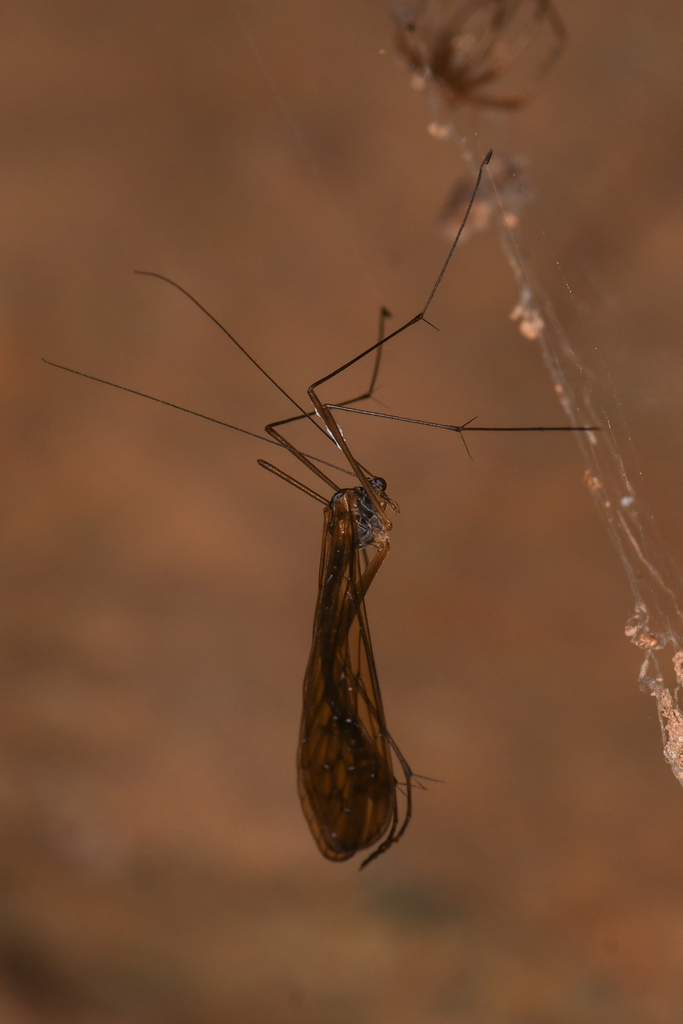
(c) Trevor Van Loon, some rights reserved (CC BY) · licence
Family: Bittacidae · Class: Insecta · Order: Mecoptera
Conservation status: G1 S1
Orobittacus obscurus (Gold Rush Hanging Scorpionfly) is a California animal in the Bittacidae family.
The Gold Rush Hanging Scorpionfly is a rare mecopteran insect endemic to California. Adults measure approximately 10-15 mm in body length, excluding appendages. Like other members of the family Bittacidae, this species exhibits distinctive raptorial hind legs adapted for grasping prey and hanging from vegetation. The wings are typically clear to lightly tinted with visible venation patterns characteristic of the order Mecoptera. Males possess enlarged genital structures typical of scorpionflies, while both sexes display elongated rostra used for feeding. This species has an extremely restricted distribution, found only in specific locations within California. The common name references the California Gold Rush era, though the species' historical range and current distribution patterns remain poorly documented in available literature. Current records suggest the species occurs in limited areas of the state, though comprehensive range mapping has not been completed. Habitat requirements for O. obscurus are not well documented in scientific literature. Based on the ecology of related Bittacidae species, the Gold Rush Hanging Scorpionfly likely inhabits areas with dense vegetation that provide structural support for its characteristic hanging behavior. Most hanging scorpionflies prefer woodland edges, shrublands, or areas with abundant understory vegetation where they can suspend themselves while hunting. Elevation preferences and specific microhabitat requirements have not been clearly established for this species. Like other members of Bittacidae, the Gold Rush Hanging Scorpionfly is presumed to be predatory, using its modified hind legs to capture small flying insects while suspended from vegetation. Adults likely feed on flies, small moths, and other soft-bodied arthropods. Reproductive behavior probably follows the typical mecopteran pattern, with males offering nuptial gifts to females during mating. Seasonal activity patterns, larval ecology, and specific prey preferences remain undocumented for this species. The Gold Rush Hanging Scorpionfly has been assigned a Global Conservation Status Rank of G1, indicating it is critically imperiled globally due to extreme rarity or very steep declines. The California state rank of S1 similarly reflects critical imperilment within the state. Despite these concerning conservation rankings, the species does not currently appear on federal or state endangered species lists. The primary threats to this species likely include habitat loss and fragmentation, though specific threat assessments have not been published. The extremely limited distribution makes the species particularly vulnerable to localized habitat disturbances. Conservation efforts are hindered by the lack of detailed ecological information and uncertainty about current population status and distribution. Scientific documentation for this species remains extremely limited despite its critical conservation status. Comprehensive studies of its biology, distribution, habitat requirements, and population status are urgently needed to guide conservation efforts. Enhanced survey work and taxonomic research would improve understanding of this rare California endemic.
Classification
Class: Insecta · Order: Mecoptera · Family: Bittacidae
Conservation status
G1 S1
Frequently asked questions
How is Orobittacus obscurus classified?
Orobittacus obscurus belongs to class Insecta, order Mecoptera, family Bittacidae.
What family does Orobittacus obscurus belong to?
Orobittacus obscurus is in the Bittacidae family.
Is Orobittacus obscurus protected or of conservation concern?
Orobittacus obscurus carries the following status: G1 S1.
What is Orobittacus obscurus?
The Gold Rush Hanging Scorpionfly is a rare mecopteran insect endemic to California.
Is Orobittacus obscurus found in California?
Yes. Orobittacus obscurus is recorded in California in The California Species Project's catalogue.
More California species
This species has no close relatives in our California data — here are other species to explore.
Data from The California Species Project — 14,000+ California species with verified data from CNPS, CDFW, USFWS, and more.