Orthemis ferruginea
Roseate Skimmer
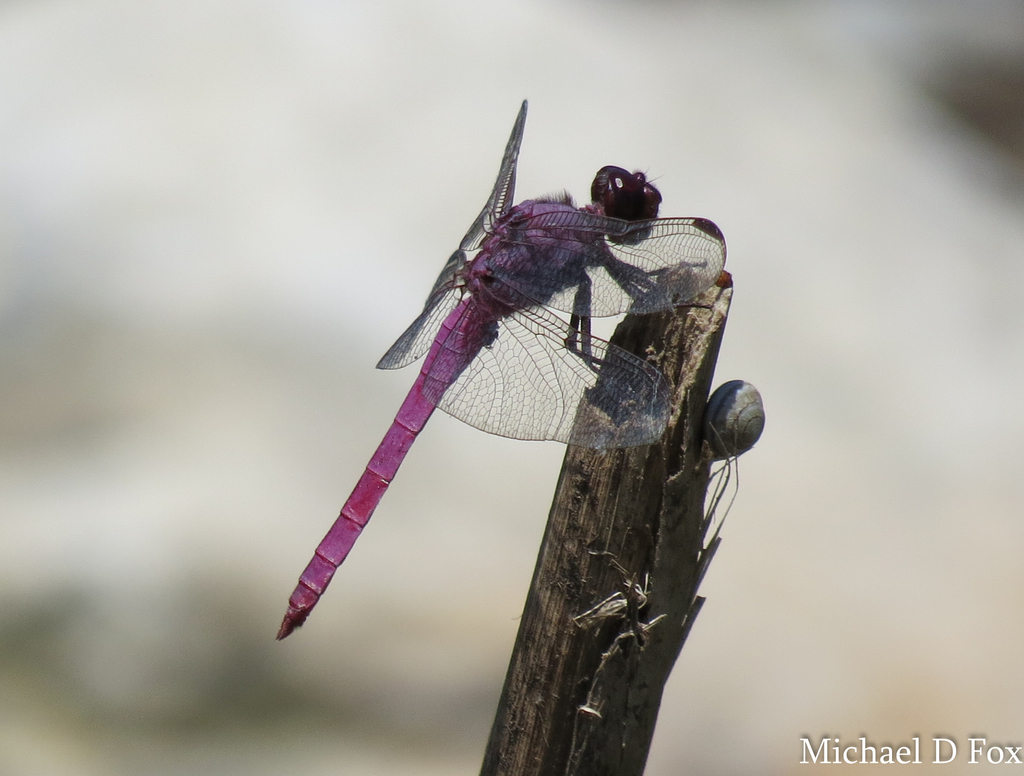
(c) Michael D Fox, some rights reserved (CC BY) · licence
Family: Libellulidae · Class: Insecta · Order: Odonata
Orthemis ferruginea (Roseate Skimmer) is a California animal in the Libellulidae family.
The Roseate Skimmer is a medium-sized dragonfly with a total length of 46 to 55 mm (1.8 to 2.2 inches). Males display distinctive coloration with a lavender-blue thorax and lavender-pink to rosy purple abdomen, complemented by a metallic purple face and dark purple-red eyes (BugGuide 2025). Females are markedly different, appearing yellow to golden brown. In flight, males can appear pink, magenta, or purple depending on lighting conditions, making them one of the most distinctive dragonflies in their range. The species occurs throughout much of the United States and extends into Central America. In North America, the Roseate Skimmer ranges from the southeastern United States westward to California and Arizona, and northward into parts of the central states. The species has also established populations in Hawaii, where it was first collected at Hale'iwa, Oahu, in 1977 and now appears to be established throughout the Hawaiian Archipelago (Hawaii Biological Survey). Roseate Skimmers inhabit a variety of aquatic environments, typically favoring still or slow-moving waters. They are commonly found around ponds, lakes, marshes, slow streams, and artificial water bodies such as retention ponds and stock tanks. The species shows a preference for open areas with emergent vegetation and muddy or sandy substrates. Adults are often observed perching on prominent vegetation near water, including cattails, rushes, and overhanging branches. This species exhibits typical libellulid behavior as a strong-flying predator. Adults are active hunters, capturing flying insects including mosquitoes, midges, small moths, and other soft-bodied prey. Males are territorial, establishing and defending perching sites near water where they intercept females and chase away competing males. Mating occurs through the typical dragonfly tandem position, with females ovipositing eggs by dipping their abdomen into the water surface or inserting eggs into submerged vegetation. The aquatic nymphs are predaceous, feeding on mosquito larvae, small aquatic invertebrates, and other prey items in the benthos. Reproduction typically occurs from spring through fall in warmer climates, with multiple generations possible in southern regions. In cooler areas, the species may have a single generation per year. Nymphal development requires several months to over a year depending on temperature and food availability. The Roseate Skimmer has no federal or state listing status and maintains a Global Status of G5 (secure) according to NatureServe (2025), indicating stable populations throughout its range. The species appears to be expanding its distribution in some areas and has successfully colonized new habitats, including artificial water bodies. Its adaptability to various aquatic habitats and tolerance of some habitat modification have contributed to its conservation security. However, like other aquatic insects, populations may be locally affected by water pollution, habitat loss, and pesticide use. The species' establishment in Hawaii demonstrates its dispersal capability and ecological adaptability, though impacts on native Hawaiian aquatic ecosystems have not been thoroughly documented.
Classification
Class: Insecta · Order: Odonata · Family: Libellulidae
Frequently asked questions
How is Orthemis ferruginea classified?
Orthemis ferruginea belongs to class Insecta, order Odonata, family Libellulidae.
What family does Orthemis ferruginea belong to?
Orthemis ferruginea is in the Libellulidae family.
What is Orthemis ferruginea?
The Roseate Skimmer is a medium-sized dragonfly with a total length of 46 to 55 mm (1.8 to 2.2 inches).
Is Orthemis ferruginea found in California?
Yes. Orthemis ferruginea is recorded in California in The California Species Project's catalogue.
Related species
Other California species in the same genus, family, or bioregion.
Data from The California Species Project — 14,000+ California species with verified data from CNPS, CDFW, USFWS, and more.