Orthops scutellatus
Carrot Plant Bug
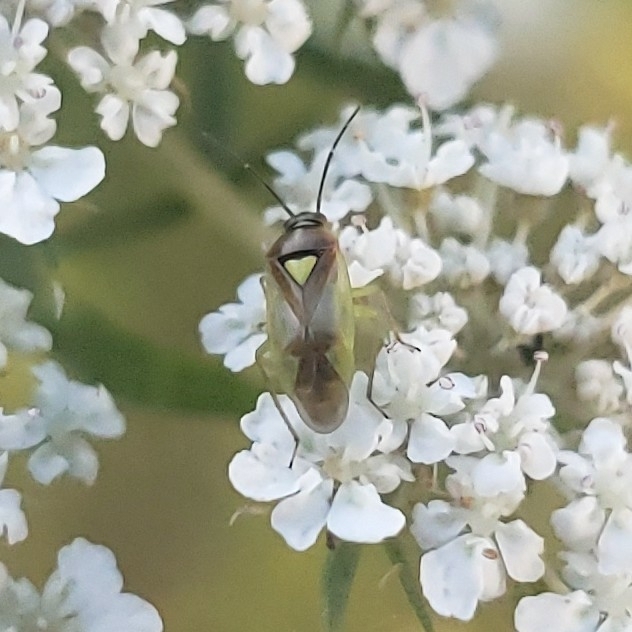
(c) Gavin Slater, some rights reserved (CC BY) · licence
Family: Miridae · Class: Insecta · Order: Hemiptera
Orthops scutellatus (Carrot Plant Bug) is a California animal in the Miridae family.
The carrot plant bug (Orthops scutellatus) is a true bug in the family Miridae, commonly known as plant bugs or leaf bugs. This species belongs to the order Hemiptera, characterized by piercing-sucking mouthparts and incomplete metamorphosis. Adult Orthops scutellatus are small, typically measuring 4-6 mm in length, with an elongated oval body shape characteristic of mirids. The species exhibits the typical mirid body plan with relatively long antennae, well-developed legs adapted for rapid movement, and forewings that are partially hardened at the base (hemielytra). The distribution of Orthops scutellatus extends across North America, though specific range data for California populations requires further documentation. According to NatureServe Explorer, the species occurs throughout much of the continental United States, but detailed distributional records within California counties are not well established (NatureServe 2025). The species appears to have a widespread but potentially scattered occurrence pattern typical of many specialized plant-feeding insects. Carrot plant bugs inhabit areas where their host plants in the family Apiaceae (carrot family) are present. This includes both natural habitats such as meadows, field margins, and disturbed areas where wild members of the carrot family grow, as well as agricultural settings where cultivated crops like carrots, celery, parsley, and fennel are grown. The species shows a strong association with umbelliferous plants, which provide both feeding sites and reproductive habitat. Adults and nymphs are typically found on the foliage and flower heads of these plants during the growing season. As a member of the Miridae, Orthops scutellatus feeds by inserting its needle-like stylets into plant tissues to extract fluids. The species primarily targets plants in the Apiaceae family, making it potentially significant in agricultural systems where these crops are grown. Like other plant bugs, this species undergoes incomplete metamorphosis with five nymphal instars before reaching adulthood. Reproductive activity typically occurs during the warmer months, with females depositing eggs in plant tissues. The species may produce multiple generations per year in favorable climates, though specific details of its life cycle timing in California have not been thoroughly documented. Currently, Orthops scutellatus does not appear on federal or state endangered species lists, and its conservation status has not been formally assessed by major conservation organizations. The species' association with both wild and cultivated members of the carrot family suggests it may benefit from diverse agricultural landscapes that maintain habitat connectivity between crop areas and natural plant communities. However, like many specialized herbivorous insects, populations could be vulnerable to intensive agricultural practices that eliminate non-crop host plants or rely heavily on broad-spectrum pesticides. The lack of comprehensive survey data for this species in California highlights the need for additional research to understand its current distribution, population trends, and ecological role within the state's diverse ecosystems. Detailed studies of its host plant relationships and seasonal activity patterns would improve understanding of its conservation needs and potential agricultural impacts.
Classification
Class: Insecta · Order: Hemiptera · Family: Miridae
Frequently asked questions
How is Orthops scutellatus classified?
Orthops scutellatus belongs to class Insecta, order Hemiptera, family Miridae.
What family does Orthops scutellatus belong to?
Orthops scutellatus is in the Miridae family.
What is Orthops scutellatus?
The carrot plant bug (Orthops scutellatus) is a true bug in the family Miridae, commonly known as plant bugs or leaf bugs.
Is Orthops scutellatus found in California?
Yes. Orthops scutellatus is recorded in California in The California Species Project's catalogue.
Related species
Other California species in the same genus, family, or bioregion.
Data from The California Species Project — 14,000+ California species with verified data from CNPS, CDFW, USFWS, and more.