Orthosia pacifica
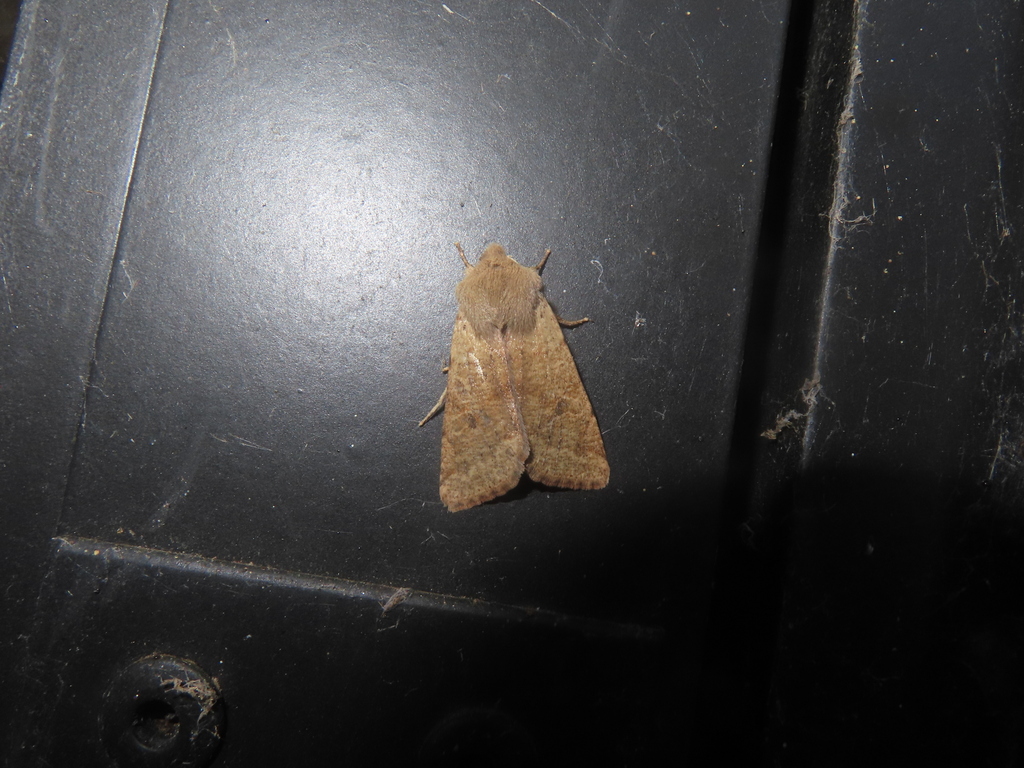
(c) Hawk T., some rights reserved (CC BY) · licence
Family: Noctuidae · Class: Insecta · Order: Lepidoptera
Orthosia pacifica is a California animal in the Noctuidae family.
Orthosia pacifica is a moth species in the family Noctuidae, belonging to the subfamily Hadeninae. This nocturnal lepidopteran is part of a genus commonly known as dagger moths or quaker moths, characterized by their relatively robust build and muted coloration patterns typical of many noctuid species. The adult moth displays the cryptic coloration characteristic of Orthosia species, with forewings typically measuring 15-20 mm in length. The forewings are generally brownish-gray to grayish-brown, marked with darker transverse lines and pale-bordered reniform and orbicular spots. The hindwings are lighter, often pale gray to whitish with darker marginal areas. Like other members of the genus, O. pacifica exhibits sexual dimorphism, with males possessing more feathered antennae compared to females and often displaying slightly smaller wing spans. The species' range appears to be restricted to western North America, with populations documented along the Pacific Coast. The specific epithet 'pacifica' suggests a strong association with Pacific coastal regions, though detailed distribution records remain limited in published literature. Current knowledge of the species' precise geographic boundaries requires further taxonomic and distributional research. Orthosia pacifica likely inhabits coastal forest and woodland environments typical of Pacific Northwest ecosystems. Members of this genus are generally associated with deciduous and mixed forests, where larvae feed on various broadleaf trees and shrubs. The species probably occurs in areas supporting native vegetation communities, including coastal scrub, oak woodlands, and mixed evergreen forests. Elevation preferences and specific microhabitat requirements have not been thoroughly documented. Adult flight periods for Orthosia species typically occur during late winter and early spring months, when temperatures begin to moderate and host plants begin leafing out. Males are attracted to artificial lights and pheromone sources during nocturnal activity periods. Larvae are likely polyphagous feeders on various deciduous woody plants, following the pattern observed in related Orthosia species. Development probably follows a typical noctuid life cycle, with eggs laid on or near host plants, larvae feeding during spring and early summer months, and pupation occurring in soil or leaf litter. The conservation status of Orthosia pacifica remains poorly understood due to limited distributional and ecological data. The species lacks formal conservation rankings at federal, state, or international levels, indicating either stable populations or insufficient survey data for assessment. Pacific coastal moth fauna face potential threats from habitat loss due to urban development, altered fire regimes, invasive plant species, and climate change impacts on coastal forest communities. Light pollution may also affect nocturnal behavior patterns and reproduction success. Comprehensive surveys and taxonomic research are needed to better understand the species' distribution, population trends, and conservation needs within its presumed range along the Pacific Coast.
Classification
Class: Insecta · Order: Lepidoptera · Family: Noctuidae
Frequently asked questions
How is Orthosia pacifica classified?
Orthosia pacifica belongs to class Insecta, order Lepidoptera, family Noctuidae.
What family does Orthosia pacifica belong to?
Orthosia pacifica is in the Noctuidae family.
What is Orthosia pacifica?
Orthosia pacifica is a moth species in the family Noctuidae, belonging to the subfamily Hadeninae.
Is Orthosia pacifica found in California?
Yes. Orthosia pacifica is recorded in California in The California Species Project's catalogue.
Related species
Other California species in the same genus, family, or bioregion.
Data from The California Species Project — 14,000+ California species with verified data from CNPS, CDFW, USFWS, and more.