Orthosia revicta
Subdued Quaker
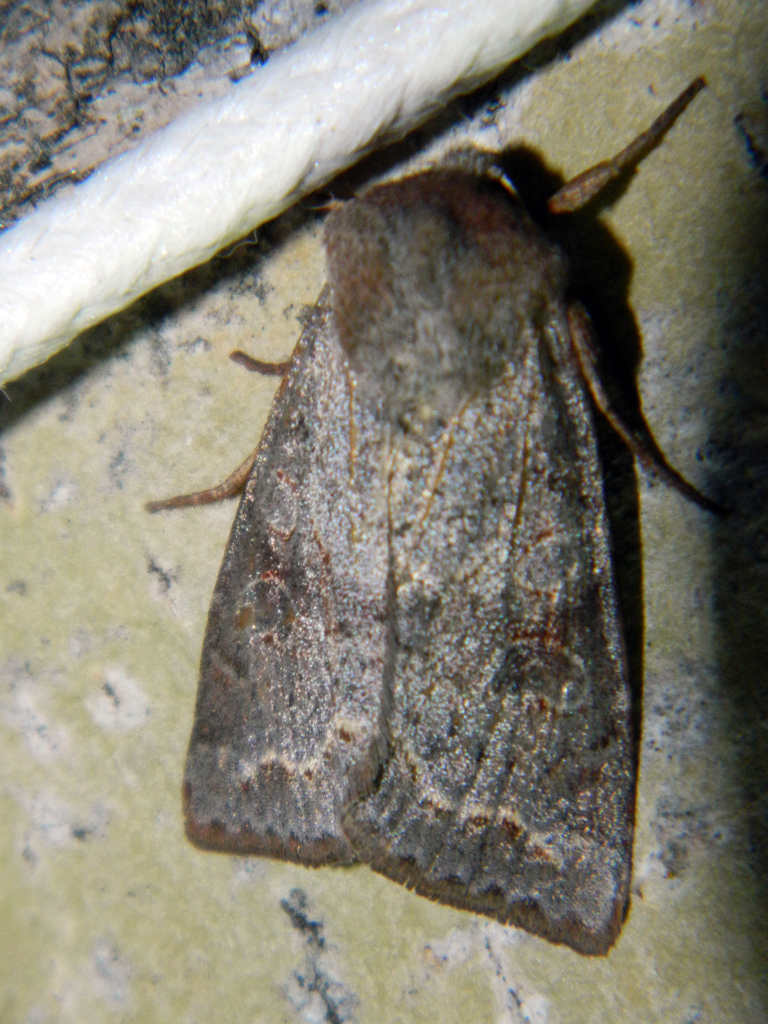
(c) Louis Imbeau, some rights reserved (CC BY) · licence
Family: Noctuidae · Class: Insecta · Order: Lepidoptera
Orthosia revicta (Subdued Quaker) is a California animal in the Noctuidae family.
The Subdued Quaker (Orthosia revicta) is a medium-sized moth in the family Noctuidae, also known as the rusty whitesided caterpillar. This species belongs to the cutworm or dart moth group, which are typically nocturnal moths with cryptic coloration patterns that provide camouflage during daytime resting periods. Orthosia revicta occurs across North America, with its range extending from Canada south through the United States. The species is found throughout much of the western United States, including California, where it has been documented in counties such as Napa and Los Angeles (Butterflies and Moths of North America). According to BugGuide, the range extends south to Colorado in the Rocky Mountains, and the southern extent along the Pacific Coast may reach northern California, though specific records exist from southern California locations. The habitat preferences of the Subdued Quaker have not been extensively documented in available literature. As a member of the Noctuidae family, this species likely inhabits areas that support its larval host plants, though specific host plant relationships have not been well established in current references. Many Orthosia species are associated with deciduous trees and shrubs, particularly during their larval stage when caterpillars feed on foliage. Like other members of the genus Orthosia, this species likely follows a typical noctuid life cycle with egg, larval, pupal, and adult stages. The common name "rusty whitesided caterpillar" suggests that the larval stage exhibits distinctive coloration patterns. Adult moths are presumably active during nighttime hours, as is characteristic of most Noctuidae species. The seasonal timing of adult flight periods and specific reproductive behaviors have not been well documented in available scientific literature. The conservation status of Orthosia revicta has not been formally assessed by major conservation organizations. The species does not appear on federal or state endangered species lists, and no specific conservation concerns have been identified in current literature. According to NatureServe Explorer, the species has been cataloged but lacks detailed conservation status information. The apparent wide distribution across North America suggests the species may be relatively stable, though population trends and specific threats have not been systematically studied. Scientific documentation for this species remains limited compared to more extensively studied moths. The information presented here is based on available sources including taxonomic databases, citizen science observations, and regional moth inventories. If you have additional verified information about this species' biology, distribution, or ecology, please contact us to help improve this species account.
Classification
Class: Insecta · Order: Lepidoptera · Family: Noctuidae
Frequently asked questions
How is Orthosia revicta classified?
Orthosia revicta belongs to class Insecta, order Lepidoptera, family Noctuidae.
What family does Orthosia revicta belong to?
Orthosia revicta is in the Noctuidae family.
What is Orthosia revicta?
The Subdued Quaker (Orthosia revicta) is a medium-sized moth in the family Noctuidae, also known as the rusty whitesided caterpillar.
Is Orthosia revicta found in California?
Yes. Orthosia revicta is recorded in California in The California Species Project's catalogue.
Related species
Other California species in the same genus, family, or bioregion.
Data from The California Species Project — 14,000+ California species with verified data from CNPS, CDFW, USFWS, and more.