Oryctolagus cuniculus
European Rabbit
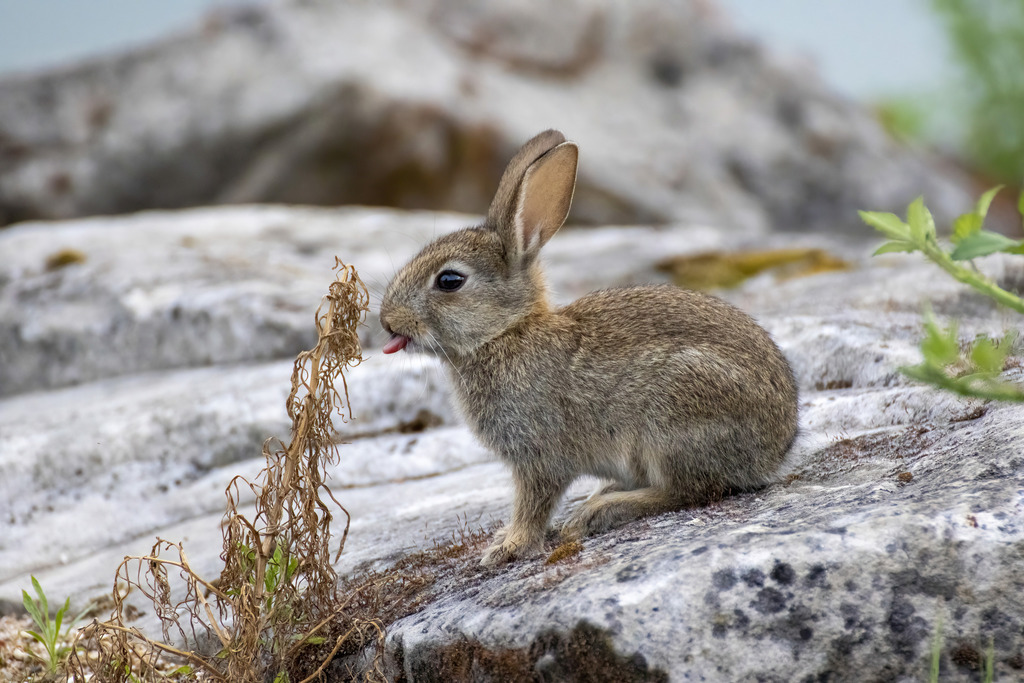
(c) Alexis Lours, some rights reserved (CC BY) · licence
Family: Leporidae · Class: Mammalia · Order: Lagomorpha
Oryctolagus cuniculus (European Rabbit) is a California animal in the Leporidae family.
The European rabbit is a medium-sized lagomorph measuring 34 to 45 centimeters (13 to 18 inches) in body length, with ears reaching 6 to 7 centimeters (2.4 to 2.8 inches) long. Adults typically weigh 1.2 to 2.5 kilograms (2.6 to 5.5 pounds). The species displays a grayish-brown dorsal pelage with a reddish-brown nape patch and white underparts. The tail measures 4 to 7 centimeters with a distinctive black upper surface and white underside. European rabbits can be distinguished from native cottontails by their longer ears, larger size, and different tail coloration patterns. Originally native to the Iberian Peninsula and southern France, European rabbits were introduced to California in the mid-1800s and have established populations throughout much of the state. Current populations occur primarily in coastal and central valley regions, with documented occurrences in Los Angeles, Orange, Riverside, San Bernardino, Ventura, Santa Barbara, San Luis Obispo, Monterey, and Santa Clara counties. The species has also been reported in portions of the Central Valley and some foothill areas. European rabbits inhabit a variety of habitats including grasslands, agricultural areas, urban parks, golf courses, and scrublands. They prefer areas with soft, well-drained soils suitable for burrow construction, typically at elevations below 1,000 meters (3,280 feet). The species constructs extensive warren systems with multiple entrances and interconnected tunnels extending up to 3 meters (10 feet) deep. These burrow complexes provide shelter and breeding sites for family groups. European rabbits are primarily crepuscular, exhibiting peak activity during dawn and dusk hours. Their diet consists of grasses, herbs, bark, and agricultural crops. Breeding occurs year-round in California's mild climate, with females producing 3 to 5 litters annually. Gestation lasts 31 to 32 days, resulting in litters of 3 to 8 kits. Females construct fur-lined nests in shallow burrows separate from the main warren. Kits are born altricial and remain in the nest for approximately 3 weeks. Sexual maturity is reached at 3 to 4 months of age. As an introduced species in California, European rabbits are not afforded conservation protection and are considered an invasive species in many contexts. According to the California Department of Food and Agriculture, populations can cause significant agricultural damage through crop consumption and bark stripping of young trees and vines. The species competes with native wildlife for resources and habitat. Management efforts focus on population control through trapping, exclusion fencing, and habitat modification. In urban areas, populations are often maintained through supplemental feeding and reduced predation pressure, leading to localized overabundance issues that require active management intervention.
Classification
Class: Mammalia · Order: Lagomorpha · Family: Leporidae
Frequently asked questions
How is Oryctolagus cuniculus classified?
Oryctolagus cuniculus belongs to class Mammalia, order Lagomorpha, family Leporidae.
What family does Oryctolagus cuniculus belong to?
Oryctolagus cuniculus is in the Leporidae family.
What is Oryctolagus cuniculus?
The European rabbit is a medium-sized lagomorph measuring 34 to 45 centimeters (13 to 18 inches) in body length, with ears reaching 6 to 7 centimeters (2.4 to 2.8 inches) long.
Is Oryctolagus cuniculus found in California?
Yes. Oryctolagus cuniculus is recorded in California in The California Species Project's catalogue.
Related species
Other California species in the same genus, family, or bioregion.
Data from The California Species Project — 14,000+ California species with verified data from CNPS, CDFW, USFWS, and more.