Ovis canadensis sierrae
Sierra Nevada bighorn sheep
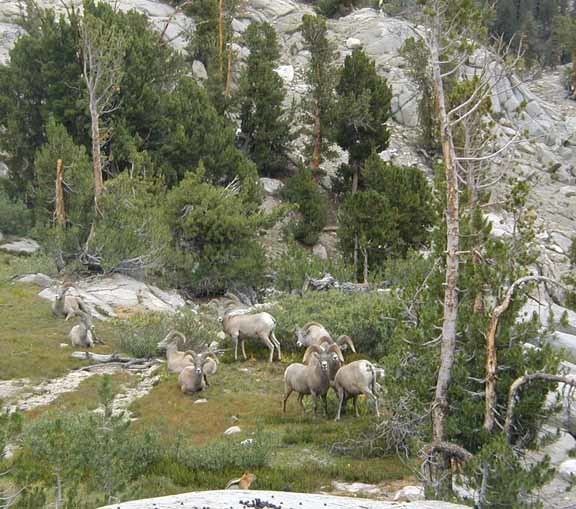
(c) gdurkee, some rights reserved (CC BY) · licence
Family: Bovidae · Class: Mammalia · Order: Artiodactyla
Conservation status: SE ST · Endangered · G4T2 S2
Ovis canadensis sierrae (Sierra Nevada bighorn sheep) is a California animal in the Bovidae family.
The Sierra Nevada bighorn sheep is a large ungulate endemic to the high country of the Sierra Nevada mountain range. Adults weigh 75 to 130 kg (165 to 285 pounds), with rams significantly larger than ewes. The species exhibits considerable color variation, ranging from nearly white to dark brown, with characteristic white markings on the belly, rump patch, back of legs, muzzle, and around the eyes. Both sexes possess permanent horns, though sexual dimorphism is pronounced: rams develop massive, curved horns that spiral backward over the ears, while ewes have slender, sabre-like horns that never exceed half a curl. Historically, Sierra Nevada bighorn sheep ranged throughout the high elevations of the Sierra Nevada from Lake Tahoe south to Olancha Peak. The current population is fragmented into approximately 14 separate herds distributed across the eastern escarpment of the Sierra Nevada in California and Nevada. Major population centers include the Mount Baxter, Mount Williamson, Mount Langley, and Olancha Peak areas, with smaller populations in the Sawmill Canyon and other locations. The species occupies precipitous rocky terrain at elevations ranging from 2,400 to 4,300 meters (8,000 to 14,000 feet). Summer range typically occurs at high elevations between 3,000 to 4,300 meters (10,000 to 14,000 feet), where animals access alpine vegetation including sedges, grasses, and forbs. Winter range is located at lower elevations where wind-blown slopes provide access to forage when snow covers higher terrain. Critical habitat characteristics include steep rocky escape terrain for predator evasion and open areas that provide long sight lines for predator detection. Sierra Nevada bighorn sheep are gregarious, forming gender-segregated groups outside the breeding season. Ewes and young form nursery groups, while rams typically associate in bachelor herds. Breeding occurs from November through January, with ewes giving birth to single lambs after a gestation period of approximately 175 days. The species exhibits strong site fidelity, with seasonal migrations between summer and winter ranges following traditional routes. Their specialized anatomy, including short legs and a stocky build, provides exceptional agility on rocky terrain but limits mobility in less precipitous landscapes. The U.S. Fish and Wildlife Service listed the Sierra Nevada bighorn sheep as endangered on January 3, 2000, following an emergency listing in April 1999. The population reached a critical low of approximately 100 individuals in 1995 but has recovered to an estimated 400 animals as of recent surveys (CDFW). Primary threats include habitat loss, predation by mountain lions, disease transmission from domestic livestock, and climate change impacts on alpine ecosystems. According to the California Department of Fish and Wildlife, the species was historically listed as California bighorn sheep (Ovis canadensis californiana) but taxonomic revision established it as the distinct subspecies O. c. sierrae. Recovery efforts include population monitoring, predator management, habitat restoration, and translocation programs to establish new herds and enhance genetic diversity.
Classification
Class: Mammalia · Order: Artiodactyla · Family: Bovidae
Conservation status
SE ST · Endangered · G4T2 S2
Frequently asked questions
How is Ovis canadensis sierrae classified?
Ovis canadensis sierrae belongs to class Mammalia, order Artiodactyla, family Bovidae.
What family does Ovis canadensis sierrae belong to?
Ovis canadensis sierrae is in the Bovidae family.
Is Ovis canadensis sierrae protected or of conservation concern?
Ovis canadensis sierrae carries the following status: SE ST · Endangered · G4T2 S2.
What is Ovis canadensis sierrae?
The Sierra Nevada bighorn sheep is a large ungulate endemic to the high country of the Sierra Nevada mountain range.
Is Ovis canadensis sierrae found in California?
Yes. Ovis canadensis sierrae is recorded in California in The California Species Project's catalogue.
Related species
Other California species in the same genus, family, or bioregion.
Data from The California Species Project — 14,000+ California species with verified data from CNPS, CDFW, USFWS, and more.