Oxidus gracilis
Greenhouse Millipede
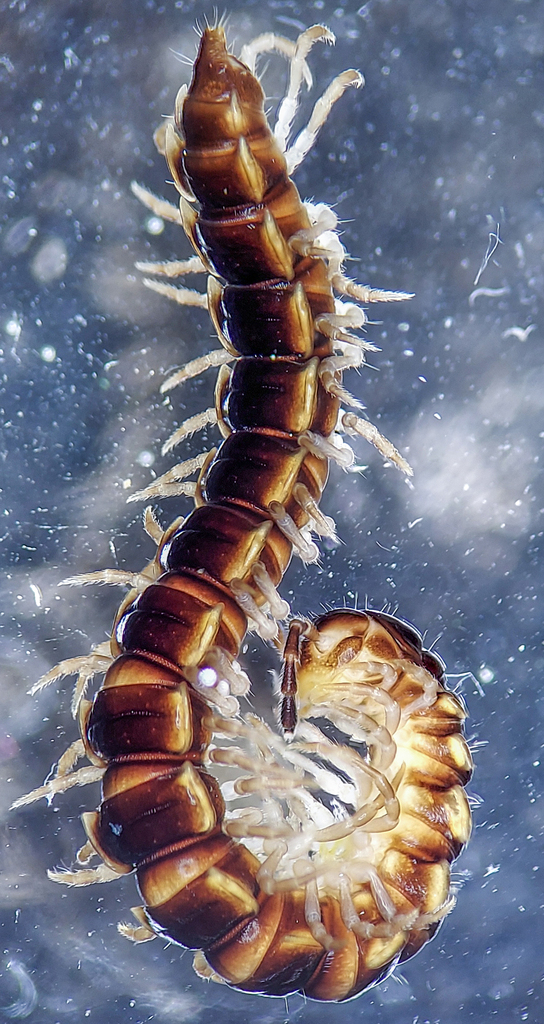
(c) Derek Hennen, some rights reserved (CC BY) · licence
Family: Paradoxosomatidae · Class: Diplopoda · Order: Polydesmida
Oxidus gracilis (Greenhouse Millipede) is a California animal in the Paradoxosomatidae family.
The greenhouse millipede is a small, elongated arthropod in the family Paradoxosomatidae, characterized by its segmented body and numerous paired legs. Adults typically measure 18 to 25 millimeters (0.7 to 1.0 inches) in length, with a slender, cylindrical form that tapers slightly toward the posterior end. The body is brown to grayish-brown in coloration, often with lighter longitudinal stripes running along the dorsal surface. Each body segment bears two pairs of legs, giving the appearance of four legs per segment, which distinguishes millipedes from centipedes that have one pair per segment. The species has relatively short antennae and lacks eyes, adaptations consistent with its preference for dark, humid environments. Originally native to Asia, Oxidus gracilis has become widely distributed as an introduced species throughout temperate and subtropical regions worldwide. In North America, populations are established across much of the United States, including California, where the species occurs in both urban and natural environments. The species has also colonized parts of Europe, Australia, and other continents through human transport activities. Its current global distribution reflects its ability to survive in diverse climatic conditions and its association with human-modified habitats. Greenhouse millipedes inhabit moist environments rich in organic matter, including greenhouse facilities, gardens, compost piles, leaf litter, and rotting wood. The species thrives in areas with high humidity and temperatures between 15 to 25 degrees Celsius (59 to 77 degrees Fahrenheit). In natural settings, individuals are commonly found under logs, stones, and bark, as well as in soil layers with substantial organic content. Urban populations frequently occur in basements, crawl spaces, and other damp indoor locations. The species requires consistent moisture and will rapidly desiccate in dry conditions. As detritivores, greenhouse millipedes feed primarily on decomposing organic matter, including fallen leaves, rotting wood, fungi, and other plant debris. Their feeding activity contributes to nutrient cycling and soil formation in both natural and managed ecosystems. Reproduction occurs through sexual mating, with females depositing eggs in soil or organic substrate. Development includes several molts as juveniles progress through multiple instars before reaching sexual maturity. The species exhibits limited dispersal ability, with adults moving slowly through substrate using their numerous legs in coordinated waves. Oxidus gracilis is classified with a global conservation status of G5 by NatureServe, indicating the species is secure and widespread (NatureServe 2025). As an introduced species in most of its current range, it faces no significant conservation concerns and is not listed under any federal or state endangered species legislation. The species' ability to colonize diverse habitats and its association with human activities suggest populations will likely remain stable. In some contexts, the greenhouse millipede is considered a minor agricultural or horticultural pest when populations become numerous in greenhouse facilities or gardens, though it rarely causes significant economic damage.
Classification
Class: Diplopoda · Order: Polydesmida · Family: Paradoxosomatidae
Frequently asked questions
How is Oxidus gracilis classified?
Oxidus gracilis belongs to class Diplopoda, order Polydesmida, family Paradoxosomatidae.
What family does Oxidus gracilis belong to?
Oxidus gracilis is in the Paradoxosomatidae family.
What is Oxidus gracilis?
The greenhouse millipede is a small, elongated arthropod in the family Paradoxosomatidae, characterized by its segmented body and numerous paired legs.
Is Oxidus gracilis found in California?
Yes. Oxidus gracilis is recorded in California in The California Species Project's catalogue.
More California species
This species has no close relatives in our California data — here are other species to explore.
Data from The California Species Project — 14,000+ California species with verified data from CNPS, CDFW, USFWS, and more.