Oxylebius pictus
Painted Greenling
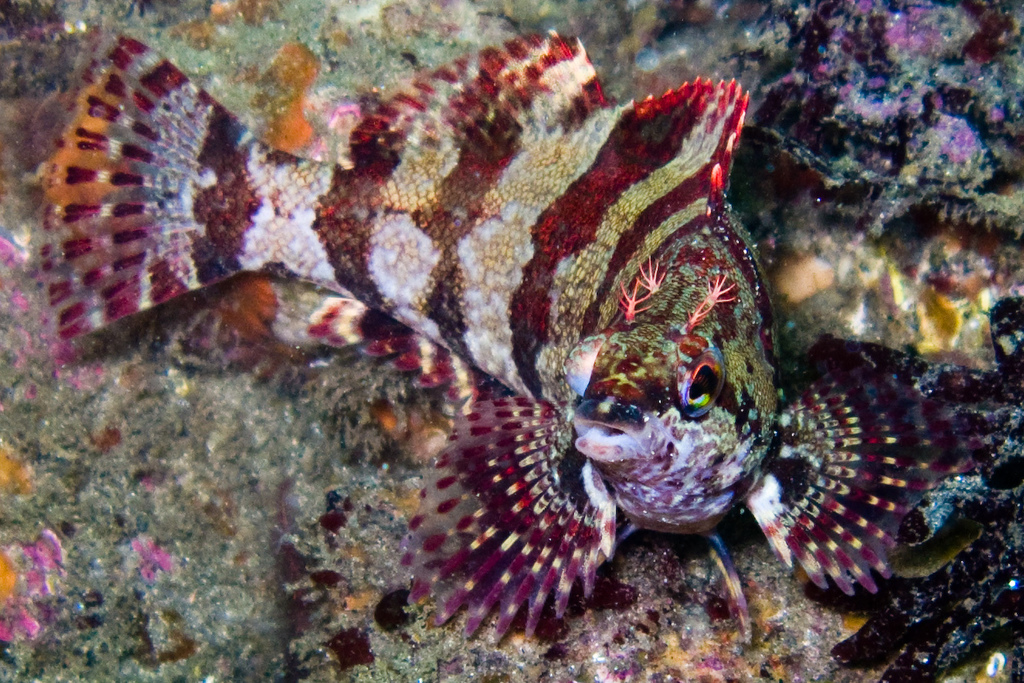
(c) Ken-ichi Ueda, some rights reserved (CC BY) · licence
Family: Hexagrammidae · Class: Teleostei · Order: Scorpaeniformes
Oxylebius pictus (Painted Greenling) is a California animal in the Hexagrammidae family.
The painted greenling is a small marine fish in the family Hexagrammidae, reaching maximum lengths of approximately 25 cm (10 inches). The species exhibits distinctive sexual dimorphism in coloration. Males display bright orange to reddish-brown bodies with five to seven dark vertical bars and blue-green bands along the head and anterior portion of the body. Females are more subdued, typically brownish with mottled patterns and less pronounced banding. Both sexes have large pectoral fins and a single dorsal fin with a distinctive notch between the spiny and soft-rayed portions. Painted greenling occur along the Pacific coast from southeastern Alaska to Baja California, Mexico. In California waters, the species is distributed from the Oregon border south to Point Conception, with populations documented in rocky reef habitats throughout the north-central coast. According to California Department of Fish and Wildlife monitoring data, painted greenling are particularly abundant in areas such as Monterey Bay and the greater San Francisco Bay region. The species inhabits rocky intertidal and subtidal zones from the low tide line to depths of approximately 49 meters (160 feet). Painted greenling show strong site fidelity to rocky reef structures, crevices, and kelp forest environments. They are commonly found among algae-covered rocks and in tidepools during low tide. Adults prefer areas with complex topography that provide shelter and foraging opportunities, while juveniles often occupy shallower tidepools and surge channels. Painted greenling are carnivorous, feeding primarily on small invertebrates including amphipods, isopods, polychaete worms, and small mollusks. The species exhibits territorial behavior, with males establishing and defending breeding territories during the reproductive season. Spawning occurs from late fall through early spring, typically between November and March. Males construct and guard nests in rocky crevices or under ledges, where females deposit clusters of adhesive eggs. The male provides parental care by guarding the nest until the eggs hatch after approximately 30 to 45 days, depending on water temperature. The species demonstrates strong philopatric behavior, with individuals often returning to the same general area after brief foraging excursions. Painted greenling are long-lived for their size, with maximum reported ages of approximately 12 years. Growth rates vary with latitude, with northern populations generally growing more slowly but reaching larger maximum sizes than southern populations. Painted greenling are not federally or state listed as threatened or endangered. The species is considered stable throughout most of its range, though local populations may be affected by habitat degradation, pollution, and fishing pressure. They are occasionally taken as bycatch in recreational fisheries targeting other nearshore species. Climate change impacts, including ocean acidification and rising water temperatures, may affect future population dynamics by altering prey availability and suitable habitat distribution. The species benefits from marine protected areas along the California coast, which provide refugia for breeding populations and help maintain genetic connectivity between local populations.
Classification
Class: Teleostei · Order: Scorpaeniformes · Family: Hexagrammidae
Frequently asked questions
How is Oxylebius pictus classified?
Oxylebius pictus belongs to class Teleostei, order Scorpaeniformes, family Hexagrammidae.
What family does Oxylebius pictus belong to?
Oxylebius pictus is in the Hexagrammidae family.
What is Oxylebius pictus?
The painted greenling is a small marine fish in the family Hexagrammidae, reaching maximum lengths of approximately 25 cm (10 inches).
Is Oxylebius pictus found in California?
Yes. Oxylebius pictus is recorded in California in The California Species Project's catalogue.
Related species
Other California species in the same genus, family, or bioregion.
Data from The California Species Project — 14,000+ California species with verified data from CNPS, CDFW, USFWS, and more.