Oxyopes scalaris
Western Lynx Spider
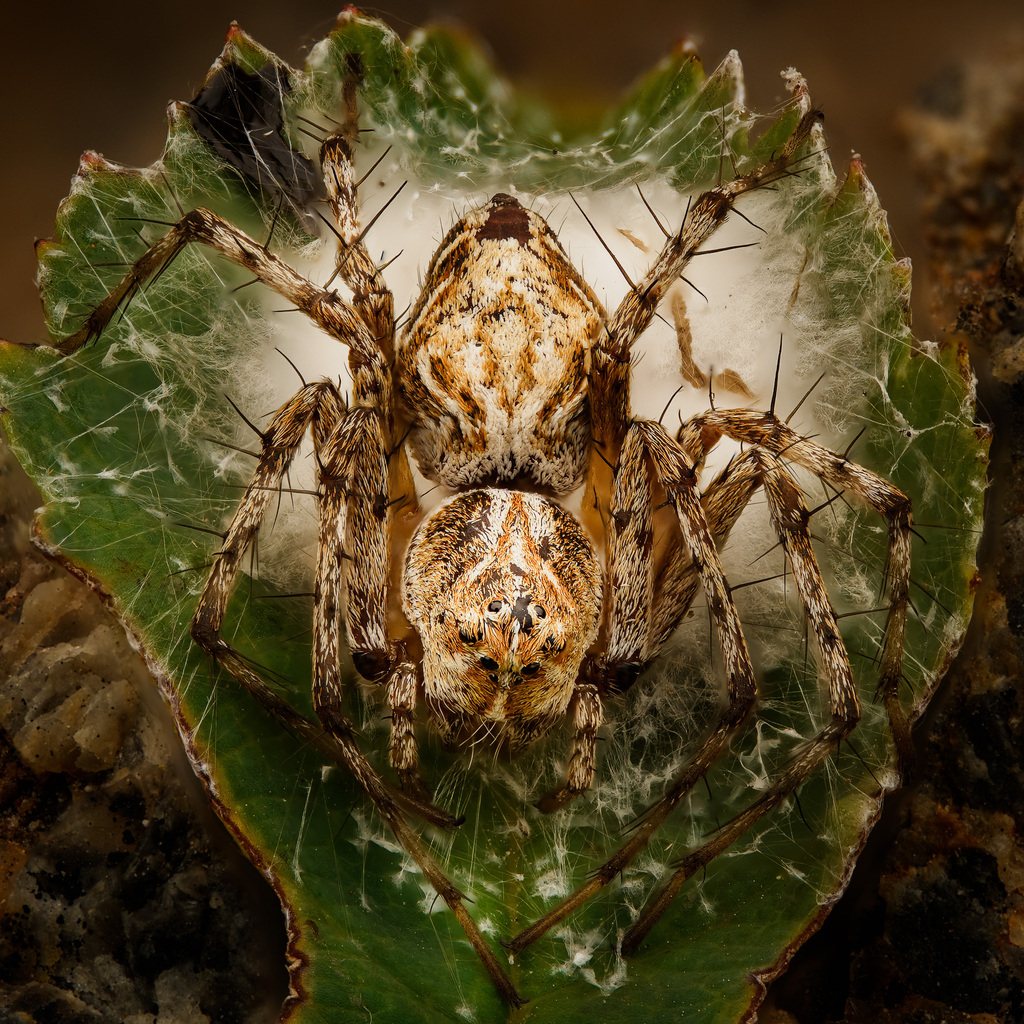
(c) Claus Giloi, some rights reserved (CC BY) · licence
Family: Oxyopidae · Class: Arachnida · Order: Araneae
Oxyopes scalaris (Western Lynx Spider) is a California animal in the Oxyopidae family.
The Western Lynx Spider is a medium-sized hunting spider in the family Oxyopidae, characterized by its active predatory behavior and distinctive leg spination. Adults typically measure 6 to 10 mm (0.24 to 0.39 inches) in body length, with females being slightly larger than males. The species exhibits variable coloration ranging from pale yellow to brown, often with red markings on the dorsal surface that may form bands or blotches (Gertsch 1949). Some western populations display blue markings in addition to the typical red patterns. The legs are long and spiny, adapted for grasping prey, with the characteristic lynx spider arrangement of prominent spines that give the family its common name. Oxyopes scalaris occurs across much of the western United States, with a range extending from California eastward to Texas and northward into the Great Plains. In California, the species is found throughout much of the state, from coastal areas to inland valleys and foothills. The distribution extends beyond California to include parts of the southwestern and south-central United States, with documented populations in Iowa and other midwestern states (BugGuide 2016). NatureServe ranks the species as G4, indicating it is apparently secure globally. The Western Lynx Spider inhabits a variety of open habitats including grasslands, prairies, fields, and shrublands. In California, populations show a preference for wild buckwheat (Eriogonum fasciculatum) vegetation, where they hunt among the dull green leaves and construct egg sacs attached to the yellow flowers of this woody shrub (Gertsch 1949). The species also utilizes other vegetation types and is commonly found in non-cultivated habitats, which support higher predator densities than agricultural areas (Fuchs & Harding 1976). Unlike web-building spiders, lynx spiders are active hunters that pursue prey on plant surfaces. Western Lynx Spiders are diurnal predators that actively hunt small arthropods, particularly soft-bodied insects. They rely on their excellent vision and speed to capture prey, often leaping significant distances to secure a meal. Females construct spherical egg sacs that are typically attached to vegetation, with the female remaining nearby to guard the eggs. In California populations associated with wild buckwheat, egg sacs are frequently observed tied to the plant's yellow flower clusters. The species exhibits seasonal activity patterns, with adults most commonly observed during warmer months. The Western Lynx Spider is not listed under federal or state conservation programs and appears to maintain stable populations across its range. As a generalist predator, the species plays an important ecological role in controlling insect populations in various habitats. Studies in Texas found that spiders, including Oxyopes species, comprised over 50% of all predatory arthropods collected in natural habitats (Fuchs & Harding 1976). While the species faces no immediate conservation concerns, habitat loss and conversion of natural areas to agriculture may impact local populations, as natural habitats support significantly higher predator densities than cultivated areas.
Classification
Class: Arachnida · Order: Araneae · Family: Oxyopidae
Frequently asked questions
How is Oxyopes scalaris classified?
Oxyopes scalaris belongs to class Arachnida, order Araneae, family Oxyopidae.
What family does Oxyopes scalaris belong to?
Oxyopes scalaris is in the Oxyopidae family.
What is Oxyopes scalaris?
The Western Lynx Spider is a medium-sized hunting spider in the family Oxyopidae, characterized by its active predatory behavior and distinctive leg spination.
Is Oxyopes scalaris found in California?
Yes. Oxyopes scalaris is recorded in California in The California Species Project's catalogue.
Related species
Other California species in the same genus, family, or bioregion.
Data from The California Species Project — 14,000+ California species with verified data from CNPS, CDFW, USFWS, and more.