Pachydiplax longipennis
Blue Dasher
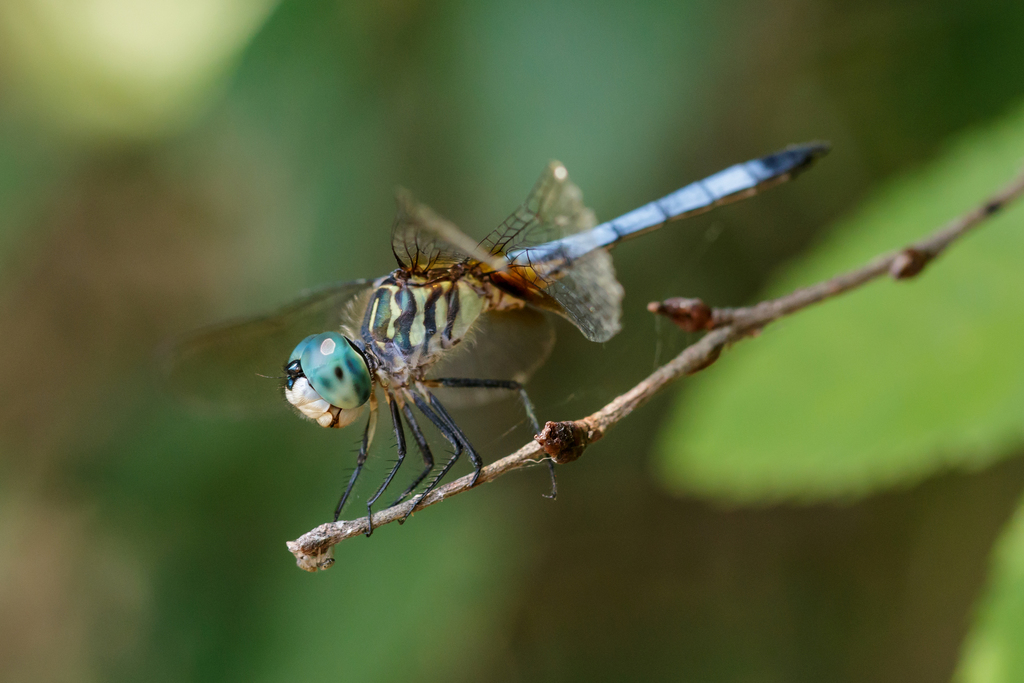
(c) Meghan Cassidy, some rights reserved (CC BY-SA) · licence
Family: Libellulidae · Class: Insecta · Order: Odonata
Pachydiplax longipennis (Blue Dasher) is a California animal in the Libellulidae family.
The Blue Dasher is a medium-sized dragonfly in the family Libellulidae, subfamily Sympetrinae. Adult males measure approximately 25-30 mm (1.0-1.2 inches) in body length with a wingspan of 50-60 mm (2.0-2.4 inches). Mature males develop distinctive bright blue coloration on the abdomen and thorax, with the face becoming blue-gray. Females and immature males display brown and yellow coloration with distinctive markings. Both sexes have clear wings that often become tattered with age due to wear (BugGuide 2025). Their compound eyes retain a characteristic half red-brown, half blue-gray coloration in immatures, though occasional green-eyed females occur. Older females may develop some bluish coloration but never achieve the intense blue of males (BugGuide 2025). Blue Dashers occur throughout much of the United States and extend just into southern Canada and Mexico. In the United States, they are absent from the Dakotas and Rocky Mountain regions (BugGuide 2025). Their range spans from the Atlantic to the Pacific coasts, including California, where they are commonly observed in suitable habitats. Federal wildlife refuge records document their presence from Massachusetts to North Carolina along the Atlantic coast and in refuge systems throughout their range. This species inhabits a wide variety of freshwater environments including ponds, lakes, marshes, and bogs. They can be found in almost any still water habitat and are notably tolerant of degraded conditions (BugGuide 2025). The aquatic larvae demonstrate high tolerance for wetlands with poor water quality and low dissolved-oxygen levels, allowing the species to persist in habitats that exclude other dragonfly species. Adults are commonly observed perching on emergent vegetation, bare ground, or structures near water bodies. Blue Dashers are primarily active during summer months and feed on small flying insects captured during aerial hunting flights. Mating occurs in the characteristic dragonfly wheel position, with pairs often remaining coupled for extended periods. Females oviposit by inserting eggs directly into aquatic vegetation or floating plant matter. The species exhibits territorial behavior, with males establishing and defending perching sites near suitable breeding habitat. Adults frequently engage in obelisking behavior, positioning their bodies vertically to minimize sun exposure during hot periods (Xerces Society 2018). Blue Dashers are not federally listed and appear secure throughout their range. NatureServe assigns the species a global conservation rank of G5 (secure), indicating stable populations with no immediate conservation concerns. Their adaptability to various wetland conditions and tolerance of habitat degradation contribute to their widespread distribution and stable status. However, like all dragonflies, they remain vulnerable to wetland loss, water pollution, and climate change impacts on freshwater ecosystems. Their presence often indicates healthy aquatic ecosystems, making them valuable as biological indicators for wetland conservation efforts.
Classification
Class: Insecta · Order: Odonata · Family: Libellulidae
Frequently asked questions
How is Pachydiplax longipennis classified?
Pachydiplax longipennis belongs to class Insecta, order Odonata, family Libellulidae.
What family does Pachydiplax longipennis belong to?
Pachydiplax longipennis is in the Libellulidae family.
What is Pachydiplax longipennis?
The Blue Dasher is a medium-sized dragonfly in the family Libellulidae, subfamily Sympetrinae.
Is Pachydiplax longipennis found in California?
Yes. Pachydiplax longipennis is recorded in California in The California Species Project's catalogue.
Related species
Other California species in the same genus, family, or bioregion.
Data from The California Species Project — 14,000+ California species with verified data from CNPS, CDFW, USFWS, and more.