Pachygrapsus crassipes
Striped Shore Crab
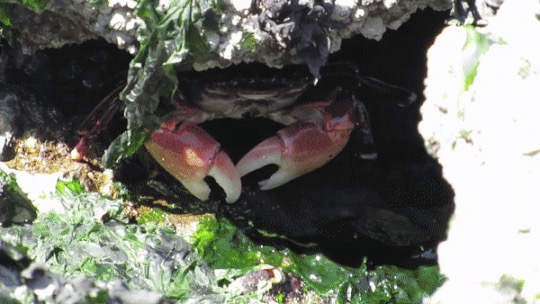
(c) Linzy L., some rights reserved (CC BY-SA) · licence
Family: Grapsidae · Class: Malacostraca · Order: Decapoda
Pachygrapsus crassipes (Striped Shore Crab) is a California animal in the Grapsidae family.
The striped shore crab is a medium-sized decapod crustacean measuring 25 to 40 mm (1.0 to 1.6 inches) in carapace width. The species displays a distinctive square-shaped carapace with pronounced longitudinal stripes running across the dorsal surface, typically alternating between dark green or brown and lighter coloration. The legs are robust and well-adapted for gripping rocky surfaces, with the claws being relatively small compared to other crab species. Males can be distinguished from females by their narrower abdominal flap and larger claws. Pachygrapsus crassipes ranges along the Pacific coast from Oregon through Baja California, Mexico. In California, the species occurs from Humboldt Bay in the north to the Mexican border, including offshore islands such as the Channel Islands. The crab is documented in multiple California Marine Protected Areas including Carrington Point State Marine Reserve on Santa Rosa Island, Dana Point State Marine Conservation Area in Orange County, South Humboldt Bay State Marine Reserve and Management Area, Upper Newport Bay State Marine Conservation Area, and Santa Barbara Island State Marine Reserve. This species inhabits rocky intertidal zones, typically found in the mid to high intertidal areas where it can withstand significant wave action and periodic aerial exposure. Striped shore crabs prefer areas with crevices, tide pools, and rocky surfaces that provide shelter during low tide. They are commonly found under rocks, in mussel beds, and among barnacle clusters. The species tolerates a wide range of salinities and can be found in both fully marine conditions and brackish environments such as estuaries and coastal lagoons. Striped shore crabs are omnivorous scavengers and active predators, feeding on algae, small invertebrates, detritus, and occasionally dead fish (Morris et al. 1980). They exhibit territorial behavior, particularly males defending prime crevice sites during breeding season (Hiatt 1948). The species demonstrates high agility, capable of rapid sideways movement across wet rocks and quick retreat into protective crevices when threatened. Reproduction occurs throughout the warmer months from spring through early fall, with females carrying eggs beneath their abdomens for several weeks before releasing larvae into the water column (Knudsen 1964). The planktonic larval stage lasts approximately one month before settling and metamorphosing into juvenile crabs. Striped shore crabs are not listed under federal or state endangered species legislation and maintain stable populations throughout their range as of December 2025. The species benefits from California's network of Marine Protected Areas, where they are protected from collection and disturbance. Their abundance in rocky intertidal habitats makes them an important component of coastal food webs, serving as prey for shorebirds, fish, and other marine predators while also functioning as predators and scavengers that help maintain ecosystem balance. Climate change and ocean acidification represent potential long-term threats, though current populations appear resilient to environmental variability.
Classification
Class: Malacostraca · Order: Decapoda · Family: Grapsidae
Frequently asked questions
How is Pachygrapsus crassipes classified?
Pachygrapsus crassipes belongs to class Malacostraca, order Decapoda, family Grapsidae.
What family does Pachygrapsus crassipes belong to?
Pachygrapsus crassipes is in the Grapsidae family.
What is Pachygrapsus crassipes?
The striped shore crab is a medium-sized decapod crustacean measuring 25 to 40 mm (1.0 to 1.6 inches) in carapace width.
Is Pachygrapsus crassipes found in California?
Yes. Pachygrapsus crassipes is recorded in California in The California Species Project's catalogue.
More California species
This species has no close relatives in our California data — here are other species to explore.
Data from The California Species Project — 14,000+ California species with verified data from CNPS, CDFW, USFWS, and more.