Pachysphinx occidentalis
Big poplar sphinx
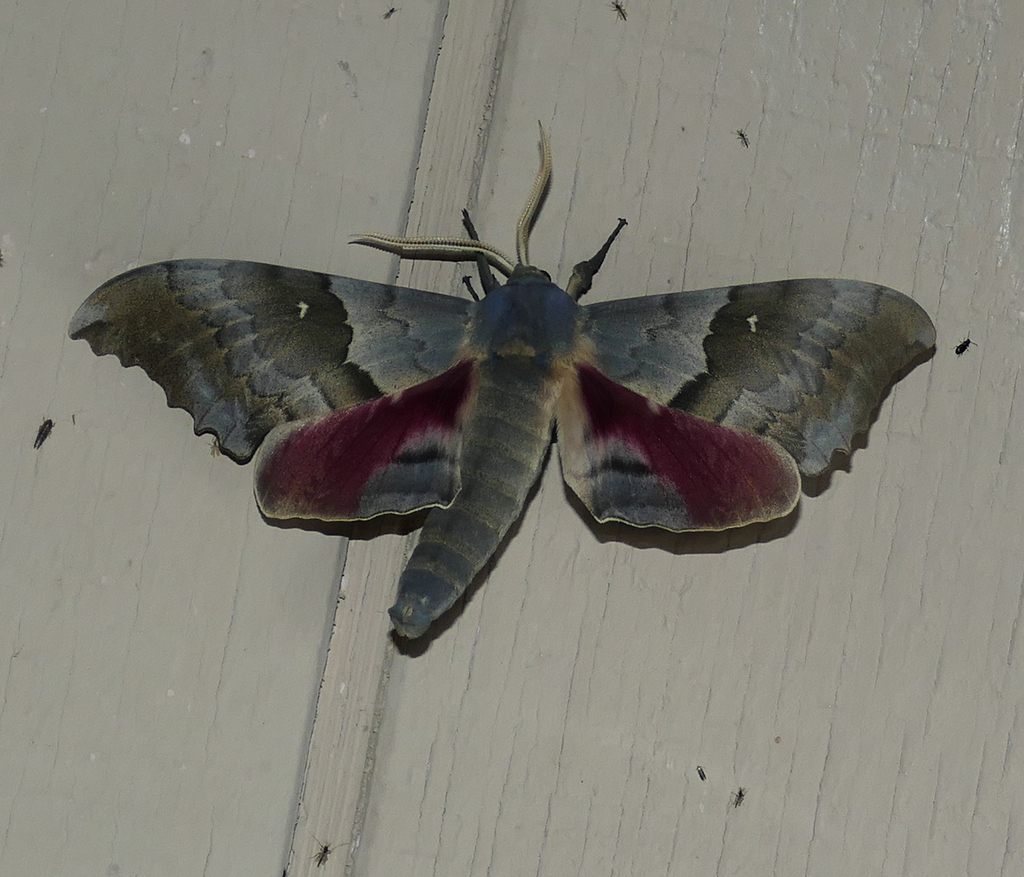
(c) Wendy McCrady, some rights reserved (CC BY) · licence
Family: Sphingidae · Class: Insecta · Order: Lepidoptera
Pachysphinx occidentalis (Big poplar sphinx) is a California animal in the Sphingidae family.
The big poplar sphinx is a large moth in the family Sphingidae, measuring 85 to 115 mm (3.3 to 4.5 inches) in wingspan. Adults display grayish-brown forewings with darker transverse lines and subtle lighter patches, while hindwings are pale gray to whitish with darker marginal bands. The thorax is robust and densely scaled, typical of sphinx moths, with a prominent dark dorsal stripe. At rest, the moth holds its wings in a triangular configuration, with forewings concealing the hindwings. This species ranges from North Dakota west to eastern Washington, extending south to Texas, southern California, and Baja California Norte. In California, populations occur primarily in the Central Valley, Sierra Nevada foothills, and desert regions where suitable host plants are present. The species has also been documented in riparian corridors of the Colorado River valley and scattered locations in southern California. Big poplar sphinx moths inhabit riparian woodlands, floodplains, and areas adjacent to water sources where cottonwoods and willows grow. They occur from sea level to approximately 2,000 meters (6,500 feet) elevation, though most populations are found below 1,500 meters. Adults are attracted to areas with dense stands of host plants, particularly mature cottonwood groves and willow thickets along streams and rivers. Larvae feed exclusively on cottonwood and poplar species (Populus) and willow (Salix). The caterpillars are large, reaching 80 to 100 mm in length, with a characteristic horn at the posterior end and longitudinal stripes along the body. Pupation occurs in underground cells or leaf litter. Adults emerge primarily from May through August, with peak flight activity during June and July. The species produces one generation annually in most of its range. Adults are nocturnal and feed on nectar from various flowering plants, with a particular attraction to night-blooming species. Mating occurs shortly after adult emergence, with females depositing eggs singly on host plant leaves. Development from egg to adult requires approximately 60 to 80 days under favorable conditions. Adults are strong fliers and may disperse considerable distances from breeding sites in search of nectar sources. The big poplar sphinx is not federally or state listed as threatened or endangered. However, populations may face localized pressures from habitat loss due to riparian development, water diversions, and removal of native cottonwood and willow stands. Urban expansion and agricultural conversion of floodplain habitats pose ongoing challenges in some portions of the range. Climate change may affect the species through alterations in precipitation patterns and water availability that influence host plant distribution and quality. Conservation of riparian corridors and maintenance of native Populus and Salix communities benefit this species and associated riparian fauna.
Classification
Class: Insecta · Order: Lepidoptera · Family: Sphingidae
Frequently asked questions
How is Pachysphinx occidentalis classified?
Pachysphinx occidentalis belongs to class Insecta, order Lepidoptera, family Sphingidae.
What family does Pachysphinx occidentalis belong to?
Pachysphinx occidentalis is in the Sphingidae family.
What is Pachysphinx occidentalis?
The big poplar sphinx is a large moth in the family Sphingidae, measuring 85 to 115 mm (3.3 to 4.5 inches) in wingspan.
Is Pachysphinx occidentalis found in California?
Yes. Pachysphinx occidentalis is recorded in California in The California Species Project's catalogue.
Related species
Other California species in the same genus, family, or bioregion.
Data from The California Species Project — 14,000+ California species with verified data from CNPS, CDFW, USFWS, and more.