Pagophila eburnea
Ivory Gull
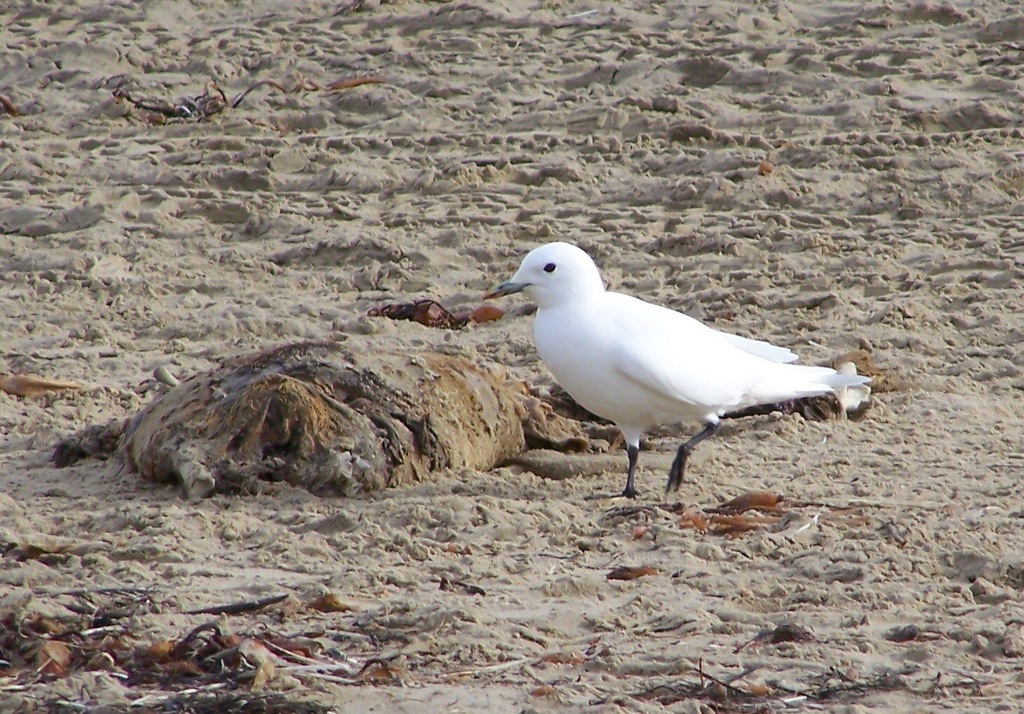
(c) nmoorhatch, some rights reserved (CC BY) · licence
Family: Laridae · Class: Aves · Order: Charadriiformes
Pagophila eburnea (Ivory Gull) is a California animal in the Laridae family.
The Ivory Gull is a medium-sized Arctic seabird distinguished by its pure white plumage throughout all life stages. Adults measure 40 to 43 cm (16 to 17 inches) in length with a wingspan of 108 to 120 cm (43 to 47 inches). Body mass ranges from 450 to 700 grams (1.0 to 1.5 pounds). The species exhibits a compact build with relatively short legs and a thick, dark-tipped yellow bill. Juveniles display scattered dark spots on the wings and back, but these fade to pure white by their second year. The legs and feet are black, contrasting sharply with the white plumage. The Ivory Gull maintains one of the most northerly distributions of any bird species. The global population breeds primarily in the high Arctic archipelagos of Canada, Greenland, and Svalbard, with smaller populations in Franz Josef Land and Severnaya Zemlya. In North America, breeding occurs on remote islands in the Canadian Arctic Archipelago, including Ellesmere Island, Devon Island, and Seymour Island. The species is considered a casual vagrant to California, with fewer than ten documented records in the state's ornithological history. Most California sightings have occurred along the coast during winter months, typically involving single individuals. Ivory Gulls inhabit pack ice environments and ice-free areas adjacent to glaciers during the breeding season. They nest colonially on nunataks, cliff ledges, and rocky outcrops near glacial margins, typically at elevations ranging from sea level to 300 meters. Outside the breeding season, the species remains closely associated with sea ice edges and polynyas in Arctic waters. The species requires access to marine environments with abundant ice-associated prey. The diet consists primarily of Arctic cod, crustaceans, and marine invertebrates gleaned from ice surfaces and shallow waters. Ivory Gulls are opportunistic scavengers, frequently following polar bears to feed on seal carcass remains. They also consume fish offal, marine worms, and occasionally bird eggs and chicks. Breeding occurs from June to August, with pairs constructing nests of moss, lichens, and debris in sheltered rocky crevices. Females typically lay one to three olive-colored eggs with dark markings. Incubation lasts 24 to 26 days, and young fledge after 35 to 40 days. The Ivory Gull faces significant conservation challenges due to climate change impacts on Arctic sea ice habitat. According to the Committee on the Status of Endangered Wildlife in Canada, the species was designated as Special Concern in 2006, with population estimates suggesting fewer than 30,000 individuals globally. The North American population has experienced substantial declines, with breeding colonies in the Canadian Arctic showing reduced occupancy and productivity. Primary threats include habitat loss from retreating sea ice, reduced prey availability, contaminant accumulation, and increased human disturbance in Arctic regions. The species' specialized habitat requirements and restricted breeding range make it particularly vulnerable to ongoing climate change effects.
Classification
Class: Aves · Order: Charadriiformes · Family: Laridae
Frequently asked questions
How is Pagophila eburnea classified?
Pagophila eburnea belongs to class Aves, order Charadriiformes, family Laridae.
What family does Pagophila eburnea belong to?
Pagophila eburnea is in the Laridae family.
What is Pagophila eburnea?
The Ivory Gull is a medium-sized Arctic seabird distinguished by its pure white plumage throughout all life stages.
Is Pagophila eburnea found in California?
Yes. Pagophila eburnea is recorded in California in The California Species Project's catalogue.
Related species
Other California species in the same genus, family, or bioregion.
Data from The California Species Project — 14,000+ California species with verified data from CNPS, CDFW, USFWS, and more.