Pagurus samuelis
Blueband Hermit Crab
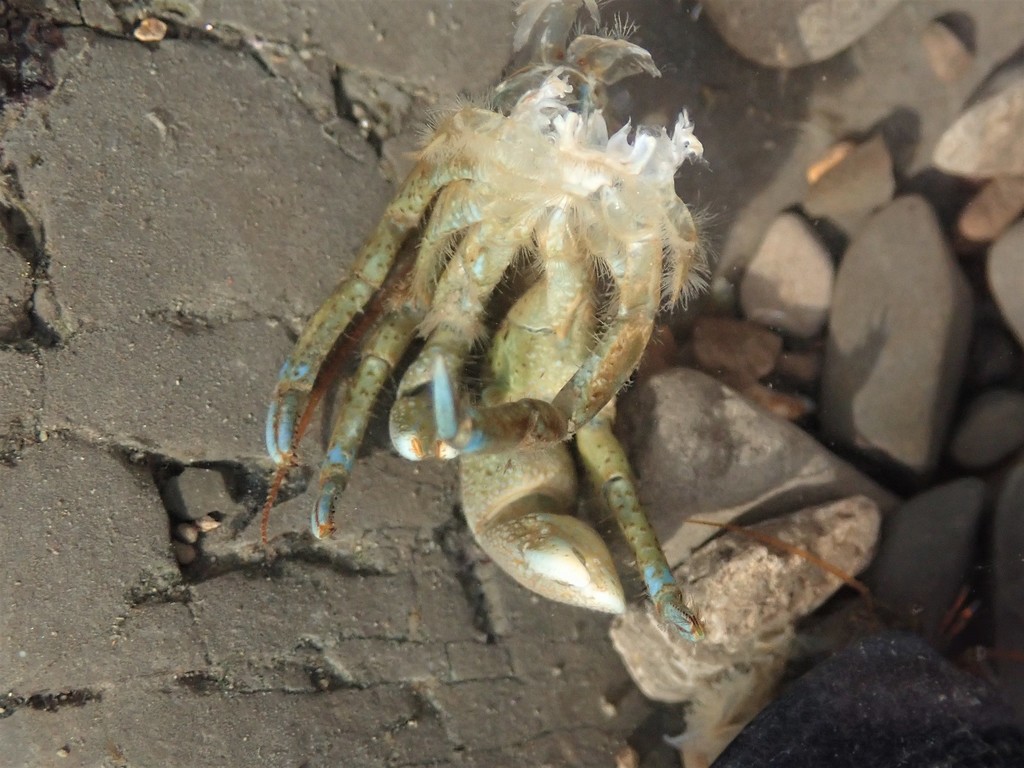
(c) P Holroyd, some rights reserved (CC BY) · licence
Family: Paguridae · Class: Malacostraca · Order: Decapoda
Pagurus samuelis (Blueband Hermit Crab) is a California animal in the Paguridae family.
The blueband hermit crab is a small marine crustacean native to the Pacific Coast of North America. Adults typically measure 12 to 25 millimeters (0.5 to 1.0 inches) in carapace length, with males generally larger than females. The species is distinguished by its characteristic blue bands on the antennae and walking legs, from which it derives its common name. The carapace and abdomen are typically reddish-brown to orange, while the chelipeds (claws) are often purple to reddish in coloration. Like all hermit crabs, P. samuelis has a soft, asymmetrical abdomen that must be protected within gastropod shells. Pagurus samuelis ranges along the Pacific Coast from British Columbia, Canada, south to Baja California, Mexico. In California, the species occurs throughout the state's rocky intertidal zones, from the Oregon border to the Mexican border. It is commonly found in marine protected areas such as the Russian River State Marine Conservation Area, where it inhabits both nearshore rocky habitats and sandy substrates. The species primarily inhabits rocky intertidal zones, tidepools, and shallow subtidal areas from the high intertidal zone down to depths of approximately 30 meters (100 feet). Blueband hermit crabs prefer areas with abundant gastropod shells for housing and are commonly associated with mussel beds, barnacle zones, and algal-covered rocks. They can tolerate significant temperature and salinity fluctuations typical of intertidal environments and are often found in areas with moderate to heavy wave action. Blueband hermit crabs are omnivorous scavengers, feeding on detritus, algae, small invertebrates, and carrion. They play an important ecological role as both predators and prey in intertidal food webs. The species exhibits typical hermit crab behavior, actively searching for larger shells as they grow and engaging in shell fights with conspecifics. Reproduction occurs year-round in warmer waters, with females carrying orange to red egg masses on their abdomens for several weeks before larvae are released into the plankton. The planktonic larval stage lasts approximately four to six weeks before settlement and metamorphosis. Currently, Pagurus samuelis has no federal or state listing status and is considered secure throughout its range. NatureServe ranks the species as G5 (globally secure) as of December 2025. The species appears stable and maintains healthy populations throughout its range, though local populations may face threats from coastal development, pollution, and ocean acidification. In California, the species receives protection within marine protected areas, where take is prohibited. Climate change and associated sea level rise may affect intertidal habitat availability, but the species' broad depth range and adaptability suggest resilience to moderate environmental changes. The blueband hermit crab serves as an indicator species for rocky intertidal ecosystem health in monitoring programs along the Pacific Coast.
Classification
Class: Malacostraca · Order: Decapoda · Family: Paguridae
Frequently asked questions
How is Pagurus samuelis classified?
Pagurus samuelis belongs to class Malacostraca, order Decapoda, family Paguridae.
What family does Pagurus samuelis belong to?
Pagurus samuelis is in the Paguridae family.
What is Pagurus samuelis?
The blueband hermit crab is a small marine crustacean native to the Pacific Coast of North America.
Is Pagurus samuelis found in California?
Yes. Pagurus samuelis is recorded in California in The California Species Project's catalogue.
Related species
Other California species in the same genus, family, or bioregion.
Data from The California Species Project — 14,000+ California species with verified data from CNPS, CDFW, USFWS, and more.