Pandion haliaetus
Osprey
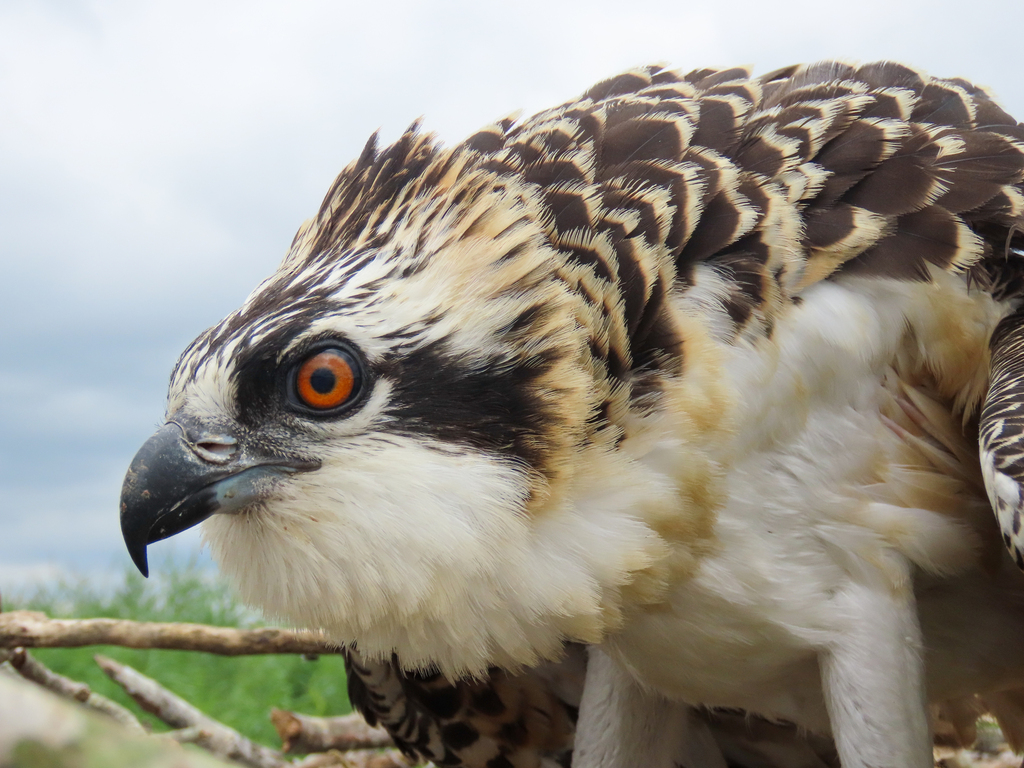
(c) Alina Martin, some rights reserved (CC BY) · licence
Family: Pandionidae · Class: Aves · Order: Accipitriformes
Conservation status: WL · G5 S4
Pandion haliaetus (Osprey) is a California animal in the Pandionidae family.
The osprey is a large raptor with distinctive adaptations for piscivory. Adults measure 54 to 58 centimeters (21 to 23 inches) in length with a wingspan of 127 to 174 centimeters (50 to 68 inches). Females are typically larger than males, weighing 1.2 to 2.0 kilograms (2.6 to 4.4 pounds) compared to males at 1.2 to 1.7 kilograms (2.6 to 3.7 pounds). The species displays dark brown upperparts contrasting with white underparts and head. A distinctive dark eye stripe extends from the bill through the eye to the nape. In flight, ospreys show a characteristic crooked wing profile with dark carpal patches on the underwings. The feet are equipped with reversible outer toes and sharp, curved talons specialized for grasping slippery fish. Ospreys breed across much of North America, Europe, Asia, and northern Africa. In California, the species occurs as both a breeding resident and migrant. Breeding populations are found primarily in the northern counties, including the Sierra Nevada, Cascade Range, and coastal areas from Marin County north to the Oregon border. Non-breeding individuals may be observed statewide during migration periods from March through May and August through October. Winter populations concentrate along the coast and in the Central Valley. Breeding habitat consists of areas near large bodies of water including lakes, rivers, reservoirs, coastal bays, and estuaries. Ospreys require clear water for fishing and suitable nesting substrates such as tall trees, cliffs, or artificial platforms. Nest sites are typically located within 3 kilometers of fishing areas. The species shows high site fidelity, often returning to the same nest for multiple breeding seasons. Nests are large stick structures that may reach 2 meters in diameter after years of use. Ospreys are specialized fish-eaters, with fish comprising 95 to 99 percent of their diet. Common prey species in California include trout, bass, catfish, and carp. Hunting occurs through steep dives from heights of 10 to 40 meters, with the bird plunging feet-first into water to capture prey. The breeding season extends from March through August. Females typically lay 2 to 4 eggs with an incubation period of 35 to 43 days. Young fledge at 48 to 59 days but may remain dependent on parents for an additional 2 to 8 weeks. California lists the osprey on its Watch List, reflecting concerns about population stability and habitat availability. The species experienced severe declines during the mid-20th century due to DDT contamination, which caused eggshell thinning and reproductive failure. Following the DDT ban, populations have recovered substantially across most of North America. Current threats in California include habitat loss from development, human disturbance at nest sites, and climate change impacts on prey availability. Artificial nesting platforms have proven effective for supporting breeding populations in areas lacking natural nest sites.
Classification
Class: Aves · Order: Accipitriformes · Family: Pandionidae
Conservation status
WL · G5 S4
Frequently asked questions
How is Pandion haliaetus classified?
Pandion haliaetus belongs to class Aves, order Accipitriformes, family Pandionidae.
What family does Pandion haliaetus belong to?
Pandion haliaetus is in the Pandionidae family.
Is Pandion haliaetus protected or of conservation concern?
Pandion haliaetus carries the following status: WL · G5 S4.
What is Pandion haliaetus?
The osprey is a large raptor with distinctive adaptations for piscivory.
Is Pandion haliaetus found in California?
Yes. Pandion haliaetus is recorded in California in The California Species Project's catalogue.
More California species
This species has no close relatives in our California data — here are other species to explore.
Data from The California Species Project — 14,000+ California species with verified data from CNPS, CDFW, USFWS, and more.