Panoquina errans
Wandering Skipper
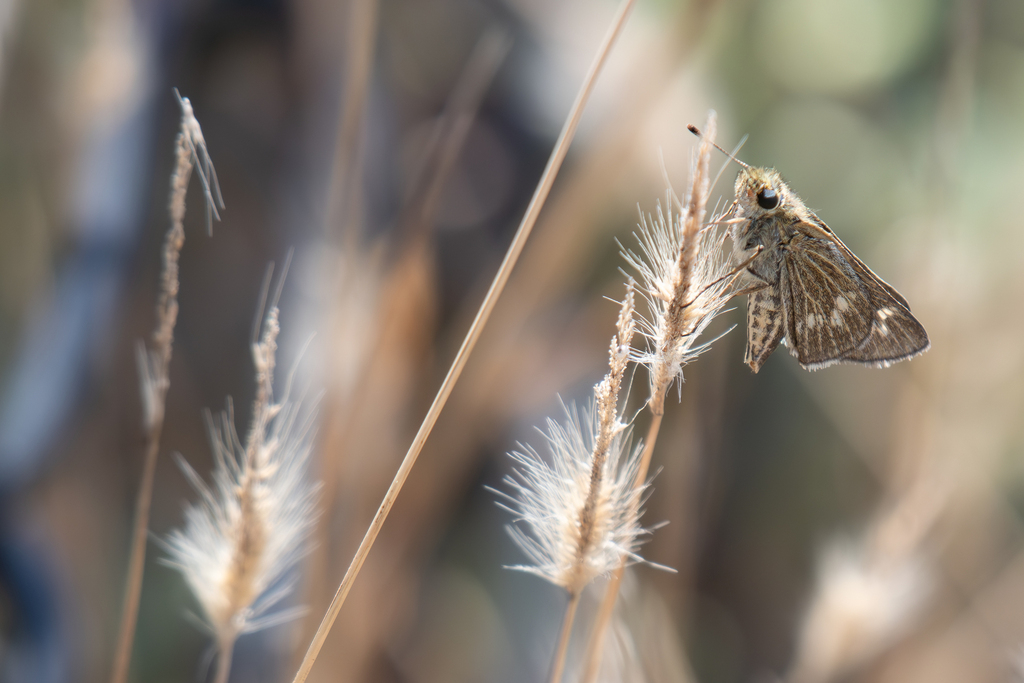
(c) Rajan Rao, some rights reserved (CC BY) · licence
Family: Hesperiidae · Class: Insecta · Order: Lepidoptera
Conservation status: G4G5 S2 · G4 S2
Panoquina errans (Wandering Skipper) is a California animal in the Hesperiidae family.
The Wandering Skipper (Panoquina errans) is a medium-sized butterfly in the family Hesperiidae, distinguished by its golden-brown to orange-brown wings with darker borders and veining. Adults have a wingspan of approximately 32-38 mm (1.3-1.5 inches). The forewings display a distinctive series of pale yellow to cream-colored spots arranged in a curved line across the upper surface. Males possess a prominent black sex brand (stigma) on the forewings, appearing as a dark streak. The hindwings are typically unmarked golden-brown above, while the undersides of both wings show a more muted brown coloration with obscure pale spotting. The antennae are short with distinctly hooked tips, characteristic of skipper butterflies. The Wandering Skipper occurs along the Pacific coast from southern California through coastal Baja California and into mainland western Mexico. In California, the species is documented from coastal areas of San Diego, Orange, Los Angeles, Ventura, and Santa Barbara counties. The distribution extends inland only short distances from the immediate coastline, rarely exceeding 10 kilometers from the ocean. Historical records indicate the species was once more widespread along the California coast but has experienced range contraction in recent decades. This butterfly inhabits coastal salt marshes, alkali meadows, and brackish wetlands where its host plant, seashore saltgrass (Distichlis spicata), grows abundantly. The species requires areas with persistent soil moisture and moderate salinity levels, typically at elevations from sea level to 100 meters. Wandering Skippers are closely associated with tidal marshes, coastal lagoons, and the margins of salt ponds where saltgrass forms dense stands. The butterflies are often observed nectaring on nearby flowering plants including alkali heath, salt marsh asters, and pickleweed. Adults are active from March through November in southern California, with peak activity occurring from May through September. The species exhibits multiple broods per year, with overlapping generations during the extended flight period. Males establish territories around saltgrass patches and engage in perching behavior, defending suitable habitat from other males. Females lay eggs singly on saltgrass leaves and stems. Larvae feed exclusively on seashore saltgrass, creating silk-lined shelters within rolled or folded leaves. The caterpillars are pale green with darker longitudinal stripes and complete development through five instars before pupating in leaf litter or plant debris. The Wandering Skipper maintains a global rank of G4 (apparently secure) but receives a state rank of S2 (imperiled) in California, reflecting significant population decline and habitat loss within the state. Primary threats include coastal development, salt marsh conversion, altered hydrology from urban runoff, and invasive plant species that displace native saltgrass communities. Sea level rise poses an emerging threat to low-elevation coastal habitats. Conservation efforts focus on protecting remaining salt marsh ecosystems and restoring degraded wetland habitats to support both the butterfly and its obligate host plant relationship.
Classification
Class: Insecta · Order: Lepidoptera · Family: Hesperiidae
Conservation status
G4G5 S2 · G4 S2
Frequently asked questions
How is Panoquina errans classified?
Panoquina errans belongs to class Insecta, order Lepidoptera, family Hesperiidae.
What family does Panoquina errans belong to?
Panoquina errans is in the Hesperiidae family.
Is Panoquina errans protected or of conservation concern?
Panoquina errans carries the following status: G4G5 S2 · G4 S2.
What is Panoquina errans?
The Wandering Skipper (Panoquina errans) is a medium-sized butterfly in the family Hesperiidae, distinguished by its golden-brown to orange-brown wings with darker borders and veining.
Is Panoquina errans found in California?
Yes. Panoquina errans is recorded in California in The California Species Project's catalogue.
Related species
Other California species in the same genus, family, or bioregion.
Data from The California Species Project — 14,000+ California species with verified data from CNPS, CDFW, USFWS, and more.