Panthea gigantea
Giant Panthea
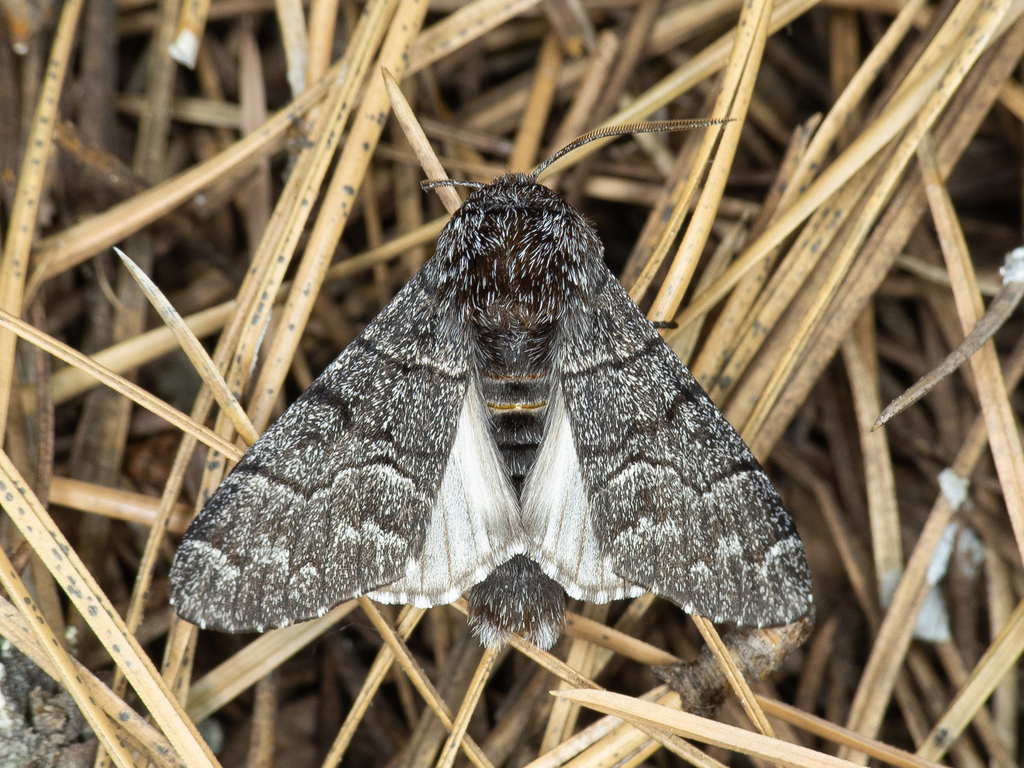
(c) Jason Alexander, some rights reserved (CC BY) · licence
Family: Noctuidae · Class: Insecta · Order: Lepidoptera
Panthea gigantea (Giant Panthea) is a California animal in the Noctuidae family.
Panthea gigantea is a large noctuid moth in the subfamily Pantheinae, distinguished by its substantial size and contrasting coloration. Males exhibit wingspans of approximately 44-55 mm, while females are notably larger with wingspans exceeding 60 mm (Moth Photographers Group). The forewings are dark gray-black, creating a striking contrast with the white hindwings, making this species readily identifiable among western North American moths. This species occurs throughout western North America, with documented records from California, Colorado, and other western states. In Colorado, specimens have been collected at elevations ranging from 6,611 to 8,839 feet, including locations near Bailey and Blackhawk in ponderosa pine and lodgepole pine/fir associations. The species appears to have a broad elevational range within its western distribution. Panthea gigantea inhabits warm, dry ponderosa pine forests (Moth Photographers Group). This habitat specificity aligns with the species' host plant requirements, as it specializes primarily on Pinus ponderosa. The moth has been documented in mixed coniferous forests that include ponderosa pine, lodgepole pine, and fir associations at higher elevations. Adults are attracted to ultraviolet and mercury vapor lights, suggesting nocturnal activity patterns typical of the family Noctuidae. The species demonstrates host plant specialization within the family Pinaceae, genus Pinus, with particular emphasis on ponderosa pine (Crabo et al. 2014). Flight records from Colorado indicate adult activity during May and June, with specimens collected between May 18-25 and June 21, suggesting a spring to early summer emergence period. Adults have been successfully collected using ultraviolet traps and mercury vapor lights in appropriate habitat, indicating strong phototaxis behavior common among noctuids. No federal or state listing status has been established for Panthea gigantea, and the species does not appear on current U.S. Fish and Wildlife Service endangered species lists as of December 2025. The species' dependence on ponderosa pine forests may make it vulnerable to habitat changes affecting western pine ecosystems, including wildfire patterns, forest management practices, and climate-related shifts in forest composition. However, specific population trend data and formal conservation assessments are not currently available. The moth's presence at various elevations within ponderosa pine habitat suggests some ecological flexibility within its preferred forest type, though long-term monitoring would be needed to assess population stability and conservation needs.
Classification
Class: Insecta · Order: Lepidoptera · Family: Noctuidae
Frequently asked questions
How is Panthea gigantea classified?
Panthea gigantea belongs to class Insecta, order Lepidoptera, family Noctuidae.
What family does Panthea gigantea belong to?
Panthea gigantea is in the Noctuidae family.
What is Panthea gigantea?
Panthea gigantea is a large noctuid moth in the subfamily Pantheinae, distinguished by its substantial size and contrasting coloration.
Is Panthea gigantea found in California?
Yes. Panthea gigantea is recorded in California in The California Species Project's catalogue.
Related species
Other California species in the same genus, family, or bioregion.
Data from The California Species Project — 14,000+ California species with verified data from CNPS, CDFW, USFWS, and more.