Panthea virginarius
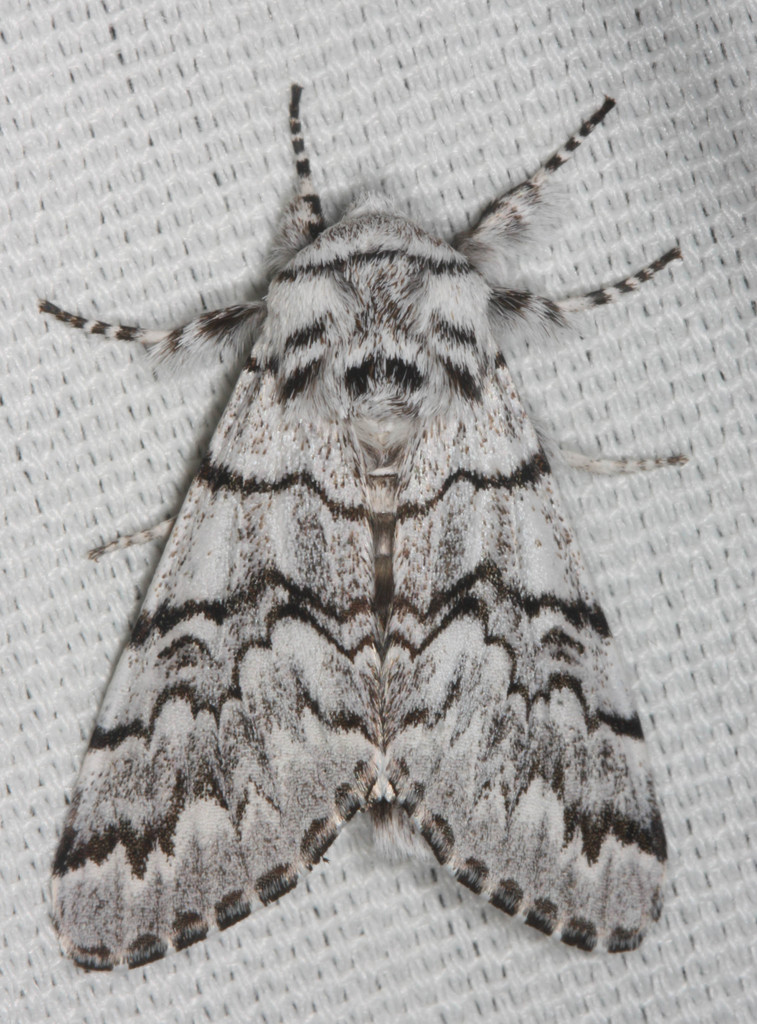
no rights reserved · CC0
Family: Noctuidae · Class: Insecta · Order: Lepidoptera
Panthea virginarius is a California animal in the Noctuidae family.
Panthea virginarius, commonly known as the Western Panthea Moth or Cascades panthea, is a noctuoid moth in the family Noctuidae. The forewings are white to dark black-gray with jagged, dentate black lines, while the hindwings are white with a dark submarginal band or pure gray coloration (BugGuide). Males typically exhibit more contrasting patterns than females. The species has a broad distribution spanning from British Columbia east to New England and south to central coastal California. In the western portion of its range, it occurs from the coast of southern California northward to the Queen Charlotte Islands of British Columbia and the Alaskan Panhandle, extending eastward to central California, northern Nevada, Idaho, northwestern Wyoming, western Montana, and southwestern Alberta (iNaturalist). A disjunct population exists in the Cypress Hills of Alberta and Saskatchewan. The species is found mainly west and north of the Great Basin. Panthea virginarius inhabits coniferous forest ecosystems where its host plants occur. The larvae feed on species of Pineaceae, with Douglas-fir being the primary host plant. This association with coniferous trees determines the moth's habitat requirements, linking its distribution to the presence of suitable forest communities throughout its range. As a member of the Noctuidae family, this species exhibits typical moth behavior patterns. Adults are nocturnal and attracted to lights during their flight period. The larvae develop on their host trees, feeding on needles and potentially causing defoliation in areas of high population density. Specific details about flight periods, number of generations per year, and overwintering strategies have not been well documented in available literature. Currently, Panthea virginarius does not appear on federal or state endangered species lists and maintains stable populations throughout most of its range. NatureServe assigns it a rank of N5 in Canada, indicating the species is secure nationally (NatureServe Explorer). No specific conservation concerns have been identified for this species, though habitat loss from logging and forest management practices could potentially affect local populations. The species' dependence on coniferous forests, particularly Douglas-fir ecosystems, means that forest health and management practices indirectly influence population stability. The taxonomic history of this species includes several synonyms, with historical names including Biston virginarius and Panthea angelica reflecting previous classification schemes. Recent taxonomic work by Lafontaine and Schmidt has clarified relationships within the genus Panthea, confirming the current scientific name and distinguishing it from closely related species. Scientific documentation for this species remains limited regarding specific ecological requirements, detailed life history, and population trends. The information presented here is based on available sources including taxonomic databases and regional surveys. If you have additional verified information about this species' biology, distribution, or ecology, please contact us to help improve this species account.
Classification
Class: Insecta · Order: Lepidoptera · Family: Noctuidae
Frequently asked questions
How is Panthea virginarius classified?
Panthea virginarius belongs to class Insecta, order Lepidoptera, family Noctuidae.
What family does Panthea virginarius belong to?
Panthea virginarius is in the Noctuidae family.
What is Panthea virginarius?
Panthea virginarius, commonly known as the Western Panthea Moth or Cascades panthea, is a noctuoid moth in the family Noctuidae.
Is Panthea virginarius found in California?
Yes. Panthea virginarius is recorded in California in The California Species Project's catalogue.
Related species
Other California species in the same genus, family, or bioregion.
Data from The California Species Project — 14,000+ California species with verified data from CNPS, CDFW, USFWS, and more.