Pantomorus cervinus
Fuller's rose weevil
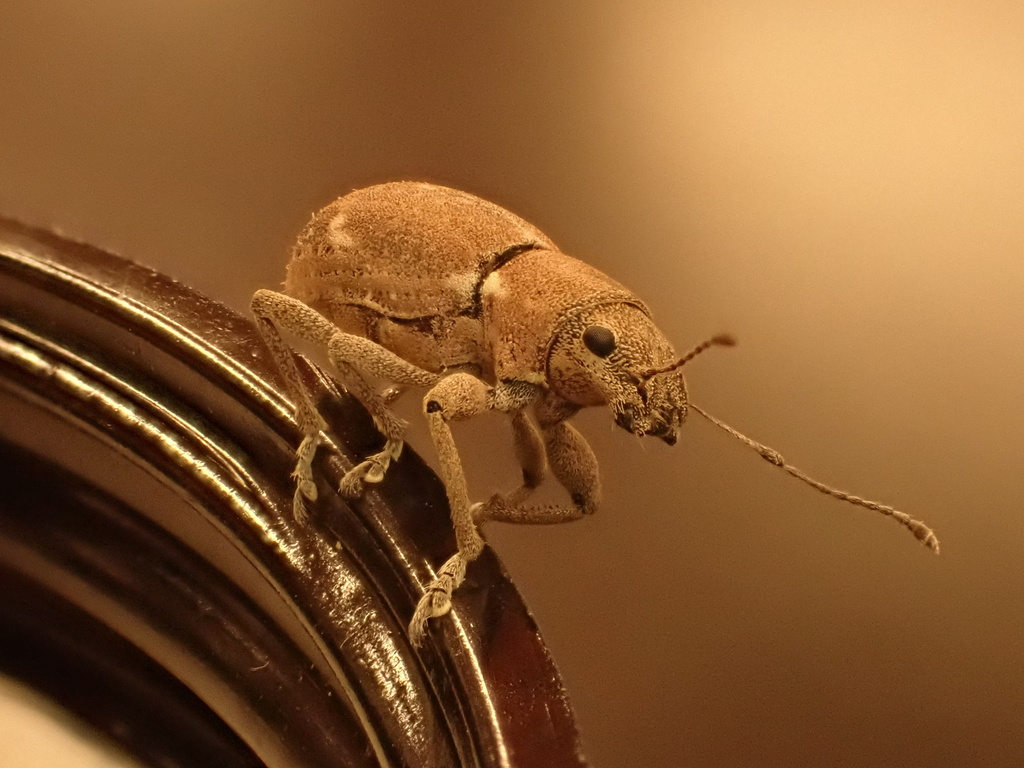
(c) reagan peschke, some rights reserved (CC BY) · licence
Family: Curculionidae · Class: Insecta · Order: Coleoptera
Pantomorus cervinus (Fuller's rose weevil) is a California animal in the Curculionidae family.
Fuller's rose weevil is a small, introduced beetle measuring 6.5 to 8.0 mm in length (BugGuide.Net). This curculionid weevil displays typical weevil characteristics with an elongated snout (rostrum) and elbowed antennae. The body is generally dark brown to grayish-brown with a somewhat mottled appearance due to scattered pale scales or setae covering the elytra and thorax. Native to South America, Fuller's rose weevil is now established as a cosmopolitan pest species found on multiple continents (BugGuide.Net). In North America, the species has a transcontinental distribution extending from Oregon to Montana to Ontario to Massachusetts in the north, and from California to Texas to Florida in the south. The weevil has become particularly established in California's agricultural regions and urban landscapes where host plants are abundant. This species demonstrates broad host plant range, feeding on a wide range of ornamental and agricultural plants. As its common name suggests, roses are among the preferred hosts, but the weevil also attacks citrus trees, various ornamental shrubs, and numerous other dicotyledonous plants. Fuller's rose weevil thrives in cultivated environments including gardens, nurseries, orchards, and urban landscaping where diverse host plants provide abundant feeding opportunities. The species adapts well to Mediterranean climates and irrigated agricultural systems. Fuller's rose weevil exhibits parthenogenetic reproduction, with females capable of producing offspring without mating. This reproductive strategy has contributed significantly to the species' successful establishment in new regions. Adults are primarily nocturnal, emerging at night to feed on foliage, buds, and young shoots of host plants. During daylight hours, weevils typically hide in soil, leaf litter, or crevices around the base of host plants. Larvae develop in the soil, feeding on plant roots and organic matter. The species can complete multiple generations per year in favorable climates, with overlapping generations common in warmer regions. Adults are flightless, as their elytra are fused, limiting natural dispersal but contributing to establishment once introduced to suitable habitat. As an introduced species, Fuller's rose weevil lacks special conservation status and is generally considered an agricultural and horticultural pest rather than a conservation concern. The species' successful establishment across diverse climatic zones demonstrates its adaptability to various environmental conditions. In California, the weevil is managed through integrated pest management strategies in agricultural settings, particularly in citrus and ornamental plant production. The species' parthenogenetic reproduction and broad host range make it a persistent pest that requires ongoing monitoring and management in susceptible crops and landscapes. Climate change may potentially expand the species' suitable habitat range, though specific population trend data for California are not well documented.
Classification
Class: Insecta · Order: Coleoptera · Family: Curculionidae
Frequently asked questions
How is Pantomorus cervinus classified?
Pantomorus cervinus belongs to class Insecta, order Coleoptera, family Curculionidae.
What family does Pantomorus cervinus belong to?
Pantomorus cervinus is in the Curculionidae family.
What is Pantomorus cervinus?
Fuller's rose weevil is a small, introduced beetle measuring 6.5 to 8.0 mm in length (BugGuide.Net).
Is Pantomorus cervinus found in California?
Yes. Pantomorus cervinus is recorded in California in The California Species Project's catalogue.
Related species
Other California species in the same genus, family, or bioregion.
Data from The California Species Project — 14,000+ California species with verified data from CNPS, CDFW, USFWS, and more.