Paonias excaecata
Blinded sphinx
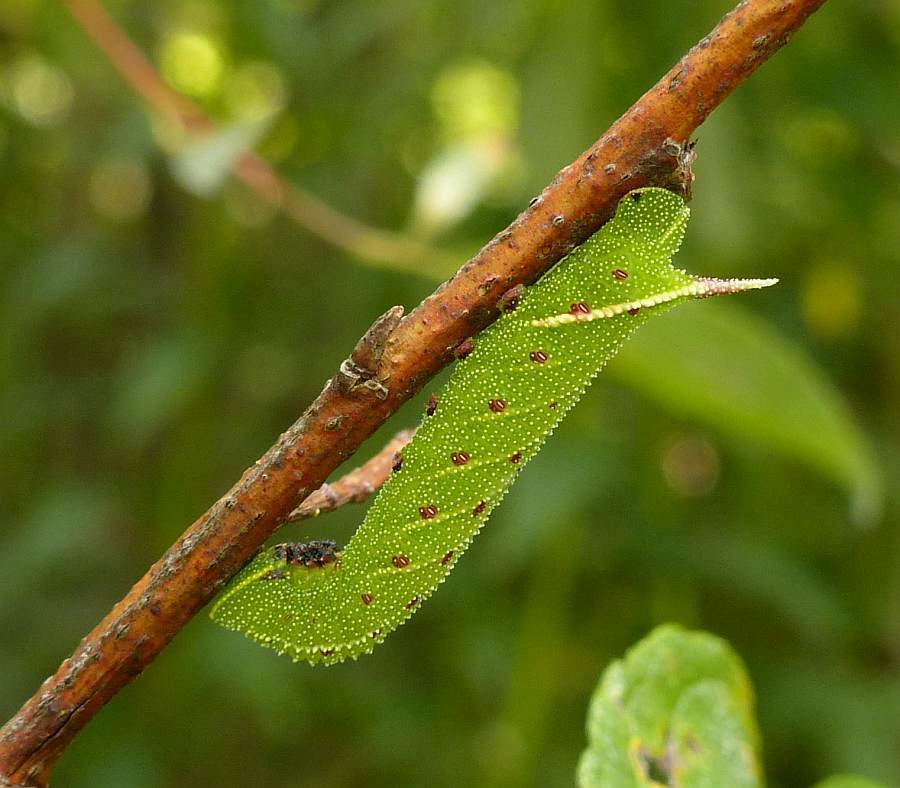
(c) christine123, some rights reserved (CC BY) · licence
Family: Sphingidae · Class: Insecta · Order: Lepidoptera
Paonias excaecata (Blinded sphinx) is a California animal in the Sphingidae family.
The blinded sphinx is a medium-sized moth in the family Sphingidae, with forewings measuring 38 to 50 mm (1.5 to 2.0 inches) in length. Adults display mottled brown and gray forewings with intricate patterns of wavy lines and bands that provide effective camouflage against tree bark. The hindwings are pale brown to orange-brown with darker borders. The species name 'excaecata' refers to the characteristic eyespots on the hindwings, which appear as dark, blind or closed eyes rather than the prominent open eyespots found in related species. The robust body is covered in dense scales matching the wing coloration, and the antennae are slightly feathered in males. The blinded sphinx occurs throughout most of the United States and southern Canada, ranging from Nova Scotia and Maine south to Florida, and west to British Columbia, Washington, northern California, and Arizona. In California, the species is primarily found in the northern counties where suitable deciduous forest habitat exists. The distribution follows riparian corridors and mixed deciduous-coniferous forests throughout the western portion of its range. This species inhabits deciduous and mixed forests, riparian woodlands, parks, and suburban areas with abundant host trees. Adults are typically found from sea level to moderate elevations in montane zones. The species shows strong association with areas containing its diverse range of host plants, which include basswood (Tilia), willow (Salix), birch (Betula), hawthorn (Crataegus), poplar (Populus), oaks (Quercus), ocean spray (Holodiscus), and cherry (Prunus). Larvae develop on the foliage of these deciduous trees, often selecting younger growth or edge habitats where leaves are more tender. Adults are nocturnal and typically active from late spring through early autumn, with peak flight periods varying by latitude and elevation. Females lay pale green, spherical eggs singly on host plant leaves. Larvae are large, green caterpillars reaching 75 to 100 mm (3.0 to 4.0 inches) in length, with a characteristic horn on the posterior end typical of sphinx moth larvae. The caterpillars feed on leaves during summer months, pupating in the soil during autumn. The species typically produces one generation per year in northern areas and potentially two in warmer southern regions. Adults are strong fliers and may be attracted to artificial lights, though they primarily feed on nectar from various flowering plants. The blinded sphinx is not federally or state-listed and appears to maintain stable populations across much of its range. The species benefits from its broad host plant range and adaptability to various forest types, including managed landscapes and suburban environments. However, like many forest-dependent moths, populations may face pressure from habitat fragmentation, pesticide use, and light pollution. The species' wide distribution and ecological flexibility suggest resilience to moderate environmental changes, though regional populations may experience declines in areas of intensive development or forest management practices that reduce host plant diversity.
Classification
Class: Insecta · Order: Lepidoptera · Family: Sphingidae
Frequently asked questions
How is Paonias excaecata classified?
Paonias excaecata belongs to class Insecta, order Lepidoptera, family Sphingidae.
What family does Paonias excaecata belong to?
Paonias excaecata is in the Sphingidae family.
What is Paonias excaecata?
The blinded sphinx is a medium-sized moth in the family Sphingidae, with forewings measuring 38 to 50 mm (1.5 to 2.0 inches) in length.
Is Paonias excaecata found in California?
Yes. Paonias excaecata is recorded in California in The California Species Project's catalogue.
Related species
Other California species in the same genus, family, or bioregion.
Data from The California Species Project — 14,000+ California species with verified data from CNPS, CDFW, USFWS, and more.